
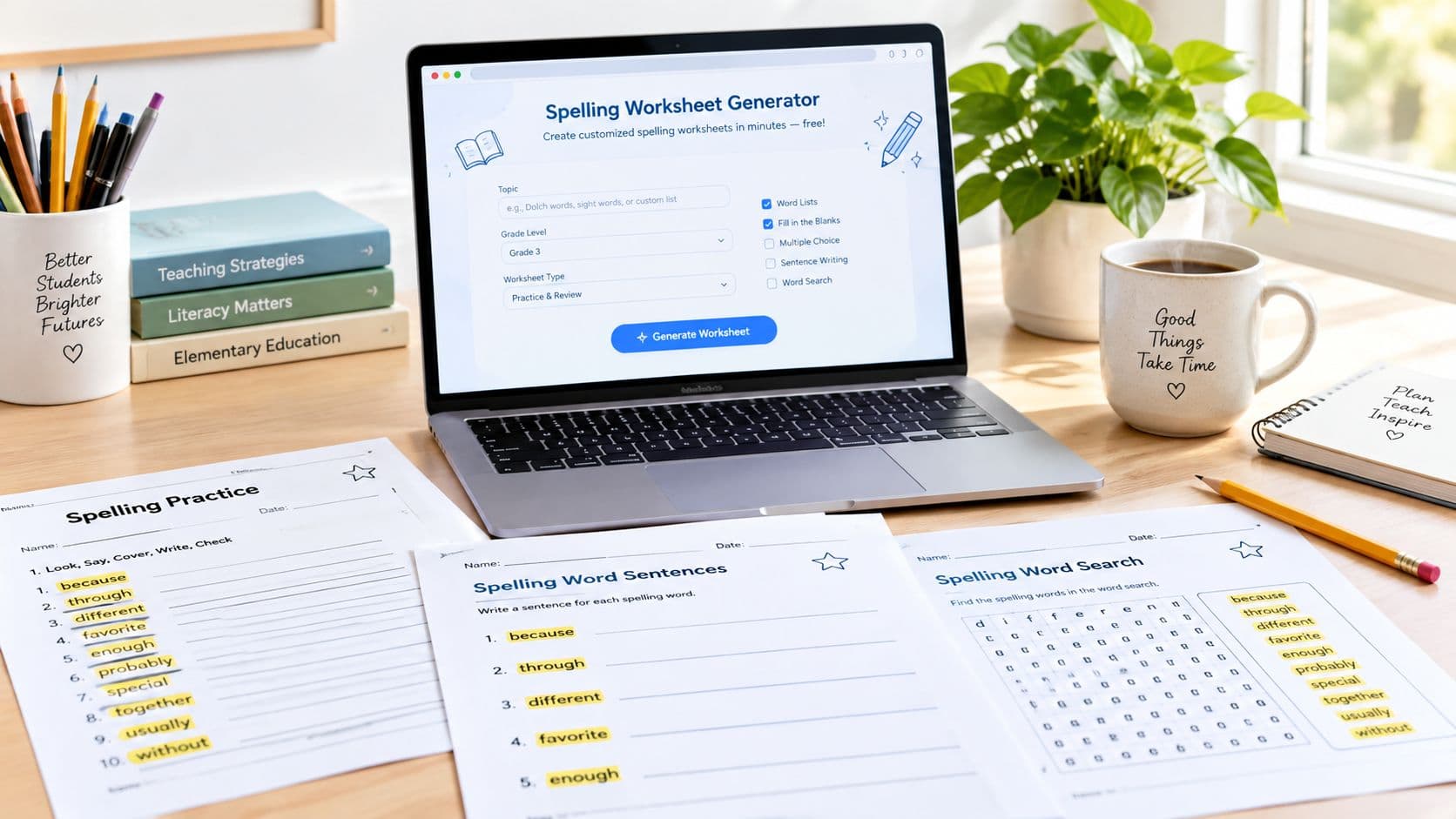
It's Thursday afternoon, the copier is jammed, and Monday's spelling lesson still doesn't have a worksheet. The textbook list doesn't match what your students are missing in writing, and the usual fix, a random PDF from the internet, rarely fits the room you're teaching in.
The better answer is to create free spelling worksheets that are short, pattern-based, and easy to print. When the worksheet matches a real spelling goal, it stops being busywork and starts saving planning time without lowering the quality of the practice.
Why Spelling Worksheet Prep Takes Longer Than It Should
A lot of teachers do not need more spelling ideas. They need a worksheet that is ready before the school day starts. The hard part is the gap between a free download and a page that prints cleanly, fits your class, and supports the words students will use in reading and writing.
Why generic printables fall short
A worksheet can be free and still miss the mark. If the words are not tied to current reading or writing, students treat the page like a separate task instead of spelling practice. The U.S. Institute of Education Sciences recommends teaching words students commonly use, frequently misspell, or want to include in their own writing, which is a stronger starting point than pulling random terms from a list IES writing practice guide.
Practical rule: If the worksheet doesn't help a child spell something they will write, it's probably not worth the paper.
Free printable resources have value when they are simple, flexible, and easy to adapt. A broad worksheet library can work because it gives teachers a repeatable structure, not just one-off pages. That matters in real planning, where the goal is not more files, it is fewer minutes spent rebuilding the same kind of page each week. A good model already exists in broad worksheet libraries, including one free history collection with nearly 500 worksheets across elementary, middle, and high school use History on the Net worksheets.
What the time pressure really looks like
For many teachers, the hidden cost is not the worksheet itself. It is the copy-paste-reformat-repeat cycle, then the last-minute fixes for different learners. A page that can be changed quickly for a small group, printed in a low-ink format, and reused with a new word set saves more time than a flashy sheet that needs redesigning every week.
Printing also shapes the work. Tight margins, cluttered fonts, and crowded answer spaces turn a simple handout into a copier problem, and that problem shows up when twenty-five students need the same page by morning.
| Activity | Time Spent |
|---|---|
| Searching for a usable word set | Lost planning time |
| Reformatting the page for printing | Lost planning time |
| Making a second version for support | Lost planning time |
| Fixing directions and answer space | Lost planning time |
What Research Says About Effective Spelling Practice
A spelling worksheet does useful work only when it helps students notice a pattern, retrieve it, and apply it in a new context. Research on spelling instruction points the same way: explicit teaching outperforms copying alone, and transfer matters because words students practice do not automatically prove broader spelling skill a 2024 meta-analysis of spelling interventions.
Pattern-based practice beats isolated memorization
A worksheet should ask for more than repeated copying. The evidence favors teacher modeling, guided practice, and timely feedback, while whole-word memorization has clear limits because it can strengthen the specific words on the page without reliably building general spelling skill. That is why a page built around a spelling pattern, such as doubled consonants or vowel teams, serves instruction better than a page of unrelated words.
The same review also reported a small positive group-study effect for spelling instruction, with g = 0.319, and a moderate single-case effect, with Tau-U = 0.578. Those figures matter less as scorekeeping than as a reminder that the structure of practice shapes what students can do next. If you want students to spell new words, the page has to ask for more than recognition.
Transfer items separate practice from proof
A worksheet that only includes words students already studied can give a false sense of mastery. Stronger practice ends with a transfer item, an unfamiliar word or sentence that follows the same pattern. The same review found gains were strongest for taught words and less reliable for untaught words, which is why transfer items belong on the page.
A spelling page should show whether students can use the pattern again, not just recognize it on sight.
For learners with or at risk for learning disabilities, spelling interventions produced a small but significant spelling effect of g = 0.33 and a smaller word-reading effect of g = 0.25. Phonemic approaches showed g = 0.45, while multilinguistic approaches combining phonemic, orthographic, and morphemic information showed g = 0.43 learning-disabilities meta-analysis. That gives teachers practical direction. Simple worksheets can still be instructionally sharp when they are built around sound, pattern, and meaning rather than decoration.

Creating Your First Worksheet with Teacher Planner
A spelling worksheet works best when it starts small. Choose one pattern, one grade level, and a short sequence of tasks that force students to use the words, not just spot them. In Teacher Planner's Worksheet Generator, the most practical workflow is to pick a grade-level set, select a text-based practice style, review the draft, and print or download it only after checking every item yourself.
A Grade 2 doubled-consonant example
A Grade 2 worksheet on doubled consonants needs words students can use in class and writing time. A workable set might include hop, hopping, plan, planned, and run. Those choices fit the kind of selection the U.S. Institute of Education Sciences recommends, where words come from student use, common misspellings, or writing needs.
Set the generator to Grade 2, then build in practice that stays close to the pattern:
- Word study with a shared spelling pattern
- Missing-letter practice
- Dictation
- Sentence completion
- Answer key
That mix gives you more than review. It gives you a page you can use for instruction and quick checking. If you need a companion file for teachers or families, it helps to create a fillable Word document so directions can be edited before printing, while the spelling content still gets teacher review.
What to expect from the tool
Teacher Planner runs in the browser, and the output is an editable draft, not a finished lesson packet. You can save, copy, download, or print the content, but it still needs a teacher's eye before students see it. The account setup includes generation limits, so check your allowance before you build a stack of pages for the week.
A practical draft for this example could look like this:
- Sort the words by whether they keep the base word or add a doubled consonant.
- Complete the missing letter in each target word.
- Write the dictated word from memory.
- Finish one sentence using a target word.
- Use an answer key for quick checking.
That structure keeps the page text-based, which fits the tool well and avoids layout problems that slow teachers down. Start with a clear set of words, use the generator to shape the practice, and keep the page simple enough to print cleanly for students who need fast, focused spelling work.
Worksheet Types for Different Learning Goals
Not every spelling page should look the same. A well-made worksheet changes the task depending on what you're trying to learn, whether that's retrieval, pattern recognition, or using the word in context. A spelling week works better when the tasks vary, because students need more than one way to meet the same set of words.
Matching the task to the goal
Study-Copy-Cover-Compare is the best fit when students need a short, structured memory routine. Reading Rockets describes it as looking at the word, copying it, covering it, writing it from memory, and then checking the result Study-Copy-Cover-Compare guide. That format is simple, but it still asks for active recall, which is where the value lies.
Pattern sorting is stronger when you want students to notice why words belong together. A doubled-consonant set, for example, can be sorted by whether the base word changes or stays intact. Dictation is the better choice when you want retrieval under pressure, and sentence completion pushes students to use spelling in context rather than in isolation.

A simple comparison for everyday planning
| Worksheet Type | Best For | Skill Focus |
|---|---|---|
| Study-Copy-Cover-Compare | Quick retrieval practice | Memory and self-checking |
| Pattern sort | Rule noticing | Orthographic reasoning |
| Dictation | Independent spelling | Written retrieval |
| Sentence completion | Contextual use | Application in writing |
| Word list with corrections | Error review | Feedback and repair |
The smartest use of one word set is to turn it into more than one page. A Grade 2 list with hop, hopping, plan, planned, run can become a sorting sheet for the doubling rule, then a dictated practice row, then a short sentence task. That approach is easier to manage than hunting for three unrelated worksheets.
If you want a second example of how word lists can be repurposed across formats, the vocabulary worksheet generator guide shows how one set can be adapted into different practice types without changing the core content. The same idea works here: change the task, keep the learning target stable.
When to choose each format
- Study-Copy-Cover-Compare for students who need a calm, repeatable routine.
- Pattern sorts for learners who benefit from visual structure and comparison.
- Dictation for checking whether the spelling is actually stored, not just recognized.
- Sentence completion for older or more confident writers who need transfer into composition.
Building a Sustainable Spelling Worksheet System
A spelling worksheet works best when it is part of a repeatable system. Teachers should be able to reuse the same structure every week without starting over, while changing the word set, the support level, and the task focus. That keeps prep faster and the instruction cleaner.
Organize by pattern, not by random list
A dependable spelling folder starts with word families and rule groups. Keep one bank for doubled consonants, another for vowel teams, and another for prefixes and suffixes. Then reuse the same structure with different words. That lowers the workload and makes it easier to see what students still miss.
A simple routine works well:
- Select 8–12 words tied to current reading, writing, or recurring errors.
- Group them by a shared rule or pattern so the page has a clear purpose.
- Add 2–4 sorting items if students need pattern recognition.
- Include 5 dictated items for retrieval.
- Finish with 2 transfer words or sentences so you can check whether the skill carries over.
The goal is not a longer page. It is a page that shows what students understand and what they do not. A single percentage score hides too much.
Keep the worksheet simple enough that the error shows up clearly.
Make the page work for different learners
Differentiation does not require four different packets. A plain version can be adapted quickly. Younger students may need picture prompts or fewer words. Struggling spellers often do better with a word bank or a first-letter cue. More advanced learners can sort by pattern, explain the rule, or use the words in their own sentences.
Research supports targeted adjustment. For students with or at risk for learning disabilities, one-to-one delivery showed g = 0.86 in the meta-analysis cited earlier, which suggests that the level of support matters, not just the worksheet design learning-disabilities evidence summary. The same source also notes positive effects for phonemic and multilinguistic approaches, so a good worksheet should help students hear, see, and think about the pattern, not only copy it.
Plan for printing limits and rushed prep
The worksheet has to survive printing limits, mixed access, and rushed prep. A low-ink version, a screen-reader-friendly version, and a plain-text backup can save time when technology fails. One survey found 35% of teachers reported inadequate printing supplies and 25% lacked enough laptops or classroom computers, which explains why lightweight resources still matter teacher resource survey.
A widely cited Gallup teacher time survey also found that teachers spend about seven hours searching for free or paid instructional materials and five hours creating their own. In Arkansas, 82% of elementary teachers and 91% of secondary teachers reported developing curriculum materials from scratch. Those figures are a good reminder to use a generator when it removes repetitive setup, then spend your attention on the parts only a teacher can judge.
A quick quality check before you print
- Purpose: Does every item match the spelling pattern you are teaching?
- Retrieval: Does at least part of the page require students to write from memory?
- Transfer: Is there a new word or sentence that checks generalization?
- Clarity: Would the directions make sense to a child on a busy morning?
- Access: Can you print it, read it, and adapt it without extra software?
Teacher Planner's Multiple Choice Quiz Generator can sit alongside spelling work when you want a fast check on pattern recognition before or after the worksheet. That gives you one planning workflow instead of several disconnected tools.
The best free spelling system is one you can repeat on a Wednesday night without dreading Friday morning. If the worksheet generator gives you a clean draft, and your own review turns it into a focused practice page, you get speed without giving up instructional quality.