
A preschool math curriculum is a sequenced set of goals in number, comparison, joining and separating, geometry, measurement, patterns, and sorting, taught in a short daily block and reused in routines and play. One precise idea anchors each day, and children show that idea with objects, talk, and movement before symbols appear.
Why can a child chant numbers to 20, name four shapes on a poster, and still not know how many counters sit on the table? Conventional planning often treats reciting, labeling, and completing a themed activity as learning. A stronger plan checks the strategy underneath the performance, then gives the child the next task that strategy needs.
What Belongs in Preschool Math
A preschool math curriculum covers seven strands that stay active all year. Teachers rotate the spotlight among them instead of retiring a strand after one themed week.
- Counting: Children say number words in order, match one word to one object, and use the last number as the total.
- Compare: Children decide whether sets or sizes show more, less, or the same.
- Join and separate: Children combine or remove objects and describe the result.
- Geometry: Children describe, compare, take apart, and compose common shapes.
- Measurement: Children compare length, height, size, and capacity directly.
- Patterns: Children copy, extend, and repair repeating sequences.
- Sort and classify: Children group objects by a rule they can name or show.
The practical products for Monday are a strand-by-strand sequence, a repeatable daily block, and a five-day counting-and-shape plan. Each lesson names one observable idea, the materials, the teacher prompt, and the evidence that shows whether the child used the target strategy.
Two habits don't belong at the center. A counting song can't confirm cardinality, which is understanding that the final count tells how many. A shape poster can't confirm whether a child notices sides, corners, or how pieces fit together.
Early number learning also carries beyond preschool. A meta-analysis of 54 longitudinal studies involving more than 58,000 students found that early numeracy predicted later mathematics performance at r = 0.49. That predictive finding doesn't prove one program causes later success, but it supports giving children systematic work with quantities, relationships, operations, and explanations rather than numeral recognition alone.
Scope and Sequence by Math Strand
Teachers can copy the scope table into a weekly plan, choose one spotlight strand, and keep the remaining strands warm through routines and centers. The taught objective stays narrow, while familiar ideas continue to appear at snack, cleanup, attendance, block play, and outdoor time. Returning to a strand later doesn't mean repeating the identical task. The representation, set size, or question changes so children must use the strategy again in a new context.
| Strand | Preschool goal | Teach in this order | Watch for |
|---|---|---|---|
| Counting | Say the count sequence and count about 10 objects | Number words to 10, then toward 20 by ones; one object per word; last number is the total | Touches each object once and repeats the last number when asked how many |
| Compare | Decide more, less, or the same | Line up two sets, then compare small numbers without recounting every time | Points to the larger set and can say why |
| Join and separate | Find a result by adding or removing objects | Join two small groups, then take some away, using objects before symbols | Shows the action and tells the result |
| Geometry | Name, describe, and compose common shapes | Recognize circles, triangles, rectangles, and squares; talk about sides and corners; combine pieces | Describes a shape without only memorizing its name and builds a larger shape |
| Measurement | Compare length and size directly | Side-by-side length, then height, then which holds more | Uses longer, taller, or bigger for a real comparison |
| Patterns | Copy and extend a repeating pattern | Copy AB, extend AB, then try ABB | Says what comes next and fixes a break in the pattern |
| Sort and classify | Group by an attribute | Sort by one attribute, then by a second | Explains the rule for the group |
Start Counting With Meaning
Counting works as the first spotlight because its parts build in a clear order. The Head Start Early Learning Outcomes Framework guidance identifies counting approximately 10 objects accurately, counting to at least 20 by ones, and using the last number said as the quantity. Recitation and object counting aren't the same skill. A child may say the sequence smoothly while skipping objects, touching one object twice, or restarting when asked, "How many?"
A useful planning target is observable: given a line of objects, the child touches or moves one object per number word and gives the final number as the total. The matching check uses 10 counters in a row. After the child counts them, the teacher spreads or circles the same counters and asks again. Holding the same total after movement shows stronger cardinality than another fast recount.
When recitation to 20 is solid but one-to-one matching isn't, don't advance the counting row.
Comparison and joining become steadier once "how many" means something. With two small sets, children can line objects up, match them, and say which group has more. Joining then uses action language such as "put together" and "take away" before any written sign enters the lesson.
Keep Other Strands Concrete
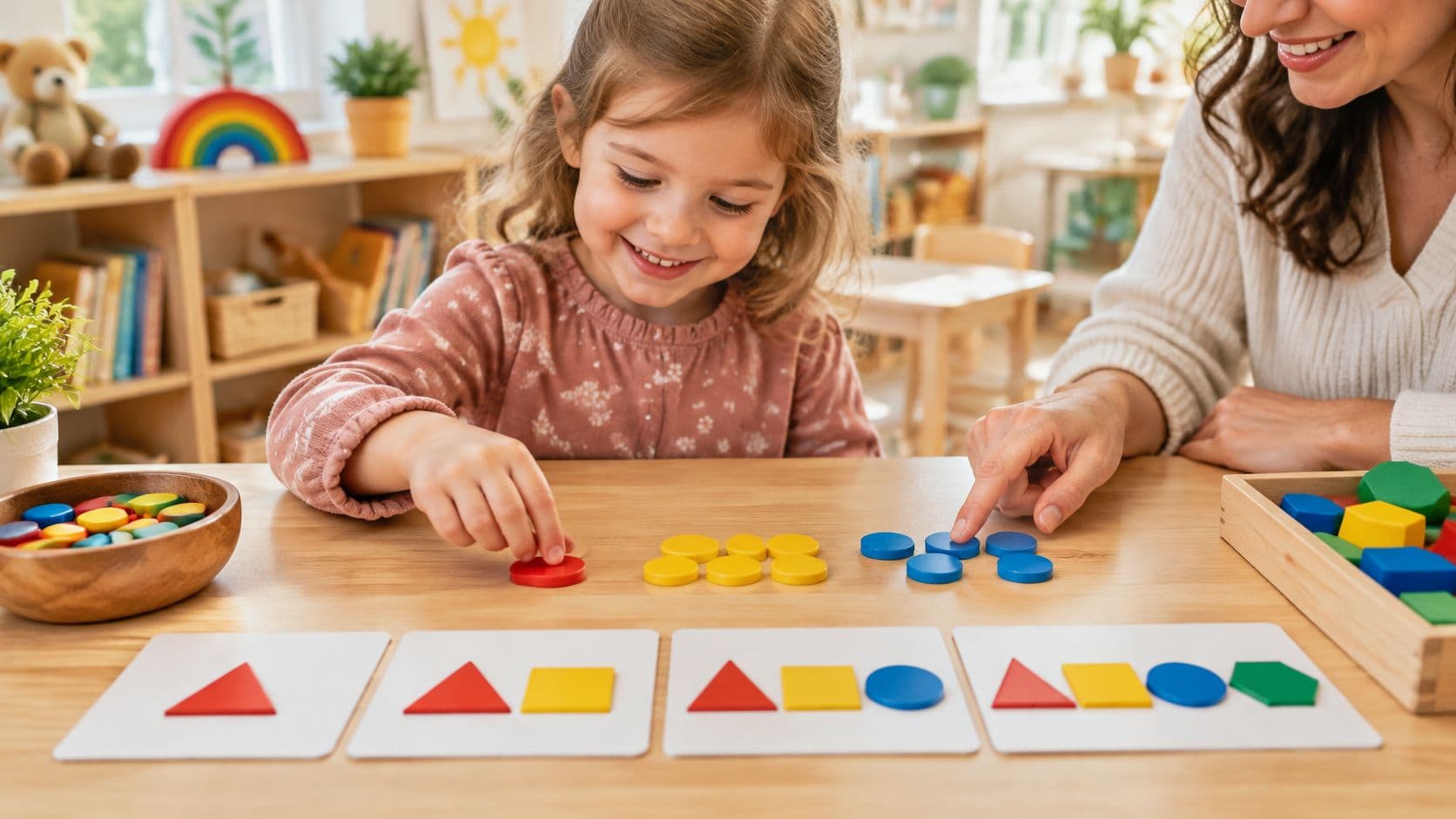
Geometry runs beside number from the start. Children handle circles, triangles, rectangles, and squares, trace edges, count corners, and combine pieces. The objective isn't naming alone. It's describing how shapes are alike or different and testing how parts form a whole.
Measurement stays direct. Two ribbons sit side by side, two towers stand on the same floor line, or two containers show which holds more. Formal rulers can wait because preschool children first need the comparison and the words longer, shorter, taller, and holds more.
Patterns begin with copying AB, such as red, blue, red, blue. Extending that pattern comes next, followed by ABB when children can say what repeats. Sorting follows the same logic: one attribute first, then a second attribute only when the first rule is clear.
The Watch for column belongs on a clipboard during teaching, not inside an end-of-unit test file. Teachers who place these rows into a wider sequence can adapt the approach in a unit planning guide, then replace broad unit goals with the child-observable evidence listed here.
Match Each Task to the Next Strategy
A learning trajectory links three planning decisions. The first is a mathematical goal, such as cardinality or shape composition. The second is the progression of strategies children use toward that goal. The third is a task aimed at the next strategy rather than at a seasonal theme.
The U.S. Institute of Education Sciences learning trajectories project describes this model as connecting goals, developmental levels, and corresponding instructional activities. Planning starts with the child's current move. The next task stretches that move without skipping the level between.

An Illustrative Counting Example
A child counts five bears in a line and says, "Five." The teacher circles the same bears, and the child immediately begins again at one. Introducing six wouldn't address the problem. The needed prompt is, "Did we add any bears?" That question directs attention to whether rearrangement changed the total.
Shape learning follows the same rule. A child who names a triangle but can't explain how it differs from a square doesn't need a larger poster. The next task asks the child to compare sides and corners on pieces that can be turned and touched.
Tag Every Activity Before Teaching
Each planned activity needs six short tags beside the activity name.
- Target concept: Cardinality.
- Prerequisite strategy: Touches one object for each number word.
- Expected response: Keeps the last number as the total after rearrangement.
- Likely misconception: Recounts because the objects moved.
- Next-step prompt: "Did we add any bears?"
- Representation: Objects first, then a drawing, then talk, with a numeral last.
Those tags turn observation into a decision during the lesson. If the misconception appears, the teacher uses the prepared prompt and repeats the same idea with another set. If the strategy holds with objects and a drawing, the next lesson can extend it.
Preschool understanding is often uneven across objects, drawings, verbal explanations, and symbols. One correct answer with counters doesn't confirm the same understanding on paper. Varied representations protect the plan from mistaking a familiar format for a secure concept.
Run a Short Daily Math Block
The What Works Clearinghouse practice guide on teaching math to young children recommends dedicated daily mathematics time, integration throughout the school day, and number instruction based on a developmental progression. That structure fits a short block when every step has a specific job.

The Six-Step Cycle
- Write one objective: State an action a teacher can see, such as "Touches one counter per number word up to 10 and says the last number as how many." List materials, grouping, minutes, the exact prompt, and success evidence.
- Model for five minutes: Demonstrate slow touching and counting, then invite one child to show the same strategy. Keep the whole-group portion brief enough that children soon handle materials themselves.
- Practice for ten minutes: In pairs or small groups, children count counters, cubes, cups, or steps on a number path. The teacher listens for skipped objects, double touches, and whether children answer "How many?" with the final number.
- Reuse the idea in a routine: Attendance can ask, "How many children are here today?" Snack can compare two groups, cleanup can sort pieces, and outdoor time can compare path lengths. These prompts support the objective without adding another formal lesson.
- Run a two-item probe: One item asks for performance, such as counting eight counters. The second asks for explanation with "How do you know?" A gesture, recount, drawing, or short sentence can supply useful evidence.
- Choose tomorrow's move: Record the observed strategy and mark repeat, simplify, or extend. That decision prevents the calendar from advancing the class past an unstable idea.
Cardinality, comparison, and joining shouldn't all debut on the same day. Routine questions may touch familiar strands, but the direct objective remains one idea. Teachers turning this cycle into a written plan can follow the structure in a lesson plan walkthrough while keeping preschool evidence in actions and talk rather than worksheet answers.
Planning test: A co-teacher should be able to run the block from the objective, materials, prompt, grouping, timing, and success line without guessing.
Worksheets, when used at all, come after the idea is visible with objects. A numeral tracing page can't repair weak one-to-one matching. Returning to movable counters gives the teacher better evidence and gives the child a strategy that transfers to real sets.
Catch the Math Inside Play
A block tower leans, falls, and gets rebuilt with a wider base. That moment may involve height, stability, shape composition, counting, or simple persistence. The teacher's job is to notice which mathematical action is present before speaking.
Play and intentional teaching aren't opposites. A Springer article on early mathematical thinking in play warns that activities labeled mathematical may not reliably involve children in mathematizing from their own perspective. Children can handle math materials without noticing quantity, pattern, space, or comparison. A prepared look-for helps the teacher name the idea, ask one useful question, and step back.
| Setting | Math to notice | Prompt | Evidence to record |
|---|---|---|---|
| Blocks | Composing shapes and comparing height | Can you make it taller and still have it stand? | Builds or describes a taller stable structure |
| Snack | Compare quantities | Which group has more, or are they the same? | Uses more, less, or same for the actual sets |
| Cleanup | Sort and match shapes | Which bin matches this piece, and how do you know? | Sorts by a stated attribute |
| Outdoors | Compare length | Which path is longer if we walk both? | Compares length directly |
| Dramatic play | One-to-one matching | How many plates do we need for the people here? | Matches one object per person |
Intervene Lightly
A prompt works best when play stalls or the math remains invisible. "Which tower is taller?" can start comparison. "What changed when the base got wider?" invites an explanation without supplying the answer. When a child is already matching plates to people or extending a bead pattern, observation is enough.
Finding time is a real planning constraint. Center invitations should therefore carry their prompts in advance rather than depend on a teacher inventing one mid-rotation. Choice, challenge, and visible progress can also keep children returning to a task, a principle explored in boosting student engagement through gamification. For preschoolers, that might mean trying to build a taller stable tower or repairing a broken pattern, not earning points.
The record needs only three lines:
- Observed: What the child did or said.
- Prompt used: The exact teacher question.
- Next decision: Whether the daily block should repeat, support, or extend the idea.
That note is more useful than a star or score because it preserves the strategy. It also keeps attention on measurement, spatial reasoning, patterns, comparison, and argument, not only counting. Number answers are easy to mark, so they're easy to overweight. A child explaining why two shapes belong together is also producing mathematics evidence.
A Five-Day Counting and Shape Plan
This illustrative classroom plan suits four- and five-year-olds who can say some number words in order. It keeps one number goal and introduces one geometry goal without making Friday a catch-all review. Each day uses the short daily block and ends with the listed success check.
Head Start's effective practice guide for cognition identifies recognizing, describing, comparing, and naming common shapes, understanding parts and attributes, composing shapes, and comparing size as preschool capabilities. Thursday and Friday therefore move beyond label memorization.

| Day | Number focus | Geometry focus | Success check |
|---|---|---|---|
| Monday | Count 10 counters, then rearrange | None | Keeps the last number as the total |
| Tuesday | Count a handful to 10 into a cup | None | Explains how they knew |
| Wednesday | Compare two groups with objects | None | Says more, less, or same with objects |
| Thursday | Count corners on each shape | Name and compare shapes by sides and corners | Describes attributes, not only names |
| Friday | Rearranged-counter check for anyone still recounting | Compose a larger shape from pieces | Builds a shape and says what the pieces made |
How the Days Connect
Monday establishes cardinality. Children count 10 counters, answer "How many?", watch the teacher spread the same counters, and answer again. Tuesday transfers matching to a cup. Moving each piece while counting reduces double touches, and the probe is, "Show me how you knew."
Wednesday asks which of two object groups has more. Children may count both groups or line objects up for matching. Either strategy is acceptable when the objects support the claim. Thursday shifts the question to attributes: "How are these alike?", "Which shape has more corners?", and "Can you make a rectangle from these pieces?"
Friday reuses both goals in centers. Pattern blocks support composition, while the rearranged-counter check targets only children who still recount after movement. If Thursday's talk stopped at shape names, Friday repeats composition instead of opening measurement or patterns.
The home link is a routine. Families can count steps to a door or find corners on a window. The task connects school strategies to familiar movement and objects without asking families to reproduce a worksheet lesson.
Adapt for Multilingual and Uneven Learners
Adaptation changes how a child responds, not the mathematical goal. A multilingual child, a child who communicates nonverbally, and a child with limited preschool experience can all work on cardinality, comparison, or shape attributes. Lowering the task to passive watching removes the reasoning the lesson is meant to build.
Offer Several Ways to Show the Same Idea
For cardinality, a child can place one block on each dot, move one counter per number word along a number path, or hand the teacher the requested set. For comparison, pointing to the larger pile or placing matching objects in pairs can show more and less. Shape knowledge can appear through tracing an edge, holding up fingers for corners, matching pieces, or selecting a shape with the same attribute.
- Movement: Step once for each object or walk two paths to compare length.
- Visual response: Point to a picture, numeral card, or completed set.
- Home language: Count or name attributes in the language the child knows best.
- Manipulative response: Build, match, sort, or move objects instead of giving a long verbal answer.
- Drawing: Mark each counted object or draw the composed shape.
Language difficulty shouldn't be scored as mathematical difficulty. Accurate one-to-one matching is counting evidence even when the explanation contains no English words. The observation note should name the response mode, such as "matched seven blocks to seven dots and pointed to 7," so the next teacher doesn't mistake limited speech for missing number knowledge.
Different starting points still matter. A child who recites without matching returns to touching and moving objects rather than advancing to bigger numbers. A child who is secure with 10 objects can try a larger rearranged set or explain which tower is taller and why. Teachers can use differentiation strategies for varied learners to vary supports while keeping the shared goal intact.
Family routines should also remain consistent across languages. "Count the steps to the door" can be asked at home in the family's language. The familiar action preserves the mathematical question and lets families participate without translating school worksheets.
Check the Week Before You Teach
A short review catches plans that look full but don't produce evidence. Teachers can mark each item before Monday and revise only the day that fails.

Monday Readiness Checklist
- One number goal: The week names a single main number objective in observable language.
- Another strand visible: Geometry, measurement, patterns, or sorting appears in a taught task, routine, or center.
- Trajectory tags complete: Each lesson states the prerequisite strategy, expected response, likely misconception, and next-step prompt.
- Daily block specified: Minutes, materials, grouping, exact language, and a two-item probe are written down.
- Play evidence prepared: At least one center has a math look-for, an optional prompt, and space for a three-line record.
- Response modes ready: Children who need them can point, move, draw, build, or use a home language without losing the core goal.
- Concrete before symbolic: Objects and talk come before numerals, written signs, or worksheet recording.
- Home routine included: Family practice uses steps, snacks, laundry sorting, or shape spotting rather than school-style pages.
A failed box calls for a focused repair. If the misconception prompt is missing, add it to that lesson. If the objective says "understand numbers," rewrite it as an action involving objects and a total. If no alternate response mode exists, add materials that let a child show the strategy physically.
Teacher Planner's browser-based planbook can hold the five-day order in Day, Week, Month, Unit Timeline, and Outline views. Its Bump Forward action moves affected lessons while keeping subsequent lessons in order when rain cancels an outdoor measuring task. The Lesson Plan Generator can draft from a topic, objective, or standard, and the Worksheet Generator supports Pre-K through 12th grade plus University and Adult education. Generation requires a free account and daily limits apply, and every AI draft still needs teacher review against children's observed strategies.
Store the plan in a system, but let classroom evidence decide whether the next lesson repeats or advances.
Put the strand table, daily block, play prompts, and five-day sequence into one browser-based planbook so Monday's preschool math curriculum is ready to teach and easy to adjust. Teacher Planner lets teachers organize lessons by day or week, preserve the order with Bump Forward when schedules change, and draft editable lesson materials from objectives or standards. Visit Teacher Planner to build the week around the strategies children show.