

You ask a simple question, put 0.8 and 0.45 on the board, and then half the room hesitates. A few students say 0.45 is larger because 45 is bigger than 8. A few say 0.8 is larger but can't explain why. Others stare at the decimal point as if it changed the rules of math.
That moment is common because comparing decimals looks easy to adults and feels slippery to students. The mistake many of us make is treating it like a one-day procedure instead of a place-value idea that students build over time. If you teach upper elementary or middle grades, you've probably seen students get one pair right and the next pair wrong for completely different reasons.
What helps most isn't one more reminder to “line up the digits.” It's a way to diagnose the misconception behind the wrong answer, then match the fix to the error.
Why Comparing Decimals Trips Students Up
A student looks at 0.45 and 0.8, points to 45 and 8, and chooses 0.45 because 45 is bigger. Another student compares the same pair and picks 0.8, but only because “8 is more than 4.” Both answers give us information. One student is treating decimals like whole numbers. The other may have the right answer without a clear place-value reason.
That is why decimal comparison can feel so slippery in class. Students are not all making the same mistake.
In the United States, formal decimal instruction usually starts in grade 4 with links to fractions such as tenths and hundredths, then continues in grade 5 with operations and deeper place-value work, as described in this PMENA conference paper on decimal understanding. So when students struggle to compare decimals, the problem is often bigger than one missed procedure. They may be shaky on magnitude, equivalence, or the idea that a digit's value depends on its place.
I find it helpful to sort wrong answers into four misconception types, because each one needs a different response.
First, some students use whole-number thinking. They see more digits and assume the number must be larger, so 0.125 seems greater than 0.7.
Second, some students notice the decimal point but do not understand place value to the right of it. They can name digits, but “4 in 0.45” does not yet mean 4 tenths to them.
Third, some students do not yet grasp equivalence with trailing zeros. If 0.5 and 0.50 do not feel like the same amount, comparison quickly gets shaky.
Fourth, some students know a procedure on paper but have weak magnitude sense. They may compare correctly in a column format, then place the same numbers incorrectly on a number line.
Research summarized in Mathematics Teacher Education and Development describes decimal comparison as a persistent area of difficulty across grade levels. That matches what many teachers see. A student can get one pair right, miss the next pair, and do so for a completely different reason each time.
This is why correct answers need a second look.
A student who says, “I just knew,” may understand. The student may also be guessing, copying a pattern, or using a shortcut that only works on that one example. I want to hear language like “6 tenths is greater than 4 tenths” or “these are equal because 0.50 is 50 hundredths and 0.5 is 5 tenths.”
Number lines are often the clearest test of whether the idea is really there. The PMENA paper cited earlier notes that many students struggle to estimate decimal locations on number lines even after they have been taught decimal comparison in school. That matters because number-line placement shows whether students see decimals as quantities, not just strings of digits.
So the teaching move is not “give the lining-up rule one more time.” It is to identify which misconception is producing the error, then choose the fix that matches it. That shift helps us respond with much more precision, and students feel the difference.
A Reliable Method for Comparing Any Two Decimals
When students need a dependable routine, I teach one that works across most classroom examples. It's simple, but the language matters. We want students to compare place values, not just count digits.
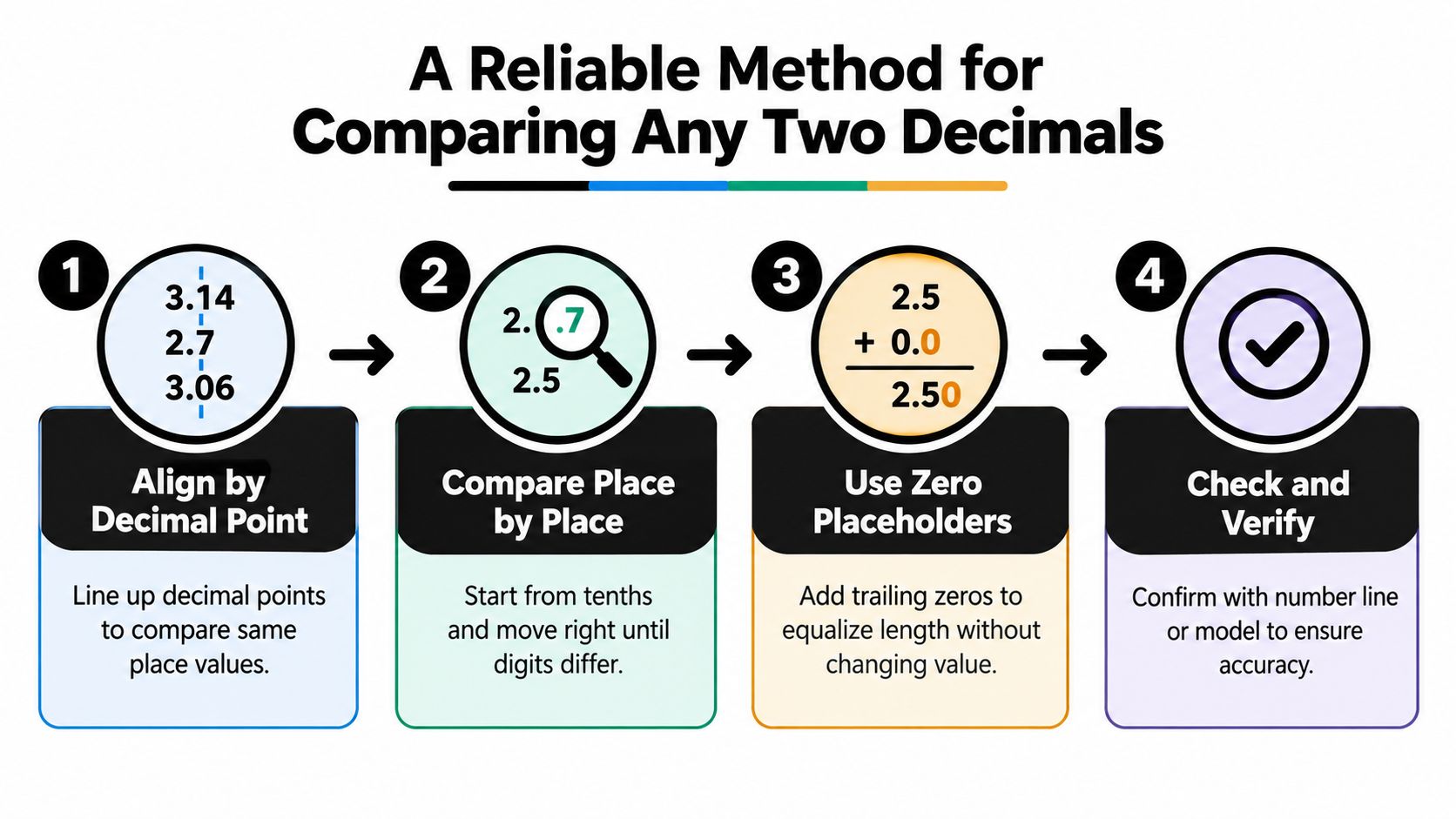
Start with alignment
Write the decimals so the decimal points line up vertically. This keeps tenths under tenths, hundredths under hundredths, and so on.
For example:
- 0.60
- 0.45
Now students can compare the same place values.
If you don't line up by decimal point, some students compare the wrong digits. They may look at 6 and 4 and be lucky enough to get the right answer, but they won't know why they were allowed to compare those digits.
Compare from left to right by place value
Once the decimals are aligned, start with the greatest place value to the right of the decimal. With numbers less than 1, that's usually the tenths place.
In 0.60 and 0.45, compare the tenths:
- 6 tenths
- 4 tenths
Since 6 tenths is greater than 4 tenths, 0.60 > 0.45.
Stop at the first place where the digits differ. That first difference decides which number is larger.
Tell students to say the place out loud: “I'm comparing tenths first.” That one sentence prevents a lot of guessing.
Use trailing zeros when needed
Students often think extra zeros change the value. Annexed zeros help.
Write:
- 0.8 as 0.80
- 0.45 stays 0.45
Now the comparison is easier to see:
- 8 tenths
- 4 tenths
So 0.80 > 0.45.
Trailing zeros to the right of a decimal don't change the amount. They only rename it. 0.8, 0.80, and 0.800 represent the same value.
Here are quick examples you can model aloud:
- 0.80 vs 0.8
Same value. The zero is only a placeholder. - 0.53 vs 0.507
Rename 0.53 as 0.530. Compare hundredths: 3 hundredths is greater than 0 hundredths, so 0.530 > 0.507. - 1.2 vs 1.19
Rename 1.2 as 1.20. Compare tenths first. Since 2 tenths is greater than 1 tenth, 1.20 > 1.19.
Language that helps students justify
I've found these sentence frames useful:
- “The whole number parts are the same, so I compare the tenths.”
- “These decimals name the same amount because trailing zeros don't change value.”
- “The first place where they differ is the hundredths place.”
Students don't need more tricks. They need one routine they can explain.
Common Misconceptions and How to Spot Them
The hardest part of teaching decimals isn't showing the method. It's noticing that different wrong answers come from different ideas. Research on decimal misconceptions identifies several persistent patterns, including whole-number thinking, longer-is-larger, shorter-is-larger, and zero-related errors, as described in this ERIC paper on decimal misconceptions.
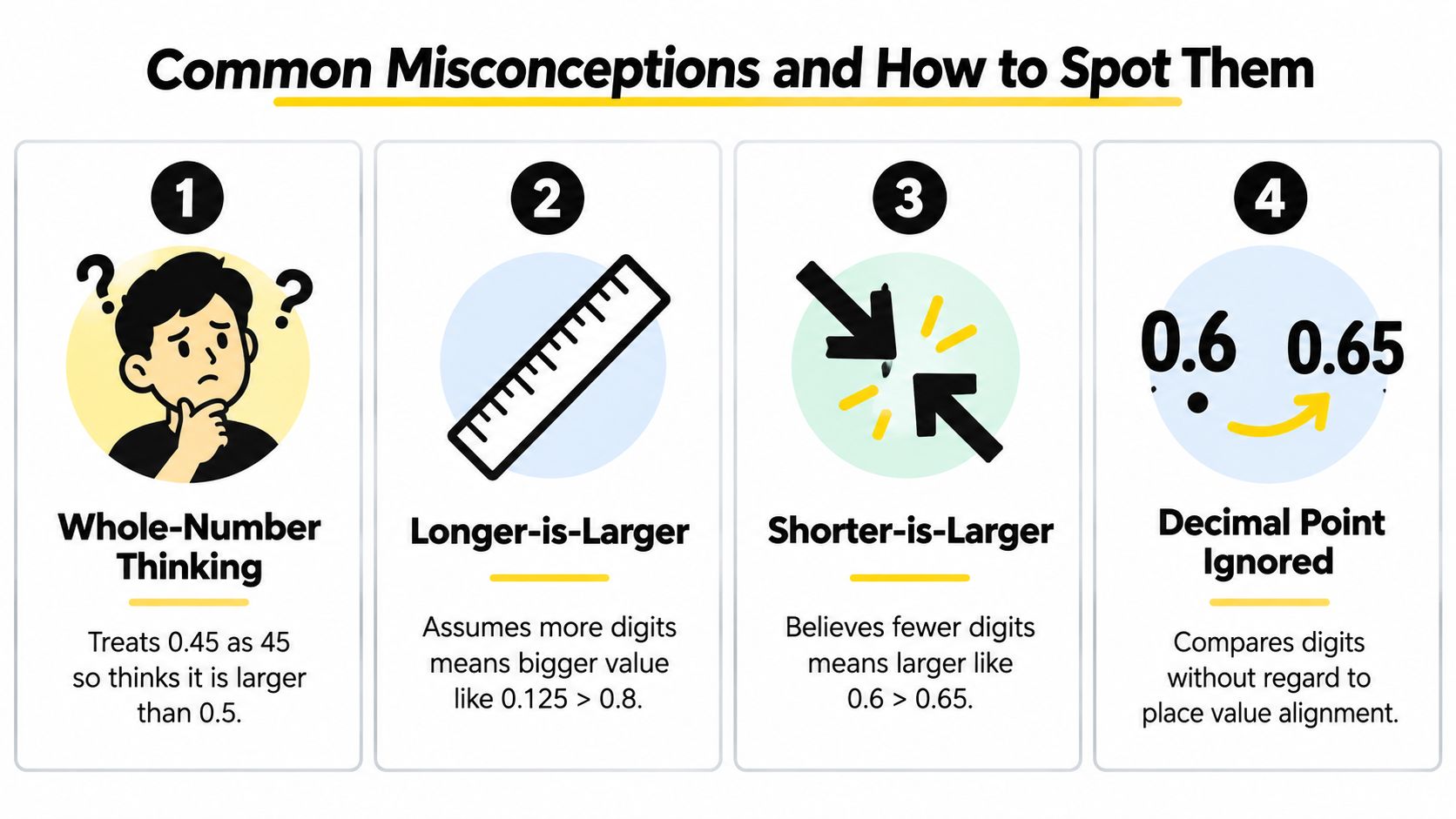
Four patterns that look similar on paper
| Misconception | What the student might say | What it reveals | A better next move |
|---|---|---|---|
| Whole-number thinking | “0.45 is bigger than 0.5 because 45 is bigger than 5.” | The student is ignoring place value after the decimal. | Compare with tenths and hundredths language. Use models. |
| Longer-is-larger | “0.125 is bigger because it has more digits.” | The student equates length with size. | Add zeros to both numbers and compare place by place. |
| Shorter-is-larger | “0.6 is bigger than 0.65 because 6 is bigger than 65 is not possible, so the short one must be bigger.” | The student has an inconsistent shortcut, often based on partial understanding of tenths. | Put both numbers on a number line between 0.6 and 0.7. |
| Zero-related errors | “0.50 is different from 0.5” or “0.05 is bigger than 0.5 because it has a 5 and a 0.” | The student doesn't understand placeholders. | Use money, grids, or equivalent naming tasks. |
Quick questions that uncover the error
Instead of immediately correcting the answer, ask one of these:
- “What place did you compare first?”
- “Would adding a zero change the value?”
- “Can you show that on a number line?”
- “What does the 5 mean in this number?”
The student's response usually tells you more than the original mistake.
For fast practice sets, I like to sort student work by misconception type rather than by score. If you want to build your own error-analysis checks, a decimal warm-up quiz generator can help you create comparison items that mix trailing zeros, unequal lengths, and explanation prompts.
A student who says 0.50 and 0.5 are different doesn't need more comparison problems first. That student needs equivalence work.
Don't reteach everyone the same way
Generic advice like “line up the digits” helps some students and misses others. The student using whole-number thinking needs place-value language. The student making zero errors needs equivalence experiences. The student using a length rule needs examples that break the rule quickly and clearly.
That's the power in learning how to compare decimal numbers well. You stop treating every wrong answer as the same problem.
Making Comparisons Visual With Number Lines and Models
When students can't hold decimal size in their heads yet, visuals do the heavy lifting. A number line is especially useful because it shows comparison as position, not just symbol choice.
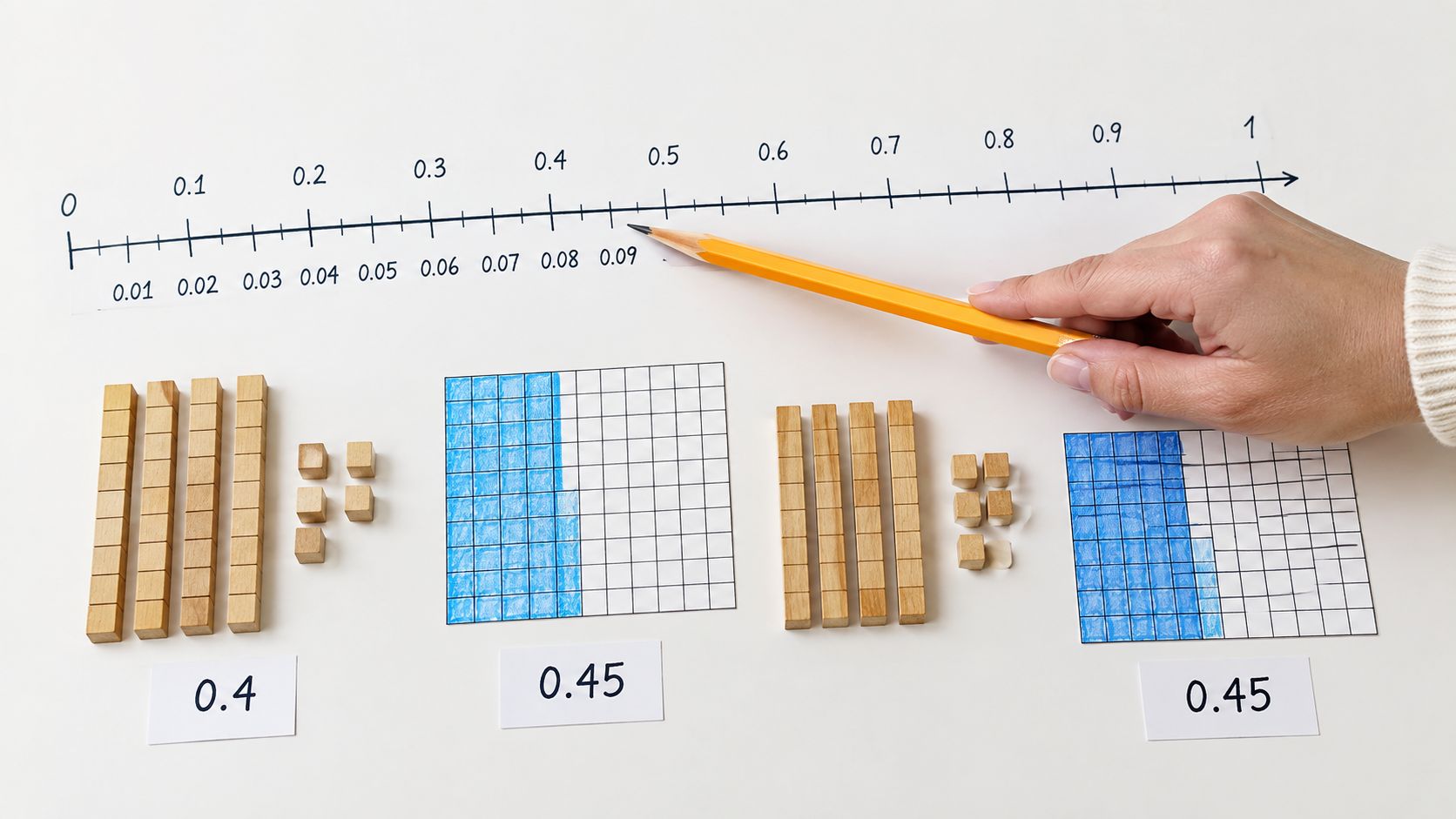
Use a 0 to 1 number line first
Draw a line from 0 to 1 and mark tenths. Then zoom in when needed.
If you're comparing 0.45 and 0.8, students can usually place 0.8 right away. Then ask where 0.45 belongs. It sits between 0.4 and 0.5, slightly left of 0.5. Once they see both points, the comparison becomes obvious because the larger decimal is farther to the right.
For 0.53 and 0.507, a tenths-only line isn't enough. Draw a zoomed-in line from 0.50 to 0.54 and mark hundredths. That tighter interval helps students notice that 0.53 is the same as 0.530, which lies to the right of 0.507.
Use grids and money for hundredths
Base-ten hundred grids work well because they connect decimals to shaded area.
- 0.5 is 50 hundredths
- 0.50 is also 50 hundredths
- 0.05 is 5 hundredths
Money can support the same idea when the values fit the context. Students often see that $0.50 equals fifty cents, while $0.05 equals five cents. That concrete comparison can clear up zero-related confusion quickly.
When students argue about 0.5 and 0.50, ask them whether fifty cents is different from fifty cents because one amount is written with an extra zero.
Keep the visual tied to language
Visuals help most when students talk through them. Prompt them with:
- “Which number is farther right?”
- “Between which two tenths does it fall?”
- “How many hundredths is that?”
Research described in this PME reference page on decimal strategy use notes that students' strategies can shift after feedback and can vary with prior proficiency. That fits what many teachers see. One student benefits from adding zeros. Another needs a number line to anchor magnitude before symbolic comparison makes sense.
Classroom Exercises That Build Fluency and Strategy Choice
Once students have a reliable routine and you've identified the misconception patterns, practice should do more than repeat the same worksheet format. The best sets vary the surface features so students have to choose a strategy, not just imitate yesterday's example.
A progression that builds decision-making
Use a progression like this:
| Level | Example Pair | Focus Strategy |
|---|---|---|
| Same-length tenths | 0.4 and 0.7 | Compare tenths directly |
| Same-length hundredths | 0.42 and 0.39 | Read left to right and stop at first difference |
| Different lengths | 0.8 and 0.45 | Rename with a trailing zero, then compare |
| Trailing-zero equivalence | 0.6 and 0.60 | Prove equal value |
| Close values | 0.53 and 0.507 | Use annexed zeros and careful place-value language |
| Mixed whole numbers and decimals | 1.2 and 1.19 | Compare whole number part, then decimal part |
| Model-based comparison | 0.5 and 0.05 | Use grids, money, or number lines |
That sequence matters because students often look solid with same-length pairs and then fall apart when the lengths differ.
Practice formats worth reusing
I'd rotate through a few short structures instead of assigning one long page.
- Card sorts: Give pairs like 0.9 vs 0.89, 0.40 vs 0.4, and 0.125 vs 0.2. Ask pairs of students to sort into greater than, less than, and equal to, then justify one tricky example.
- True or false prompts: Write statements such as “0.50 > 0.5” or “0.6 < 0.65.” Students decide, then explain the first place that proves the claim true or false.
- Always, sometimes, never: Try “Adding a zero to the end of a decimal changes its value.” That one surfaces zero misconceptions fast.
- Error analysis: Present a fictional student answer and ask, “What misconception is this?” That builds teacher-like noticing in students.
If you want printable practice that follows this progression, a decimal worksheet generator can save time when you need separate sets for intervention groups.
Feedback should change the strategy, not just the answer
Some students overuse one method. They try adding zeros to every problem, even when comparing tenths would be faster. Others refuse to use placeholders and need that support. Good feedback nudges them toward strategy choice.
I like prompts such as:
- “What was the fastest correct strategy here?”
- “Could a number line check this?”
- “Did you need to compare past the tenths place?”
Strong decimal fluency means students can choose a method on purpose, explain it, and adjust when the numbers change form.
That's a better goal than speed alone.
Putting It All Together for Confident Comparison
When students freeze on 0.8 vs 0.45, the issue usually isn't carelessness. It's that several ideas are colliding at once: place value, equivalence, magnitude, and old whole-number habits. Teaching how to compare decimal numbers well means keeping those ideas visible instead of reducing everything to a shortcut.
A sturdy classroom approach has three parts. First, give students one reliable comparison routine based on aligned place value. Second, sort wrong answers by misconception, not by whether they're incorrect. Third, keep number lines and models in regular use so decimal size stays connected to meaning.
A short planning checklist helps:
- Teach the routine clearly: Line up decimal points, compare place by place, and use trailing zeros when helpful.
- Listen for the misconception: Whole-number thinking, longer-is-larger, shorter-is-larger, or zero confusion.
- Use visuals often: Especially for close values and equivalence pairs.
- Mix practice types: Include same-length, different-length, trailing-zero, and model-based comparisons.
- Check for explanation: Ask students to name the place that decided the comparison.
For lesson sequencing and review planning, a lesson planning tool for math comparison lessons can help organize small-group reteaching, fluency checks, and number-line revisits across the week.
Students don't need a clever decimal trick. They need repeated chances to connect symbols to quantity. When that connection grows, comparison gets calmer, faster, and far more accurate.
Teacher Planner gives you one place to organize lessons, units, and standards while also drafting decimal comparison materials such as quizzes, worksheets, and small-group lesson plans. If you're building a sequence on place value, number lines, and misconception checks, visit Teacher Planner to plan it and prepare the materials more efficiently.