

Teachers spend a lot of time inside planning. AITSL reports that 40% of full-time classroom teachers spend 10 or more hours per week on lesson planning on average, and that share rises to 37 to 40% depending on school type, with most primary and secondary teachers spending at least 5 hours per week planning (AITSL workforce reporting summary). That makes a lesson plan outline example less like a nice printable and more like a working tool you come back to again and again.
The outline is the scaffold. The full lesson is the building. If the scaffold is strong, you can swap activities, tighten timing, recover from interruptions, and still keep the lesson moving in the right direction.
Why a Lesson Plan Outline Matters More Than a Full Plan
A lesson plan outline does the heavy lifting before you ever stand in front of students. It forces you to decide the destination, the sequence, and the checkpoints without getting trapped in every sentence you might say. That matters because planning is already a major part of the job, not an occasional admin task. The planning load teachers carry explains why many rely on reusable outlines, shared templates, and quick revision cycles.
A good outline also helps you teach with a lighter head. When the structure is clear, you are not holding every transition in your memory at once. You can watch the room, listen to student responses, and adjust in real time because the lesson already has a shape.
Outline first, script later
If I'm coaching a newer teacher, I usually say this: write the outline before you write the words. A script can help for a demo lesson or a brand-new class, but most everyday lessons need enough structure to guide you, not so much detail that you cannot breathe.
Practical rule: if you need to look down every few seconds to remember what comes next, the outline isn't doing its job yet.
A reusable outline saves more time than starting from zero. It gives you a place to plug in the day's objective, the specific resource, and the activity that fits the class you have, not the class you wished you had on paper. That makes it easier to adapt the same framework across subjects and year levels without rebuilding the whole lesson each time.
Why the outline is the real anchor
The strongest outlines work because they flex. A timetable changes. A fire drill interrupts. A discussion runs long. The outline keeps the sequence visible, so you can trim, shift, or return to a skipped phase without rebuilding the lesson from scratch.
That is why I treat the lesson plan outline example as a working document. It is not paperwork for the binder. It is the version you revise before Monday, annotate after Tuesday, and use again on Friday when the same objective appears in a different class.
The Five Core Components of Every Lesson Plan Outline
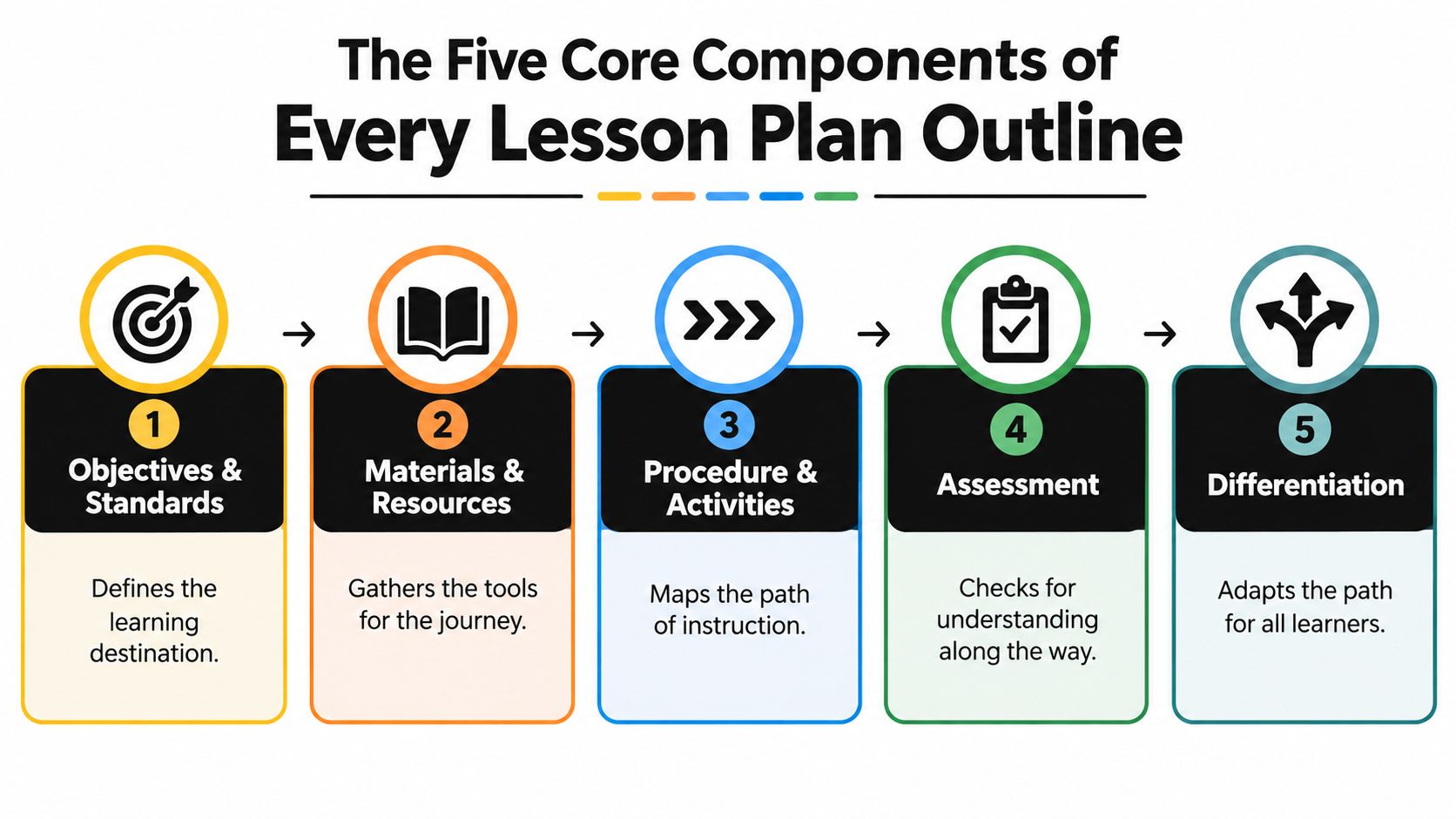
A useful outline usually comes down to five pieces. They can appear under different labels, but the job stays the same. A faculty template from UBC lays out a sequence that begins with rationale and objectives, then moves through preparation, introduction, body, closure, assessment, materials, extensions, adaptations, and reflection, which is a very clear example of how outlines support sequencing, time allocation, differentiation, and iteration (UBC lesson plan outline).
1. Objectives and standards
Start with what students should know or do by the end. If the objective is fuzzy, the whole outline drifts. In a strong outline, the objective names the learning, not just the topic.
For example, “students will compare two characters' motivations using evidence from the text” is much more useful than “students will read chapter four.” The second statement describes coverage. The first describes learning.
2. Materials and resources
This looks simple, but it prevents real trouble. If a practical lesson needs scissors, lab goggles, sentence strips, a projector, or one copied excerpt per pair, put that in the outline early. I've seen excellent lessons wobble because a teacher discovered halfway through that the copies were still on the printer.
3. Procedure and activities
This is the path of the lesson. A structured outline often maps the lesson in timed phases, such as retrieval, context, guided learning, application, and plenary. In history teaching, a commonly used structure breaks a lesson into five-minute and fifteen-minute blocks, which fits a normal school period nicely (history lesson planning example).
4. Assessment
Assessment belongs inside the outline, not at the bottom as an afterthought. A quick check for understanding, an exit slip, a short explanation, or a piece of student talk tells you whether the class is with you. Without that, you're just hoping the lesson landed.
5. Differentiation
You plan for more than one kind of learner. It can be as simple as adding a sentence stem, a visual support, a challenge task, or a shortened version of the same task. The point is not to create three different lessons. The point is to make one lesson usable by more students.
How the Same Outline Looks Across Subjects and Grades
A lesson plan outline example only becomes useful when you stop treating it like a fixed form. The shape stays steady. The details change with age, subject, and classroom reality. A teacher planning elementary ELA makes different choices from a teacher planning high school science, even though both are using the same structure.
The research on AI-assisted lesson planning points in the same direction. Teachers valued outline generation, but still needed human judgment for content alignment, pedagogical fit, and local context. A separate planning tool study used a dialogue phase to gather cultural and contextual details before generating the plan. That matters because a template only works when it matches the class in front of you, not an imaginary average class.
| Component | Elementary ELA | High School Science | Cross-Curricular Project |
|---|---|---|---|
| Objective | Read and discuss a text feature, then explain it in simple language | Use a concept accurately in a lab or problem-solving task | Combine a content goal with a writing or speaking goal |
| Materials | Book excerpt, chart paper, markers | Safety gear, lab sheet, equipment list | Shared texts, prompts, rubric, planning sheet |
| Procedure | Short retrieval, model, guided reading, partner talk | Brief review, demonstration, guided practice, lab work | Launch task, model expectations, collaborative work, share-out |
| Assessment | Oral response, notebook check, quick exit prompt | Observation, lab questions, written explanation | Product rubric, discussion evidence, reflection |
| Differentiation | Sentence frames, partner support, read-aloud | Tiered questions, vocabulary support, structured lab roles | Different roles, choice of product, scaffolded planning |
The main difference across settings is usually depth, not shape. Younger students need tighter pacing and more modeling. Older students can handle longer application blocks and more independent work. The outline still holds the lesson together.
One skeleton, three different classrooms
In an elementary class, I'd keep the directions short and the checks frequent. In science, I'd build in safety notes and exact resource handling. In a cross-curricular project, I'd be more careful about which standard gets assessed where, because teachers sometimes overload a single task with too many goals.
Subject choice changes the examples, too. A teacher working on figurative language in middle school will likely plan a very different discussion from a teacher running a chemistry lab or a writing workshop. The outline does not need a new shape for each case. It needs the right task, the right level of support, and the right evidence of learning.
The lesson plan outline example should help you adapt, not lock you in. If you can move from text analysis to lab reasoning to project-based writing without rebuilding the whole form, the outline is doing its job.
How to Annotate an Outline Example for Real Use
A clean outline is useful. An annotated outline is better. Annotation is where you tell yourself what must stay fixed and what can flex if the class goes sideways. That distinction matters because a live lesson never behaves exactly like the draft.
A case-based lesson-planning study found that plans built with stored prior cases were completed in less time than plans created without the system, and the time savings were greatest when the new lesson closely matched prior stored cases. Plan quality did not differ significantly between groups (case-based planning study). That tells me the value is in reuse and revision, not in pretending every lesson starts from nothing.
Mark the fixed parts first
I usually tag the essential elements. These are the pieces I don't want to forget when the day gets busy.
- Learning objective: this stays visible because it keeps the lesson on target.
- Safety or access notes: these matter in science, art, PE, and any activity with materials or movement.
- Assessment check: I write this early so I don't forget how I'll know whether students understood.
- Timing anchors: I label the parts that can't quietly expand and swallow the rest of the lesson.
Leave some spaces open on purpose
The flexible parts are where experience helps. I often leave the exact example, the final question, or the closing prompt open until I know how the class is responding. If I've taught the lesson before, I'll add a note like “students usually need one more model here” or “skip this extension if the pace slows.”
Keep one clean margin for the day you need to change the plan at 9:10 a.m. That margin is not a weakness, it's what makes the outline survive real classrooms.
Use past lessons as notes, not scripts
A living document pays off when you track what works. If a discussion question worked last term, keep it. If a transition was awkward, mark it. If students raced through the task, note where to add depth next time.
The goal is not perfection. The goal is a plan that gets better each time you use it.
Practical Tips That Make Your Outline Work in Chaos
Real classrooms break neat plans. Assemblies appear. A colleague borrows the room. A student support need takes longer than expected. Strong outlines leave room for those moments instead of pretending they will not happen.
An analysis of AI-generated civics lesson plans found that the drafts often stayed close to memorization, while teachers still carry much of the lesson-planning load alongside marking and administration (lesson-planning workload and AI analysis). That matters because a lesson outline has to do two jobs at once. It needs enough structure to hold the lesson together, and enough flexibility to survive the day you teach.
Build one lesson with two speeds
I like outlines that can run fast or slow without falling apart. Keep one core task and one stretch version inside the same plan, so you are not juggling two different lessons. If the class moves quickly, the stretch piece is ready. If students need more support, the core task still works.
Use flex blocks
A flex block is a small part of the lesson you can shrink, expand, or skip. It might be a review question, a partner check, or an example set. If five minutes disappear to an announcement or a behavior reset, the flex block takes the hit instead of your main teaching point.
Keep the backup simple
If technology fails, I want the lesson to keep going. A notebook task, a printed prompt, a board example, or a quick discussion can hold the room while you reset.
For teachers who want a digital place to keep outlines and adjust lessons when the week changes, How to Use a Teacher Planner explains how planning and revision can sit in the same workflow.
Protect higher-order thinking
Convenience can flatten a task fast. If the lesson should lead students into analysis, justification, or creation, write that into the outline clearly. Otherwise, the easiest draft will drift toward recall and listing, even when your real goal is deeper thinking.
Keep one fallback for mixed readiness
I always want one support move and one challenge move ready. A shorter prompt, a sentence frame, a model answer, or a deeper question can save the lesson when part of the class needs more help and other students finish early. That small adjustment keeps the outline useful instead of rigid.
Where AI Lesson-Planning Tools Fit Without Taking Over
A lesson plan outline gets easier to trust when the first draft comes together quickly, but the teacher still makes the final calls. That is the balance the research keeps pointing toward. Teachers need judgment in the loop for alignment, classroom fit, and local context.
A platform like Teacher Planner works best as a drafting and organizing layer. It can generate lesson plans, create worksheets, build quizzes, rewrite text, and give writing feedback, while keeping your work sorted by day, week, month, and outline view. It also supports timetable import and sequence adjustments, which matters when the school week shifts under you. You can see the lesson plan generator itself at Teacher Planner's lesson plan generator.
Use AI for the first draft, not the final call
The quickest workflow is usually simple. Ask the tool for a draft, then read it the way you would review a colleague's plan. Check whether the objective matches the task, whether the examples fit your class, and whether the challenge level is right. If the outline sounds polished but generic, it still needs revision.
The draft should save your thinking time, not replace your thinking.
Let the tool handle the routine parts
AI helps most with repetitive work. It can format sections, rewrite directions, generate practice items, or turn a rough outline into a cleaner structure. That leaves you with the part only a teacher can do, deciding what this group needs today and where they are likely to get stuck.
Small classroom adjustments matter here. A quick rewrite of directions can remove confusion before it starts, and a generated practice set can give you a starting point when time is tight.
Use planning tools to protect the sequence
Digital planning is useful because it keeps the lesson sequence intact when your schedule changes. You do not want to rebuild the whole term because one class moved or an assembly ran long. You want to shift the lesson, keep the order, and continue teaching.
A school pilot cited in the briefing reported weekly planning time falling from 10 hours to 4.75 hours when semi-interactive, context-gathering tools were used. That suggests teachers want support that trims drafting while still leaving control in their hands.
Complete Lesson Plan Outline Example and Template Summary
A working lesson plan outline example should be short enough to scan and detailed enough to teach from. Here's a fillable version I'd use.
Lesson title:
Grade and subject:
Objective: Students will…
Materials:
Opening or retrieval: What will students do in the first few minutes?
Direct instruction or model: What will I show, explain, or demonstrate?
Guided practice: What will students do with support?
Independent or partner task: What will students do on their own or in pairs?
Assessment check: How will I know who's ready to move on?
Differentiation:
- Support:
- Challenge:
Closure: What will students do to finish the lesson and secure learning?
Reflection: What worked, what didn't, and what gets changed next time?
The part teachers often miss is the reflection line. That's where the outline becomes smarter after each use. If you keep the template visible in a binder, a digital planner, or a printed weekly set, you'll start seeing which parts of the lesson always need more time and which parts are ready to be trimmed.
A strong outline isn't a masterpiece. It's a reliable tool you can reuse across subjects, grade levels, and messy school weeks.
If you want a planning system that keeps your outline, timetable, and lesson resources in one place, visit Teacher Planner and try building your next lesson plan outline there. It's a practical way to draft, revise, and move lessons when the week changes, while keeping your judgment at the center of the work.