

Students often know the terms. They can match simile to a definition, circle hyperbole on a worksheet, and still miss the deeper meaning in a poem, speech, or textbook paragraph. Then, when it's time to write, they fall back on flat sentences because recognizing figurative language and using it well are not the same skill.
That's why figurative language middle school instruction works better as a sequence than a glossary. Students need practice in four different moves: identification, interpretation, creation, and revision. A student might identify a metaphor in a novel, explain it in discussion, try one in a science paragraph, and then revise a weak comparison into a stronger one. Those are different classroom tasks, and they need different supports.
The sequence below starts with easier sound and comparison devices, then moves toward language that asks for more inference and judgment. You can use the same progression in literature circles, science notebooks, history responses, and narrative or argumentative writing. It also fits the standards progression many teachers already work within. Common Core grade bands treat figurative language as a recurring literacy target from upper elementary into middle school and beyond, rather than a one-time unit, as summarized in this standards overview from TeachersFirst.
If you plan digitally, Teacher Planner can help you map the sequence, draft worksheets or quizzes, save reusable resources, and adjust the order when the calendar shifts. The bigger win, though, is instructional. Students stop treating figurative language as a vocabulary list and start using it as a meaning-making tool.
1. Simile
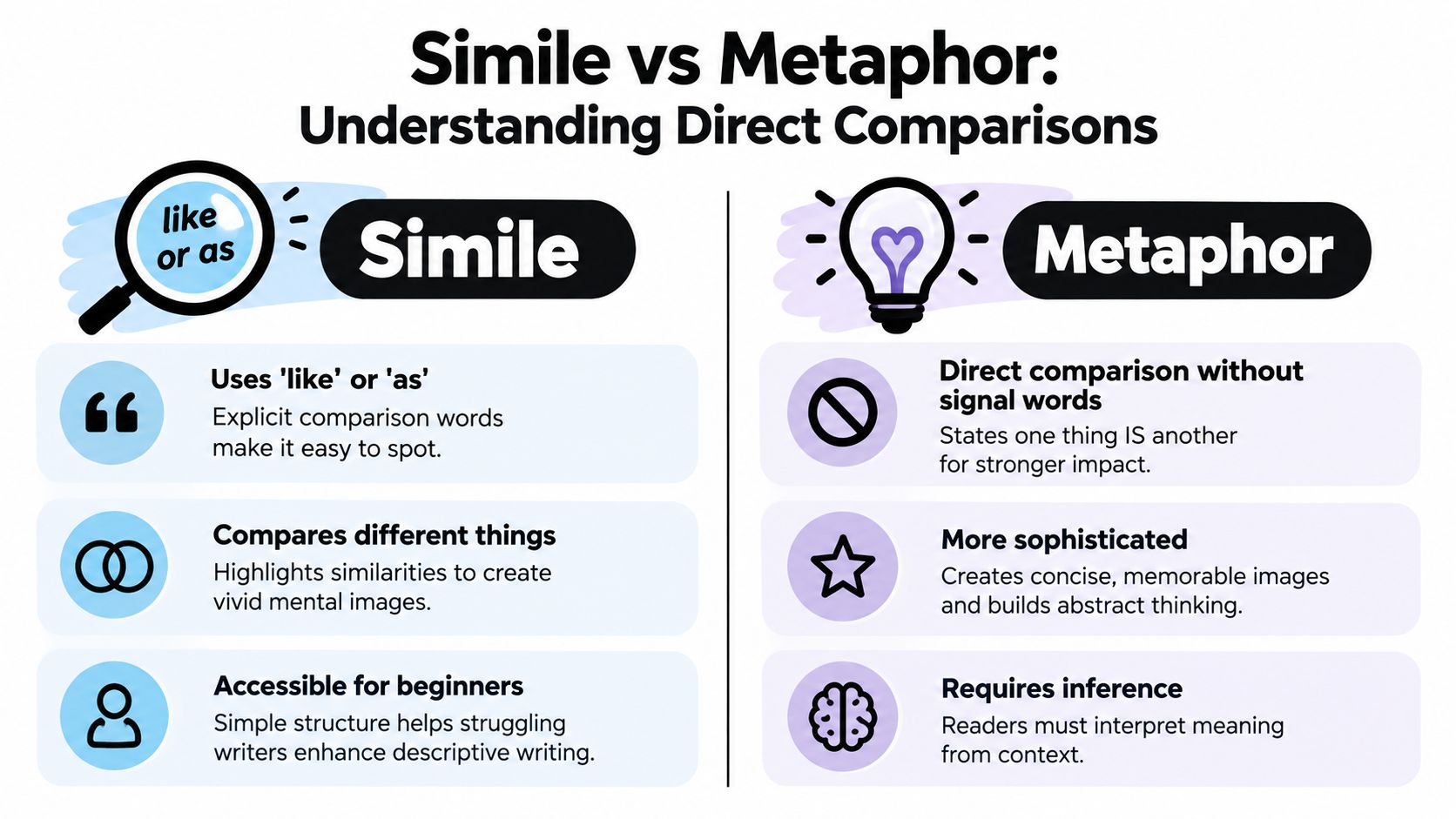
A simile is the best starting point because students can hear the comparison right away. The signal words like and as give them a visible handle. That matters in figurative language middle school lessons because many students need a clear bridge from literal thinking to figurative thinking.

Try examples that connect to subjects they already know. “Her smile was like sunshine breaking through clouds” works in descriptive writing. “Atoms are like tiny solar systems” works in science, as long as students also discuss where the comparison helps and where it breaks down. In history, “The Roman Empire was like a giant machine with many moving parts” gives them a structure for explaining systems.
Teach simile through matching and revision
Start with literal pairs before asking for interpretation. Put one concrete thing on the board, such as locker hallway, and ask students to compare it to something familiar. They might write “The hallway was like a beehive at lunch.” Then ask the class what the simile suggests: noise, movement, crowding, and energy.
Practical rule: If students can explain both sides of the comparison, they're ready to write their own.
A strong lesson sequence looks like this:
- Identify: Students highlight the words like or as in short passages.
- Interpret: Students explain what quality is being compared.
- Create: Students write one simile for a science, history, or narrative topic.
- Revise: Students replace weak comparisons such as “cold as ice” with more precise ones.
For a quick planning shortcut, you can draft differentiated practice with Teacher Planner's Lesson Plan Generator. It's useful when you want one version for whole-class modeling and another for independent practice.
When similes strengthen student writing
Similes help most when students need clarity, not just decoration. A science explanation can use one to introduce a new concept. A personal narrative can use one to sharpen a sensory detail. A history paragraph can use one to summarize how a system functioned.
Assessment should stay short. Ask students to sort three examples into “clear and helpful” or “forced and vague,” then justify one decision in a sentence. That check tells you whether they understand purpose, not just terminology.
2. Metaphor
A metaphor asks students to make a bolder move. The comparison is no longer announced with like or as. The writer states the idea directly.
That shift can confuse middle school students at first. Some will read the sentence exactly as written and stop there. Others will spot the comparison but struggle to explain why it works. A good lesson slows that down and treats metaphor as the next step after simile, not as a separate vocabulary word to memorize.
Put one pair on the board: “The classroom was like a circus.” Then, “The classroom was a circus.” Students usually hear the change right away. The second sentence feels stronger because it does more than compare. It interprets.
Move from naming to meaning
Students often can spot a metaphor before they can explain it. A simple scaffold helps. Use three boxes instead of a definition-only worksheet:
- What is the subject?
- What image replaces it?
- What qualities do they share?
For example, in “The cell is a factory,” students can identify the subject as cell, the image as factory, and the shared idea as many parts working together to do specific jobs. That same frame transfers well across subjects, which matters if you want figurative language practice to show up outside ELA.
A few classroom-ready examples:
- Science: “The circulatory system is a highway.”
- History: “The Bill of Rights is a shield.”
- ELA: “Words are tools.”
This is also a strong point in your figurative language sequence to build reusable materials. In Teacher Planner's Lesson Plan Generator, you can map one metaphor lesson into four pieces: a mini-lesson, a guided practice sheet, a quick exit ticket, and a short writing prompt for another subject area.
A lesson sequence that reduces guesswork
Metaphor works best when students move from concrete to abstract. Start with examples they can picture easily, then shift to content-area ideas and theme-based writing.
A useful sequence looks like this:
- Model: Read a short sentence or passage and explain the comparison out loud.
- Sort: Give students a mix of literal statements and metaphors to categorize.
- Explain: Have them complete the three-box scaffold for each metaphor.
- Write: Ask for one original metaphor connected to current class content.
- Translate: Partners rewrite each metaphor in plain language to prove understanding.
The translation step matters. If a student writes “Hope is a candle,” a partner should be able to explain that the metaphor suggests light, guidance, or persistence in darkness. If they cannot, the comparison may be too vague.
When metaphor strengthens student writing
Metaphor helps when students need compression and emphasis. One clear metaphor can do the work of several flat descriptive sentences. It is often the better choice when a student wants the line to sound confident, reflective, or memorable.
It weakens writing when the image is random, mixed, or disconnected from the topic. “Her ideas were a wildfire boat” gives you a useful teaching moment because the images do not work together. Students need to see that strong figurative language is not just creative. It is coherent.
For a quick formative check, give students three metaphors and ask them to rank them from strongest to weakest, then defend one choice in a sentence. That tells you who can judge effectiveness, not just identify the term.
3. Personification
Students usually enjoy personification because it feels playful, but it also does serious academic work. It helps them talk about systems, forces, and abstract ideas in memorable ways. Once they've handled simile and metaphor, personification gives them a focused form of figurative thinking.

Begin with obvious examples: “The stars danced,” “The wind whispered,” or “The alarm clock screamed.” Then move toward subject-based examples such as “The virus attacked the immune system” or “The Great Depression swallowed the nation whole.” Students quickly notice that academic language already uses personification all the time.
Turn literal sentences into living language
One effective mini-lesson is sentence transformation. Write a plain sentence such as “Rain fell all night.” Then revise it together: “Rain tapped at the windows all night.” Ask students what changed. They'll usually notice movement, mood, and stronger imagery.
Teacher Planner's Writing Feedback tool can help you generate revision comments when students are practicing that shift from flat description to purposeful personification.
Try these scaffolds:
- Concrete first: Use animals, weather, and classroom objects before moving to freedom, democracy, or fear.
- Verb bank: Give students human actions such as whispered, argued, marched, sulked, and celebrated.
- Subject transfer: Ask students to personify a concept from the current unit, such as erosion, inflation, or justice.
When personification helps and when it distracts
Personification is useful when students need to create tone or explain an abstract force. In environmental writing, “The river clawed at the banks” gives erosion a vivid image. In historical writing, “Tension crept across the colonies” can help students express gradual change.
It becomes distracting when every sentence performs. If every object in a paragraph laughs, cries, dances, and shouts, students lose control of tone. Ask them to pick one or two moments where personification does real work.
A quick formative check is to give students three sentences and ask which one uses personification to sharpen meaning instead of just sounding dramatic. Their explanation will tell you whether they're learning judgment, not just labels.
4. Idiom
A student reads, “After forgetting his notes, Marcus had to think on his feet,” and pictures literal feet. That moment matters. Idioms ask students to hold two meanings at once: the words they see and the idea the speaker intends.
That makes idiom a strong fourth step in a figurative language sequence. Simile, metaphor, and personification still give students image clues. Idioms are less transparent. Students often cannot reason them out from comparison alone, so they need context, repetition, and discussion.
Teach idioms through situations, not lists
A list of isolated phrases turns idioms into trivia. A short scene turns them into language students can interpret.
Try a three-part routine:
- Read the scene: “Maya forgot her lines before the play. Her friend said, ‘Take a deep breath. You've got this. Break a leg.’”
- Paraphrase the meaning: Students restate the idiom in plain language.
- Name the clue: Students point to the part of the scene that helped them infer the meaning.
This works like teaching a word problem in math. Students need the setting, not just the terms. If they can explain why an idiom fits a moment, they are more likely to use it correctly later.
A class idiom notebook can become part of your material-prep workflow. Add one phrase at a time, grouped by situation instead of alphabetically: pressure, success, conflict, illness, decision-making. In Teacher Planner, that organization makes it easier to turn the same set into a mini-lesson, a partner sort, a quick worksheet, or a formative check without rebuilding materials each time.
Build interpretation before production
Students usually need to understand idioms before they write with them. A simple progression helps:
- Match meaning to context: Which sentence shows hit the books correctly?
- Sort by use: Which idioms fit school, sports, family conflict, or encouragement?
- Revise dialogue: Replace a flat response with an idiom that sounds natural.
- Write original lines: Create a short exchange where the phrase fits the speaker and situation.
That order matters. Production is harder than recognition. If students jump straight to writing, many will force phrases into sentences that sound unnatural.
One quick check works well: give students an idiom and three possible situations. Ask them to choose the best fit and justify it in one sentence. Their explanation shows whether they understand usage, not just definition.
Support multilingual learners and literal thinkers
Idioms can confuse strong readers, especially in mixed-ability classrooms. A student may know every individual word and still miss the meaning because the phrase depends on shared cultural use.
Use visuals, plain-language paraphrases, and contrast sentences. For example:
- Literal: “Jalen was nervous and had to respond quickly.”
- Idiomatic: “Jalen was nervous and had to think on his feet.”
Then ask, “What does the idiom add here?” Students often notice voice first. Later they can discuss tone, character, and audience.
When idioms improve writing
Idioms help most in dialogue, narrative voice, and character development. They can make a speaker sound informal, regional, relaxed, frustrated, or confident in just a few words.
They weaken writing when students drop them into formal explanation or analytical paragraphs without a clear purpose. “The treaty was a piece of cake” makes historical writing less precise, not more precise. A useful classroom question is simple: Would a real person say this here, and does this genre allow that voice?
That question turns idiom from a glossary item into a writing decision. It also helps you place idiom lessons at the right point in your sequence: after students can recognize obvious figurative meaning, but before they begin revising for voice across subjects.
5. Hyperbole
Students know exaggeration instinctively. They say a backpack weighs a thousand pounds or that a homework assignment takes forever. That familiarity makes hyperbole easy to introduce, but students still need help deciding when exaggeration adds voice and when it undercuts credibility.
The cleanest starting point is contrast. Put a literal sentence next to a hyperbolic one: “I was tired” versus “I could've slept for a year.” Then ask what the second version adds. Usually the answer is emphasis, humor, or emotion.
Teach degree and purpose
Hyperbole works best when students see it as a scale, not an on-off switch. A sentence can be mildly exaggerated, strongly exaggerated, or so overdone that it becomes nonsense. That's useful in revision because students can test how much is enough.
Give students a plain sentence like “The cafeteria was noisy.” Ask them to rewrite it three ways:
- slightly exaggerated
- strongly exaggerated
- too exaggerated
That small shift builds judgment fast.
Connect hyperbole to audience
Hyperbole belongs in some genres more than others. It often works in personal narrative, poetry, speeches, satire, and advertising analysis. It usually doesn't belong in a lab conclusion or evidence paragraph unless students are deliberately studying voice.
A useful writing conversation is not “Is this hyperbole?” but “Does this level of exaggeration fit the task?” Students need that question because many of them overuse dramatic language once they learn the term.
One current gap in instruction is moving from recognition into writing. A 2025 study with eighth graders reported writing-score improvement from 59.5 to 70.67 after explicit figurative-language instruction in a pre-test/post-test design, and the authors noted that figurative-language use in writing remains underexplored at this level in the study on junior high writing and figurative language. Hyperbole is a good place to address that gap because revision is visible.
Use quick assessments that ask students to choose the best context for a sentence. “I'm so hungry I could eat a horse” might fit dialogue in a narrative. It doesn't fit a formal explanation of nutrition. That kind of decision-making is more valuable than another definition quiz.
6. Oxymoron
Oxymoron is where students start seeing that figurative language can hold tension instead of just painting a picture. Phrases like “deafening silence” and “bittersweet” force them to think about how opposite ideas can sit together and still make sense.
This device often belongs later in the sequence because students need confidence with simpler comparisons first. If simile and metaphor teach similarity, oxymoron teaches layered contradiction.
Use contradiction as a thinking tool
Start with familiar examples: pretty ugly, seriously funny, act naturally. Ask students why people use them. The answers usually move beyond “because it sounds cool.” Students notice that contradiction can express mixed emotion, irony, or a more precise reality than either word alone.
Then move into texts. In a poem, “deafening silence” might capture tension before bad news. In a memoir, “cruel kindness” might suggest a difficult truth someone needed to hear.
Contradiction often reveals complexity. That's why oxymoron works well in literature discussion and reflective writing.
Keep the writing purposeful
Students like inventing oxymorons, but random pairings don't help much. “Square circle” is contradictory, but it doesn't create useful meaning. “Bittersweet ending” does because readers understand the emotional blend.
Try a short routine:
- Collect: Students find oxymorons in songs, poems, titles, or everyday speech.
- Explain: They write what each phrase means in regular prose.
- Apply: They use one in a literature response or reflective paragraph.
- Revise: They remove any pair that feels forced.
This is also a good place to talk about precision. Students sometimes think figurative language always means more dramatic writing. Oxymoron proves the opposite. Sometimes two carefully chosen words do more than an entire overexplained sentence.
Across content areas, oxymoron fits best where students are analyzing tension, complexity, or conflicting perspectives. It can sharpen a character analysis, a response to a historical turning point, or a personal essay about mixed feelings.
7. Alliteration
Alliteration brings students back to sound, but with more control than simple rhyme games. It's the repetition of beginning consonant sounds in nearby words, and it helps students hear how writers make language memorable. That makes it useful not only in poetry, but also in speeches, slogans, headlines, and student presentations.
Because the pattern is audible, alliteration gives struggling readers and multilingual learners an accessible entry point. They can often hear it before they can define it.
Hear it before naming it
Read a few examples aloud: “Peter Piper picked a peck of pickled peppers.” “Silver snakes slither.” “Wild winds whipped the water.” Ask students what they notice. Most will identify the repeating beginning sound even if they don't remember the term.
Then connect it to real-world language. Brand names, chants, and public speaking often use alliteration because repetition sticks in memory. That's a strong reason to teach it across subjects, not only in poetry notebooks.
For ready-to-edit practice sets, Teacher Planner's Worksheet Generator can help you create activities tied to current vocabulary, such as ecosystems, revolutions, or geometry terms.
Make it useful, not just cute
The risk with alliteration is that it can become a novelty exercise. Students produce tongue twisters, everyone laughs, and the lesson stops there. Push one step further by asking when repeated sounds create emphasis or tone.
Try these options:
- Poetry line building: Students write one line that sounds calm, tense, or playful.
- Speech craft: Students revise a claim so it sounds more memorable when spoken aloud.
- Content vocabulary: Students build a phrase with unit words, such as “fractions, factors, and formulas.”
A useful formative check is to give students three lines and ask which one uses alliteration effectively rather than accidentally. They should point to the sound pattern and the effect. That helps distinguish intentional craft from coincidence.
Alliteration strengthens writing when students want rhythm, emphasis, or a memorable phrase. It weakens writing when every word begins with the same letter and meaning starts to wobble. Students should feel that tradeoff early.
8. Onomatopoeia
Onomatopoeia is often taught in elementary grades, but middle school students still benefit from using it intentionally. The difference is that older students can move past comic-book examples and think about sensory writing, pacing, and sound-based word choice.
Words like buzz, hiss, clang, sizzle, and thud do immediate work. They don't just tell readers that sound exists. They help readers hear the scene.
Move from comics to crafted description
Start with familiar examples from graphic novels or comics: Pow! Boom! Splash! Then raise the level with prose examples such as “The creek gurgled over the rocks” or “The bacon sizzled in the pan.” Students can hear how the sound words shape mood.
If you want a simple visual scaffold, build a sound wall. Group words by category:
- nature sounds
- machine sounds
- action sounds
- animal sounds
That organization helps students choose more precise sound words in their own writing.
Use onomatopoeia in narrative revision
This device works well in revision because students can compare before and after versions. “The pan made noise” becomes “The pan sizzled.” “The door closed” becomes “The door slammed.” The sentence gets sharper right away.
A broader planning gap in figurative-language instruction involves learners who need more explicit, visual, and systematic teaching. A 2025 scoping review on autistic learners reported that figurative-language deficits are responsive to intervention and that successful programs consistently used explicit teaching, visualization of abstract concepts, and systematic practice across diverse examples in the review on figurative-language intervention supports. Onomatopoeia is a useful device for that kind of instruction because the sound-to-word link is concrete.
Give students a brief action scene and ask them to revise only the sound words. That narrow focus keeps the task manageable. It also helps you assess whether they can choose words for effect rather than just spotting them in isolation.
8-Point Comparison: Middle School Figurative Language
| Device | Implementation complexity | Resource requirements | Expected outcomes | Ideal use cases | Key advantages |
|---|---|---|---|---|---|
| Simile | Low, explicit signals ("like"/"as") | Minimal, examples, simple prompts | Clear analogies; vivid imagery | Descriptive writing; cross-curricular explanations | Easy to teach and identify |
| Metaphor | Medium, implicit comparison, needs inference | Minimal–moderate, guided analysis, examples | Strong, concise imagery; promotes abstract thinking | Poetry, conceptual explanations, advanced writing | More powerful and memorable than similes |
| Personification | Low–Medium, assign human traits to nonhuman things | Minimal, examples, visuals, modeling | Relatable descriptions; emotional engagement | Narrative, poetry, explaining abstract concepts | Increases empathy and vividness |
| Idiom | Medium, culturally specific, needs context | Moderate, cultural explanations, corpora, ELL supports | Authentic language use; improved reading sophistication | Dialogue, reading comprehension, cultural lessons | Teaches natural language and voice |
| Hyperbole | Low, obvious exaggeration | Minimal, examples, practice distinguishing literal vs. exaggerated | Emphasis, humor, rhetorical impact | Persuasive writing, advertising, informal voice | Grabs attention and emphasizes points |
| Oxymoron | Medium–High, juxtaposes opposites, needs analysis | Moderate, examples, discussion, analysis tasks | Highlights paradox; develops higher-order thinking | Poetry, literary analysis, advanced figurative units | Creates striking, thought-provoking phrases |
| Alliteration | Low, sound-based repetition | Minimal, phonics activities, tongue twisters | Rhythm, memorability, phonological awareness | Poetry, speeches, marketing, phonics lessons | Enhances sound awareness and retention |
| Onomatopoeia | Low, sound imitation | Minimal, audio/examples, comics, sound walls | Immediate sensory connection; vivid sound imagery | Graphic novels, descriptive scenes, phonics | Intuitive and engaging; links sound to meaning |
Build a Reusable Figurative Language Toolkit
A strong figurative language middle school sequence doesn't need to feel huge. It needs to feel ordered. Start with devices students can hear and see easily, such as simile, alliteration, and onomatopoeia. Move into more interpretive comparisons like metaphor and personification. Then ask students to handle context, tone, and contradiction with idiom, hyperbole, and oxymoron.
That sequence lines up with how standards have treated figurative language as a recurring literacy outcome across multiple grade levels, not a single short unit. It also matches what many classrooms need most. Students don't just need more definitions. They need repeated chances to read, explain, try, and revise.
A reusable toolkit has a few dependable lesson types:
- Short context passages: Better than isolated sentences when you want students to infer meaning.
- Literal versus figurative sorting: Useful for simile, metaphor, idiom, and hyperbole.
- Sentence revision tasks: Strong for personification, hyperbole, and onomatopoeia.
- Cross-curricular prompts: Helpful when you want transfer into science, history, and health.
- Purpose checks: Ask when a device strengthens meaning and when it feels forced.
Assessment should also build in layers. Identification is the starting point, not the finish line. A student who can circle an idiom may still miss its meaning. A student who can define metaphor may still write confusing comparisons. Better checks ask students to paraphrase, explain effect, choose the best option for a genre, or revise a weak sentence into a stronger one.
Research on intervention design also points toward explicit teaching, visuals, and systematic practice for students who need more support, rather than broad one-pass coverage. That matters in mixed-ability classrooms, where one worksheet on “all the figurative language types” often creates confusion instead of transfer. Narrower practice, repeated over time, tends to produce better discussion and clearer student writing.
If you want to keep the sequence organized across a quarter or semester, map each device into a progression with room for retrieval practice and writing application. One week might center on identification in reading. The next might shift to sentence combining and short constructed responses. A later week might revisit the same device in poetry, informational text, or argument writing.
Teacher Planner can support that workflow in practical ways. You can map the sequence in the Unit Timeline, draft editable worksheets or quizzes, save materials that worked, and use the Standards Tracker to review coverage before the unit ends. That doesn't replace teaching judgment. It helps you keep the materials and sequence manageable when schedules change.
The best result is simple. Students stop asking, “Which kind is this?” and start asking, “Why did the writer choose it?” That's when figurative language becomes part of reading and writing, not just a quiz topic.
Teacher Planner gives you one place to organize lesson sequences, generate editable classroom materials, and adjust plans when your week shifts. If you're building a figurative language middle school unit, you can map the progression, create practice tasks, and save what works for next time. Visit Teacher Planner to see how it fits your planning workflow.