
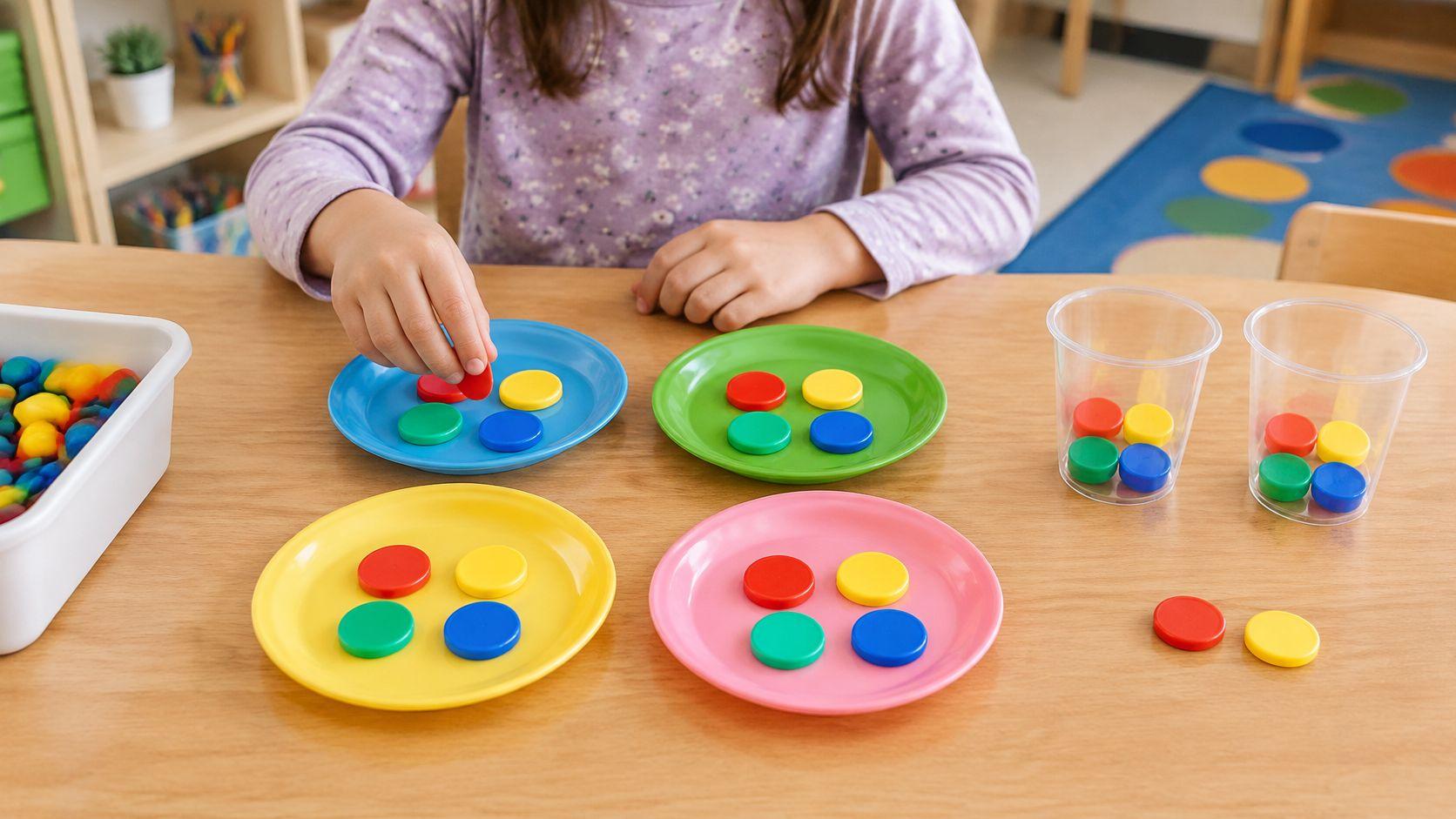
A child writes 24 ÷ 4 = 6, then can't say whether the 6 means six friends, six packs, or six stickers for each friend. That gap is the starting point for division concepts for kids. Division means splitting a total into equal shares or into equal groups, and children need to tell those two stories apart before symbols, facts, or long division will make sense.
Two Meanings of Division Children Must Learn
Consider this illustrative classroom scenario. A child has 24 stickers and four friends and asks how many stickers each friend gets. That's equal sharing. The child doesn't know the size of each share yet, so dealing stickers one at a time makes the answer visible.
Now change only the story. The same 24 stickers go into packs of four, and the question becomes how many packs can be made. That's equal grouping. Both stories use 24 ÷ 4 = 6, but one 6 counts stickers per friend and the other counts packs, so a correct number alone doesn't prove understanding.

| Model | Story question | Example | Concrete picture |
|---|---|---|---|
| Equal sharing | How many in each share? | 24 stickers shared among 4 friends gives 6 each | 4 paper plates, dealt one sticker at a time |
| Equal grouping | How many groups can we make? | 24 stickers in groups of 4 gives 6 groups | 6 cups with 4 counters in each |
| Multiplication check | What number times 4 makes 24? | 4 × 6 = 24 | An array with 4 rows of 6 dots |
The Common Core State Standards for Operations and Algebraic Thinking place formal interpretation of whole-number division in Grade 3, where 56 ÷ 8 can mean distributing 56 objects among 8 shares or making groups of 8 from 56 objects. Grade 3 students also solve multiplication and division word problems within 100 using equal groups, arrays, and measurement quantities.
Division undoes multiplication, so 24 ÷ 4 also asks what number times 4 makes 24. That unknown-factor view gives children a check they can explain, not just an answer to recall. Teachers building story practice can adapt ideas from a word problem maker guide, then ask children to retell each story in their own words before writing symbols.
Words Children Use for Division
Children need usable words before formal terms. Start with share, each, equal, group, how many groups, and left over, and pair every word with an action children can perform and point to.
Words Paired With Actions
- Share: Deal one item at a time to each plate until the total runs out.
- Group: Fill a cup or pack until it holds the set number, then start another.
- Each: Point to one plate, cup, or pack and count only what's inside it.
- Equal: Compare two shares side by side and confirm the counts match.
- Left over: Set aside items that don't fill another full group.
A sentence frame keeps the story order stable. Children say, "We have ___ in all. We are making ___ equal ___. Each ___ gets ___." That frame separates the total, the known shares or group size, and the result without requiring symbols first.
Introduce dividend, divisor, and quotient only after children can explain those three parts in plain language. Keep the formal names on labeled cards beside a model rather than making them the first lesson.
For ages 5 to 7, a picture word wall works well because the image carries the action. For ages 8 to 10, written sentence frames support word problems. Before moving on, each child should match every core word to a counter model and explain the match aloud.
Build Division Understanding Step by Step

Ask a child to solve 24 ÷ 4 and watch what their hands do. One child deals counters onto four plates and counts what lands on each. Another fills cups with four counters each and counts the cups. Same equation, two different stories, and the sequence below serves both because it keeps meaning ahead of symbols at every stage.
Equal grouping and equal sharing are the two basic situations used to build understanding of multiplication and division, and learning moves from meaning toward fluency. Third-grade work centers on division within 100, while later years extend to larger numbers and remainders. The order matters because each step keeps something visible that the next step hides.
- Act it out: Share counters among plates and group cubes into equal towers. A child who skips this step can memorize facts without attaching them to any story.
- Draw the action: Use circles, dots, or tally marks for the same problem. Drawings keep the story visible after the objects go back in the box.
- Build arrays: Arrange dots in rows and columns, then link repeated addition to multiplication. One array shows a share and a group in the same picture.
- Connect fact families: Write 3 × 8 = 24, 8 × 3 = 24, 24 ÷ 8 = 3, and 24 ÷ 3 = 8. Without this link, multiplication and division feel unrelated, and unknown-factor problems become harder to solve.
- Jump on a number line: Make equal jumps from 0 to 24 and count the jumps. Equal lengths make the groups clearer than piles do.
- Write and name the equation: Label the total, the number in each group or share, and the result. The symbols arrive last because they only compress a story the child can already tell.
Fading support is what makes the sequence work. Help is removed only as each model becomes secure, the same gradual-release idea behind the benefits of scaffolding for children. A child is ready to move on when they can name which story they are solving, explain one problem in both sharing and grouping language, and build its array without help.
Hands-On Models That Make Sharing and Grouping Visible
Each model reveals a different part of division's structure, so no single model suits every child or every story. The table below matches four common models to the meaning they show best.
| Model | Best for | How it shows 24 ÷ 4 | Watch for |
|---|---|---|---|
| Counters and plates | Sharing, ages 5 to 7 | Deal 24 counters one at a time to 4 plates, then count each plate | Children counting the plates instead of the counters on one plate |
| Arrays | Grouping and the multiplication link, ages 7 to 9 | Arrange 24 dots in 4 rows of 6 and read the row count | Mixing up rows and groups |
| Bar models | Word problems, grades 3 to 5 | Draw one bar of 24 units split into 4 equal parts | Unlabeled parts or bars that are not equal |
| Number-line jumps | Grouping and skip counting, ages 7 to 10 | Make equal jumps of 4 from 0 to 24 and count the jumps | Counting the points instead of the jumps |
Setting Up a Station That Works the Same Day
- Keep quantities small: Stay under 30 items for ages 5 to 7 so counting doesn't crowd out the division idea.
- Sequence the models: Use arrays once children can count rows and columns reliably, then introduce bar models with drawn tape for grades 3 to 5 word problems.
- Stock one 20-minute station: Provide counters, paper plates, dry-erase grids, and one card holding a sharing task and a grouping task with the same numbers.
- Rotate before choosing: Use one model per lesson for three lessons, then let children choose a model and defend the choice.
One frequent error is counting groups by ones instead of counting what's in a share. The correction is physical. Ask the child to point to one share, circle it, and count only inside that boundary before counting anything else.
Start a child who has never handled division with counters for sharing, then move to arrays for grouping once sharing feels secure.
That order works because dealing objects to plates is an action most children already understand from everyday sharing. Arrays then add structure, showing rows, columns, and the multiplication connection at the same time. Bar models and number lines come later because both require children to trust a drawing instead of moving objects.
Telling Group Size From Number of Groups
Two different stories can hide inside one equation. Partitive division finds the size of each group, as when 24 cards are dealt to four hands and the question asks how many cards each hand holds. Quotative or measurement division finds how many groups fit, as when hands of four cards are filled from 24 until none remain. Both stories produce 24 ÷ 4 = 6, which is exactly why a correct answer can hide a misread story.

A recent teaching experiment on the two division interpretations found that most children could interpret a simple cube model both ways, yet some still experienced conceptual and language difficulties. Adults therefore can't assume the distinction is obvious just because the arithmetic looks easy.
Are we finding the group size or the number of groups?
That single question does more diagnostic work than another page of calculations. It forces attention back to the story, where the confusion lives. The answer also predicts which model a child will draw: shares that each receive items, or containers that each hold a fixed count.
Three Diagnostic Prompts
- Story check: Is anything being shared, or are groups being made?
- Unit check: Does the answer count items in each group, or does it count the groups themselves?
- Model check: Can the child build the story with cubes and show what the answer counts?
A short paired activity makes the difference concrete. Give a child one set of cubes and two word problems using identical numbers, one asking for group size and one asking for number of groups. The child builds each story separately, labels what each answer counts, and only then writes the equation they share.
Checking meaning this way matters because computation and comprehension are separate skills. A child can recall that 24 ÷ 4 equals 6 and still describe packs when the story asked about friends. Catching that gap before procedures take hold is far easier than untangling it afterward, once a child has practiced the wrong interpretation many times.
Deciding What to Do With Remainders
A remainder is a decision, not just a leftover number. Depending on the story, it may be kept as a remainder, rounded down, rounded up, or expressed as a fraction or decimal. Teaching only "what's left over" leaves children unprepared for problems involving people, containers, money, or measurements.
| Context | Question to ask | Answer form | Illustrative example |
|---|---|---|---|
| Vans for a field trip | Does a partial group still need a van? | Round up | 17 students, 5 per van: 4 vans |
| Cookies for children | Can the leftover be shared? | Fraction | 17 cookies, 5 children: 3 2/5 each |
| Full pencil boxes | Is a partial box useful? | Keep as remainder | 17 pencils, boxes of 5: 3 full boxes and 2 left |
| Turns on a timer | Does the leftover make a turn? | Round down or keep as time | 17 minutes, 5-minute turns: 3 turns and 2 minutes left |
| Ribbon for craft pieces | Can each piece be a decimal length? | Decimal | 17 feet of ribbon, 5 pieces: 3.4 feet each |
The need for varied answer forms isn't only a student issue. A 2025 study of division with remainders found that 92.3% of participating elementary teachers relied on one standard written method for division with remainders. When instruction leans on a single method, children get little practice deciding what an answer should look like.
A Four-Step Remainder Routine
- Read the story first: Name what's being divided and what the groups represent before calculating.
- Decide about partial groups: Determine whether a partial group counts, needs its own container, or can be split further.
- Match the answer form: Write a rounded number, remainder, fraction, or decimal that fits the context.
- Explain in one sentence: State why that form makes sense in real life, such as "The last 2 students still need a van."
Teachers who want varied practice sets can plan them alongside a division worksheet maker workflow, provided each problem demands a different remainder decision. A strong classroom check gives one story per remainder action, then asks children to justify each choice aloud before any answer is marked correct. That justification, not the digit after the "r," shows whether the concept is secure.
Plan Your First Division Lesson and Check It
The following illustrative 35-minute lesson suits a class of 8- to 9-year-olds working with 12 counters. It teaches both meanings in one session so children compare them while the numbers stay familiar. Because 12 ÷ 3 produces no leftover, every decision in the session stays on the sharing-versus-grouping question. Remainder lessons come later, with numbers like 17 ÷ 5.
- Warm-up, 5 minutes: Skip count by 3 to 30 together. This primes the grouping work that follows.
- Sharing, 10 minutes: Children share 12 counters among 3 plates and state how many each plate gets, using the sentence frame.
- Grouping, 10 minutes: Children rebuild the same 12 counters into groups of 3 and count how many groups form.
- Word problem, 5 minutes: Children draw a bar model for a story about 12 pencils in packs of 3 and label each part.
- Exit ticket, 5 minutes: Two stories use the same numbers, one sharing and one grouping, and children identify which is which. Teachers adapting pacing for younger classes can compare formats in lesson plans for second graders, and game-based approaches to checking understanding offer low-stakes ways to run that final check.
Review Checklist
- Both meanings taught: Sharing and grouping appear as separate stories, not one merged idea.
- One equation, two questions: Children can say that 12 ÷ 3 answers "how many in each group" in the sharing story and "how many groups" in the grouping story.
- Two models used: At least two of counters, arrays, bar models, or number-line jumps appear.
- Child explanation included: Every child explains one answer in their own words and names what it counts.
- Exit ticket covers both meanings: The ticket shows sharing and grouping side by side.
A teacher can draft this sequence in Teacher Planner's Lesson Plan Generator, which drafts a plan based on the user's topic, learning objectives, or standards. Generation limits apply, and every AI draft needs teacher review before use. The draft is a starting point for editing, not a finished lesson.
Teachers ready to turn this sharing and grouping sequence into a scheduled, editable plan can draft it in Teacher Planner's browser-based planbook alongside its lesson, worksheet, and quiz tools. Visit Teacher Planner to build the first division lesson, review the draft against the checklist above, and adjust it for the class in front of them.