
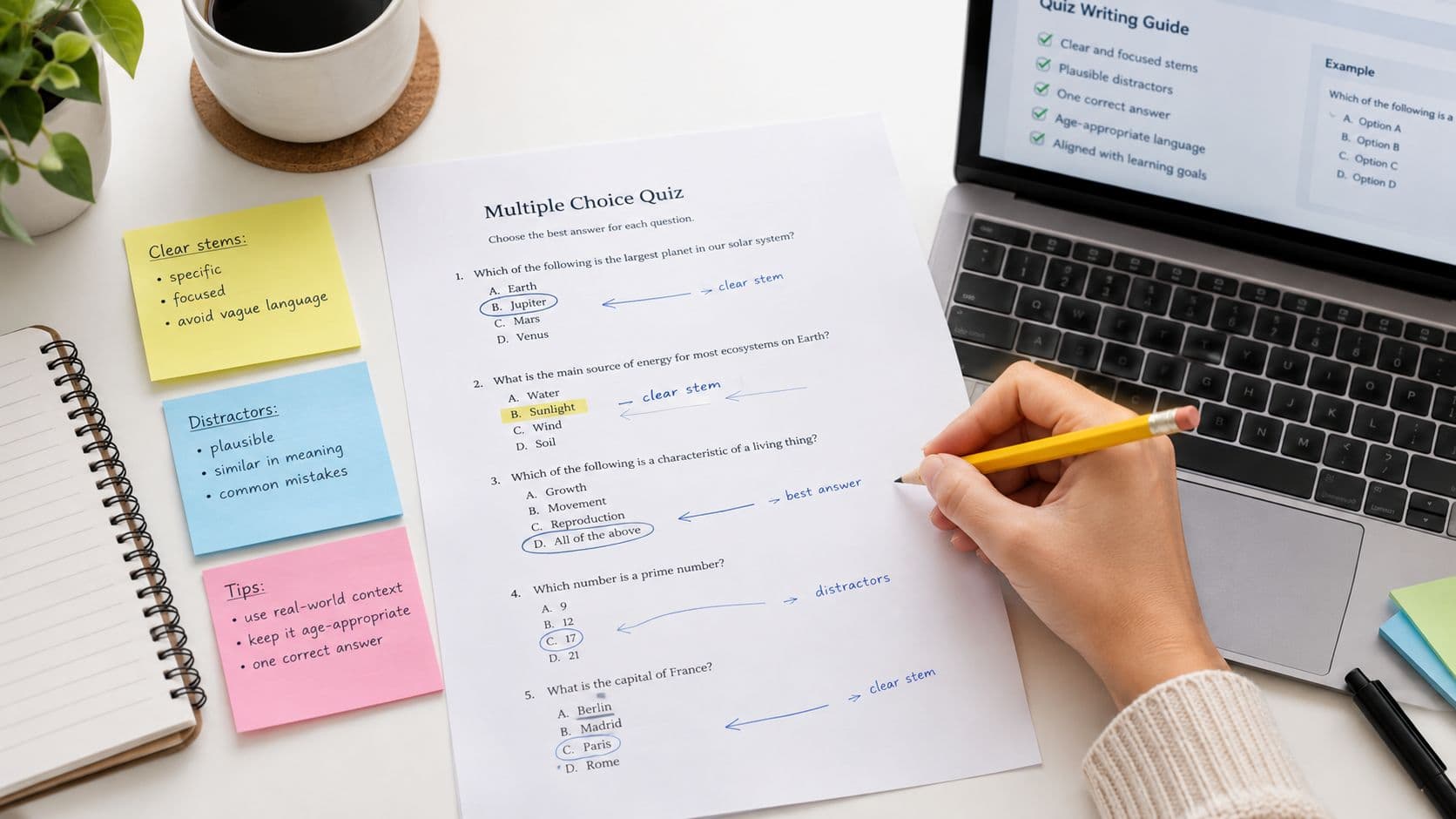
You hand back a science quiz and see a familiar pattern. Students who explained the lesson clearly in discussion miss questions because the stem is crowded, the answer choices are uneven, and one option practically announces itself as correct. The quiz was meant to check understanding, but it ends up checking who can decode awkward prose fastest.
Good multiple choice questions design prevents that problem before students ever see the page. The practical standard is simple: each item should give students a fair chance to demonstrate the knowledge or reasoning you taught, while the wrong answers should reveal meaningful misunderstandings rather than careless test-taking.
Why Your Quiz Feels Like a Reading Test Instead of a Knowledge Check
A student in your class may understand evaporation, condensation, and the water cycle. Then the quiz asks:
Which of the following statements most accurately describes the meteorological process by which water vapor, having undergone a reduction in thermal energy, transitions into a liquid state?
The student has to unpack “meteorological process,” “reduction in thermal energy,” and “transitions into a liquid state” before answering a question that could have said, “What happens when water vapor cools?”
That extra language changes the task. You may think you're measuring science knowledge, but you're also measuring vocabulary, sentence processing, and tolerance for clutter. Guidance on higher-order multiple-choice items makes the same distinction: questions can assess application and analysis, but excessive wording and complex stems can increase reading load and distort what the item measures (recent guidance on cognitive demand and reading load).
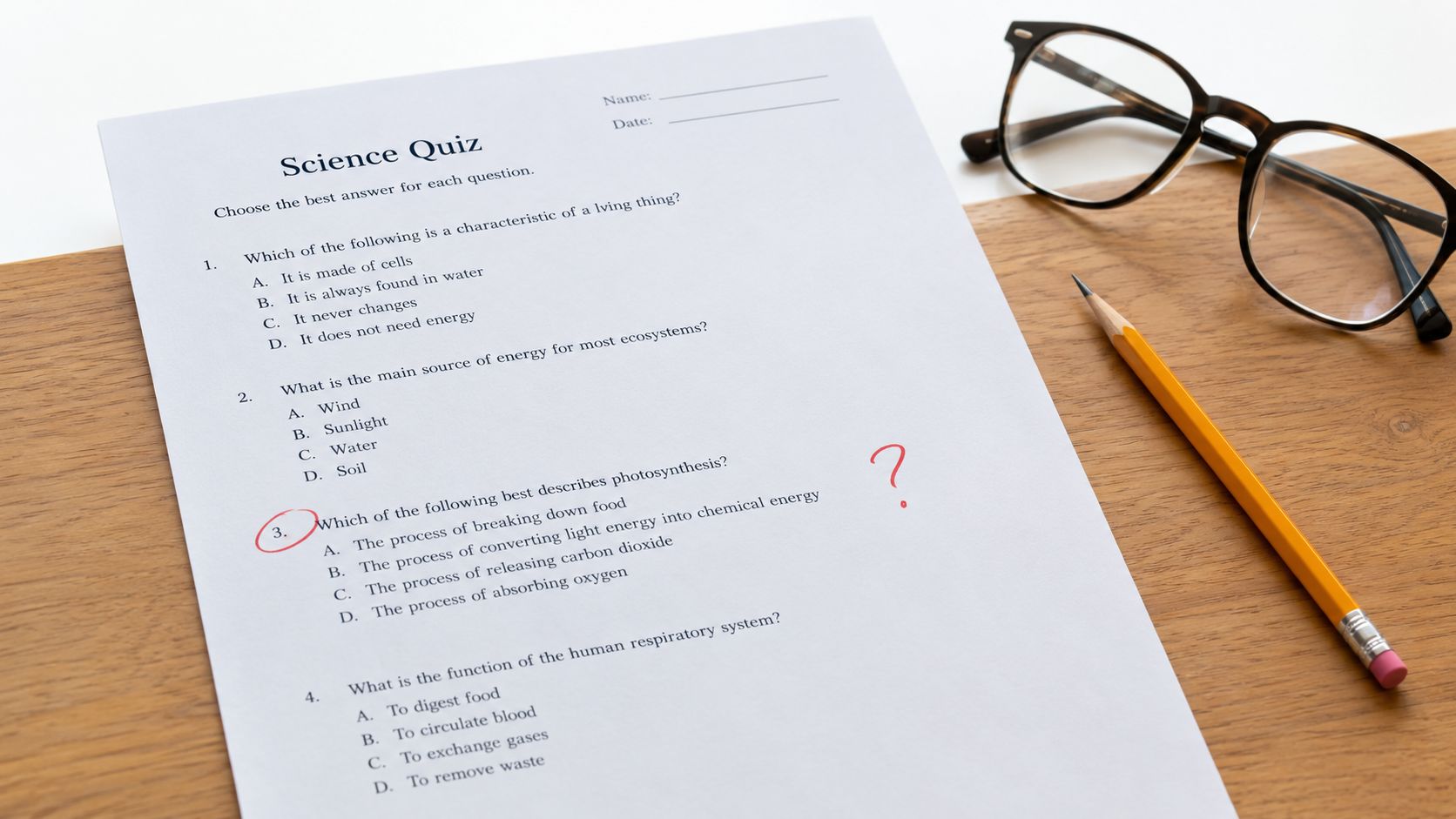
The quiz problem teachers often miss
Suppose the options are:
- Water changes from a gas to a liquid.
- Water changes from a liquid to a gas.
- Water changes from a solid to a liquid.
- Water evaporates because it becomes colder.
The first option is longer and more precise than the others. The last option is scientifically awkward. A test-wise student can eliminate choices without knowing the water cycle. That item rewards option analysis instead of subject understanding.
The history of multiple-choice testing helps explain why teachers still use the format. Frederick J. Kelly's silent reading test, first published in 1915, is widely cited as an early modern origin point. By the mid-1920s, the College Board had added multiple-choice questions to the SAT, and by 1930 the format was firmly established in U.S. schools because it allowed large groups to be scored efficiently and objectively (history of multiple-choice testing).
Efficiency is useful, but it doesn't excuse poor construction. A clean item has one clear task, options that look as if they belong together, and a correct answer that students must earn through knowledge or reasoning. A weak item asks students to spot grammar clues, identify the longest option, or guess what the teacher meant.
Practical rule: If a student can get the item right without knowing the lesson, revise the item. If a student can get it wrong because of unnecessary wording, revise the stem.
Building Stems That Let Students Show What They Know
Start with the learning objective, not the answer choices. If the objective is “explain why shadows change length during the day,” the stem should ask students to explain or apply that idea. It shouldn't ask them to recognize a rare synonym for “position.”
A reliable stem should function as a complete question or statement that students can understand before they read the options. Medical education guidance makes this point directly, recommending a stem that can be answered without looking at the choices first (guidance on writing stems and options).
Use a clean before-and-after revision
Weak stem:
Which of the following is not an example of something that would not cause the plant to grow more quickly?
This item contains nested negatives and forces students to track several reversals. It tests sentence management more than plant science.
Stronger stem:
Which change would not help a plant grow more quickly?
Even better, if students studied specific variables:
Which change would not increase a plant's growth in the classroom experiment?
The improved version identifies the task, removes unnecessary wording, and gives students a clear context. Use negative wording only when it serves the objective. If you must use not, bold it in a printed quiz or place it where students can see it easily.
Keep the information in the stem
Don't split the meaning of the question between the stem and the options.
Weak stem:
The character's decision was mainly based on...
- Fear
- The fact that she wanted to protect her brother
- Anger
- Confusion
The second option contains a full explanation while the others are single words. Students can detect the structurally different answer without analyzing the text.
Stronger stem:
Why did the character decide to protect her brother?
- She feared punishment from the adults.
- She believed her brother was in danger.
- She wanted to leave the town.
- She was angry about the argument.
The options now share a grammatical pattern and answer the same question. Parallel structure makes choices easier to compare and reduces unintended clues.
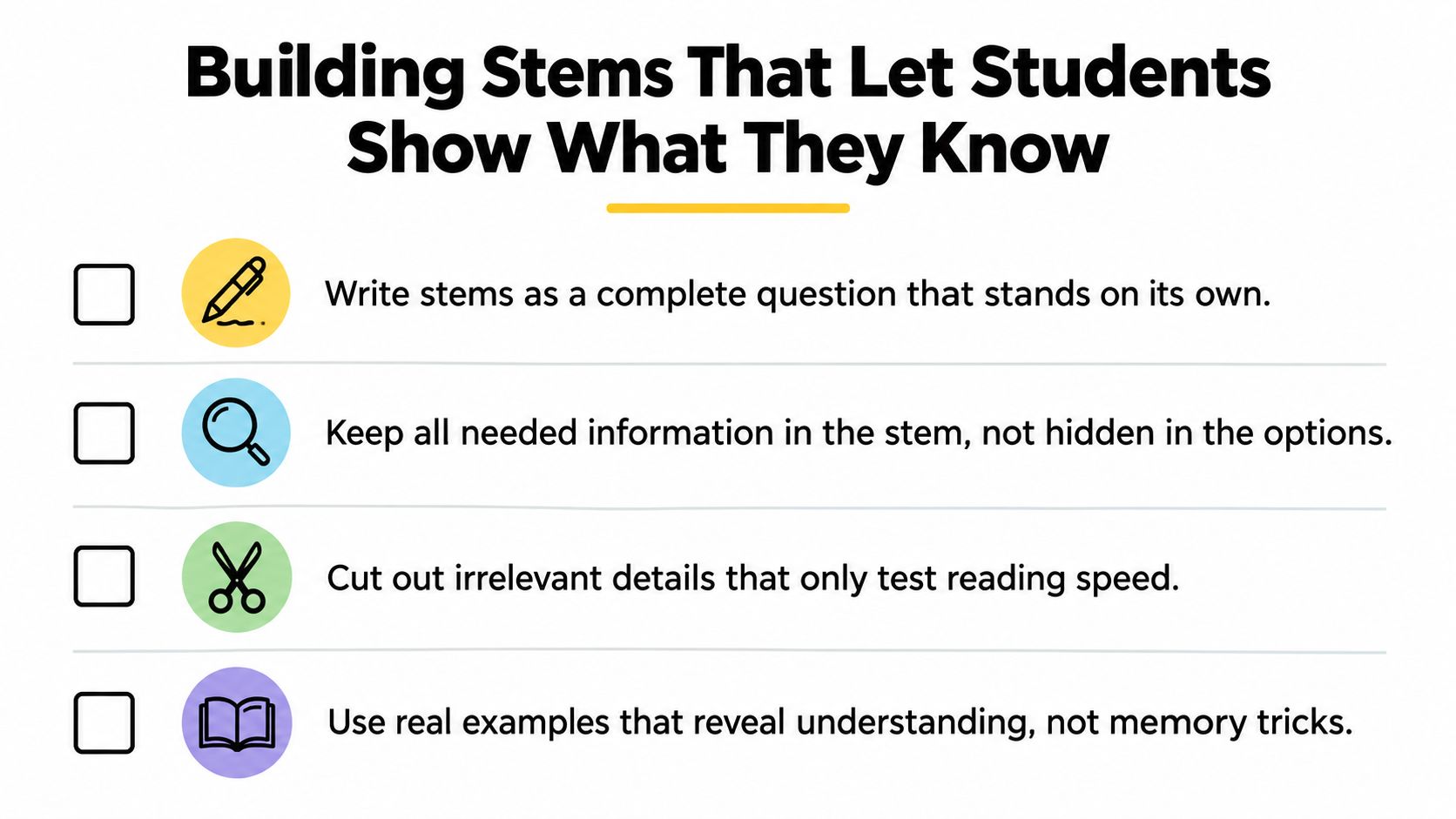
Apply this stem checklist
Before you keep an item, ask:
- Can students understand the task without reading the options?
- Does the stem contain the context needed to answer fairly?
- Have I removed details that test reading speed rather than the objective?
- Do all options complete the stem grammatically?
- Could a student eliminate an option because it is longer, more specific, or differently written?
- Does the item ask for one best answer rather than several defensible answers?
For vocabulary quizzes, clarity matters just as much. A multiple-choice vocabulary quiz workflow works better when the stem supplies a meaningful sentence and the options test word meaning in context, rather than asking students to recognize an isolated definition.
Vary the position of correct answers across the quiz, but don't use a rigid sequence. The aim isn't to create a new puzzle. It's to prevent students from relying on answer patterns instead of content knowledge.
Turning Common Misconceptions Into Credible Wrong Answers
Distractors are where many otherwise careful quizzes fall apart. Teachers write the correct answer, add one answer from a different unit, one silly answer, and one option that doesn't fit the grammar. Students then earn points for rejecting nonsense.
A better approach starts with student thinking. Look at exit tickets, notebook explanations, homework errors, lab notes, and questions students ask aloud. Those mistakes give you raw material for distractors that are wrong for a reason.
Build each distractor from an actual error
Consider this objective: students should identify why seasons change.
Correct answer:
- Earth's axial tilt changes the angle and duration of sunlight received by each hemisphere.
Possible misconceptions include:
- Earth moves much closer to the Sun in summer.
- The Sun produces more heat during summer.
- Earth's rotation causes the seasons.
Those distractors are plausible because students commonly confuse rotation with revolution or attribute seasons to distance from the Sun. They also reveal what a student may believe, which makes the item more useful after grading.
A practical workflow looks like this:
- Write the single best answer first. Make sure it is fully accurate and directly connected to the objective.
- List the errors students commonly make. Use classroom evidence rather than inventing random wrong answers.
- Turn each error into a concise alternative. Keep the options similar in length, grammar, and specificity.
- Write a rationale for every distractor. State the misconception or incorrect process it represents.
- Check that only one answer is best. Remove options that could be defended under a reasonable interpretation.
- Review performance after use. A distractor that nobody chooses may be too obvious, irrelevant, or badly written.
TIMSS item-writing guidance recommends creating a rationale for each distractor and choosing wrong answers that are close enough to be believable while remaining clearly incorrect (TIMSS item-writing guidance).
Use item analysis as a revision tool
A distractor doesn't succeed merely because it looks plausible to you. After students answer the item, examine how often each option was selected. Item-analysis guidance recommends reviewing options chosen by fewer than about 5% of examinees, since such options are often nonfunctioning and can weaken the item (item-writing and distractor analysis guidance).
The same source describes discrimination below 0.20 as often unacceptable and above 0.40 as excellent. Treat those figures as revision signals, not automatic verdicts. A young class, a small quiz, or a difficult new topic can produce noisy results, so combine the numbers with your knowledge of the lesson and student work.
| Quality Indicator | Strong Distractor | Weak Distractor | Action |
|---|---|---|---|
| Content connection | Represents a misconception from the lesson | Comes from an unrelated topic | Replace it with a real student error |
| Grammar | Completes the stem naturally | Uses a different sentence form | Rewrite it to match the other options |
| Plausibility | Sounds reasonable until the concept is applied | Is silly, extreme, or obviously false | Make the reasoning error subtle but fair |
| Selection pattern | Attracts students who hold the target misconception | Fewer than about 5% choose it | Revise or remove it after checking context |
| Specificity | Matches the level of detail in the correct answer | Is much shorter or more general | Balance length and precision |
| Diagnostic value | Helps you infer what the student misunderstood | Tells you only that the student guessed | Tie it to a distinct incorrect process |
Don't turn distractors into traps. The purpose is to separate correct reasoning from common incorrect reasoning, not to punish students for missing a hidden word.
For subject-specific practice, science multiple-choice question guidance can help you connect distractors to misconceptions in areas such as forces, ecosystems, matter, and experimental design. The same method works in history and English. A wrong answer should represent a misunderstanding of cause, evidence, chronology, or interpretation, not a careless joke.
Choosing Between Three and Four Options Without Guessing
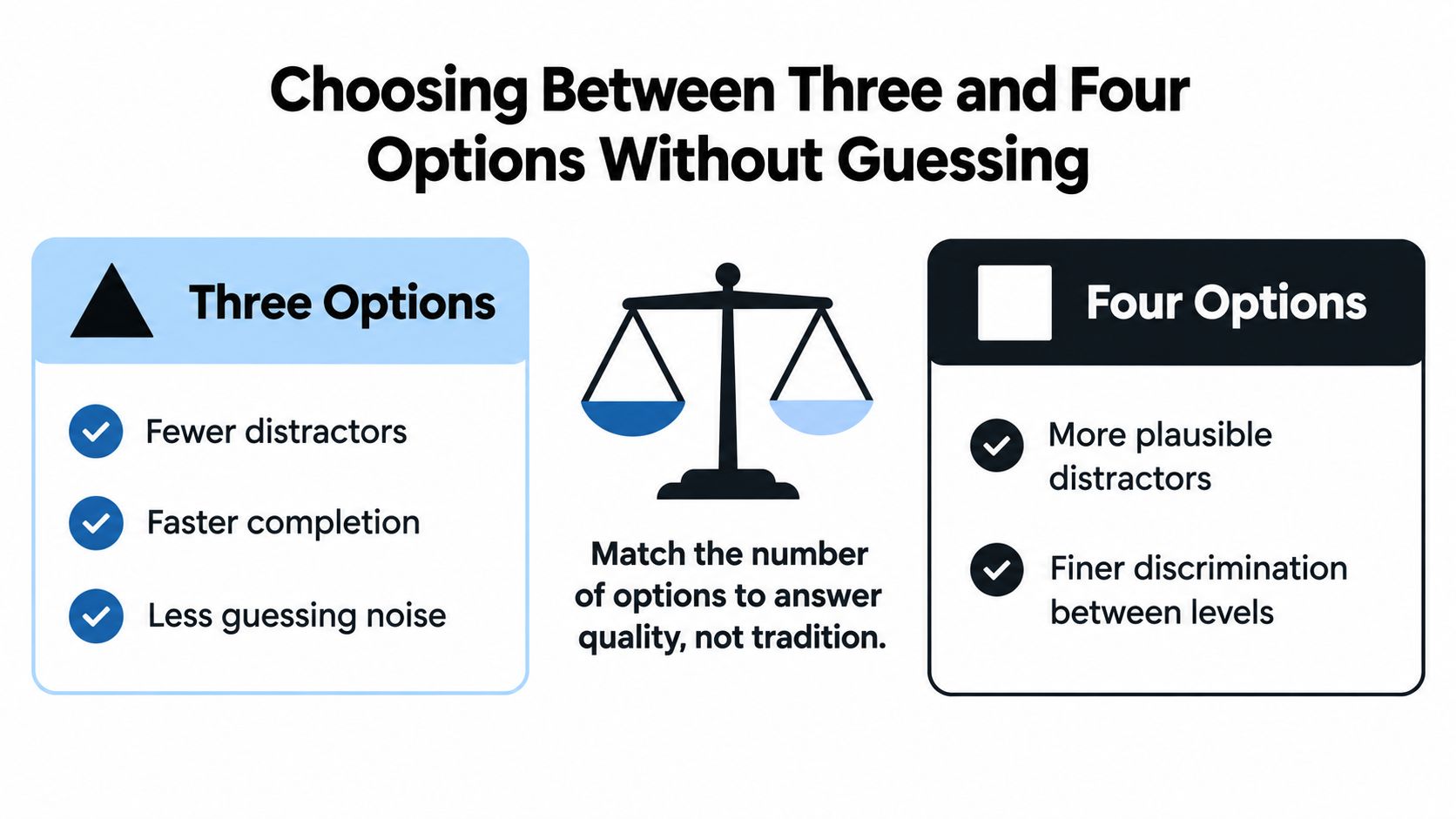
Four options often appear because a worksheet template leaves room for them, not because the content supports them. That habit creates a hidden literacy demand: students must read one more choice, compare one more sentence, and process one more possible interpretation. If the added distractor is weak, it may make the correct answer easier to spot while increasing reading time without improving measurement.
Choose the number of options from the errors students can realistically make. Current item-writing guidance on option quality supports three-option items when two credible distractors are enough. A shorter item can reveal more about understanding than a longer item padded with decorative choices.
Three options work well when
Use one correct answer and two distractors when:
- The misconception list is short. You can name two genuine, distinct errors, but a third would be invented.
- The students are younger. Fewer choices reduce scanning and comparison demands.
- The item targets application. A short scenario may already require students to connect evidence with a concept.
- You are writing a formative check. The goal is to identify the main misunderstanding quickly.
For example:
A student pushes a box across the floor, but the box slows down after the student stops pushing. Which force most directly causes the box to slow?
- Friction
- Gravity
- Magnetism
This item works only if gravity and magnetism are meaningful alternatives for this class. If students have not studied magnetism in this context, that choice tests neither knowledge nor reasoning. It just adds reading.
Four options earn their place when
Add a fourth option when:
- The content produces three distinct misconceptions.
- The item must separate several meaningful interpretations.
- Each choice represents a defensible way to read the situation.
- The extra alternative reflects the lesson rather than a random fact.
The choice is not between an easy three-option item and a rigorous four-option item. A well-designed three-option question can measure application or analysis. A poorly designed four-option question can reward students who eliminate the obviously weak choices.
Avoid structural shortcuts
Avoid “all of the above” and “none of the above” when students can solve the item by studying relationships among the choices instead of answering the question. These formats can also create ambiguity. If two answers are correct, “all of the above” may become the answer even when the task asks for the best explanation. Guidance for high-quality multiple-choice writing advises avoiding these constructions and limiting the number of alternatives to what the content fully supports (rules for writing multiple-choice questions).
Use a practical distractor workflow before adding an option. Write the correct answer first. Then list the actual wrong reasoning you have seen in student work. Turn each distinct error into one candidate distractor. Read the options as a student would, checking whether a choice can be rejected because it is longer, oddly worded, or easier to read rather than because it is wrong. Remove any candidate whose only purpose is to fill space.
Ask one final question:
Can I name the specific misconception this distractor represents?
If you cannot, leave it out. When you create a first draft from a topic or standard, a quiz generator can provide a starting set of stems and options. Inspect the cognitive demand, distractor rationales, and language level before using the draft. Generated questions need teacher review.
Designing Questions That Measure Thinking, Not Reading Speed
Higher-order thinking doesn't require a long paragraph. It requires a task that makes students use knowledge in a new situation.
A recall item asks:
What is erosion?
A stronger application item gives students a context:
After heavy rain, soil washes from a bare hillside into a nearby stream. Which process is taking place?
- Erosion
- Condensation
- Photosynthesis
- Germination
The second item still uses accessible language, but students must connect an observed event to a scientific concept. The scenario adds reasoning without burying the question under irrelevant details.
Add novelty, not clutter
A novel context should change the situation, not make the reading harder. If students learned about erosion using a playground example, use a garden slope or stream bank. Don't add a paragraph about the weather forecast, the soil's color, and the landowner's history unless those details affect the answer.
For a social studies objective, avoid this:
Considering the complex sociopolitical circumstances and economic pressures that contributed to the eventual transformation of the region's governing structure, which factor was most influential?
Try this:
Which factor most influenced the region's change in government?
Then provide a short source excerpt if students need evidence. The intellectual work should come from interpreting the evidence, not from decoding inflated vocabulary.
Edit for literacy fairness
Mixed-ability and multilingual classrooms need the same intellectual challenge with fewer accidental language barriers. Before using an item, make three passes:
- Content pass: Does the item match what students were expected to learn?
- Language pass: Can students understand the stem without specialized vocabulary unrelated to the objective?
- Fairness pass: Could a student who knows the content still miss the item because of a negative phrase, idiom, dense syntax, or irrelevant reading load?
Read the question aloud. If you lose the thread, students probably will too. Ask a colleague to identify the intended thinking skill without seeing your answer key. If they describe “reading carefully” rather than “comparing causes,” the item needs revision.
Use a final worked revision
Recall:
What is the main function of the heart?
Application:
A person's muscles need more oxygen during exercise. Which change helps the body meet that need?
- The heart pumps blood more quickly.
- The stomach digests food more slowly.
- The kidneys stop filtering the blood.
- The bones produce additional oxygen.
The revised question asks students to connect exercise, oxygen demand, and circulation. The distractors should still be reviewed against what the class has misunderstood. If the students never studied kidney function, that option may be an obvious elimination cue rather than a useful diagnostic choice.
The strongest multiple-choice questions are often quiet on the page. They don't show off complex wording. They make the learning target visible, give every option a fair grammatical shape, and reserve difficulty for the reasoning students must do.
Teacher Planner combines a browser-based planbook with editable AI drafts for lesson plans, worksheets, quizzes, adapted texts, and writing feedback. Its Multiple Choice Quiz Generator can help you create an initial question set and answer key, which you can then review for clear stems and misconception-based distractors. Visit Teacher Planner to see how it fits into your preparation workflow.