
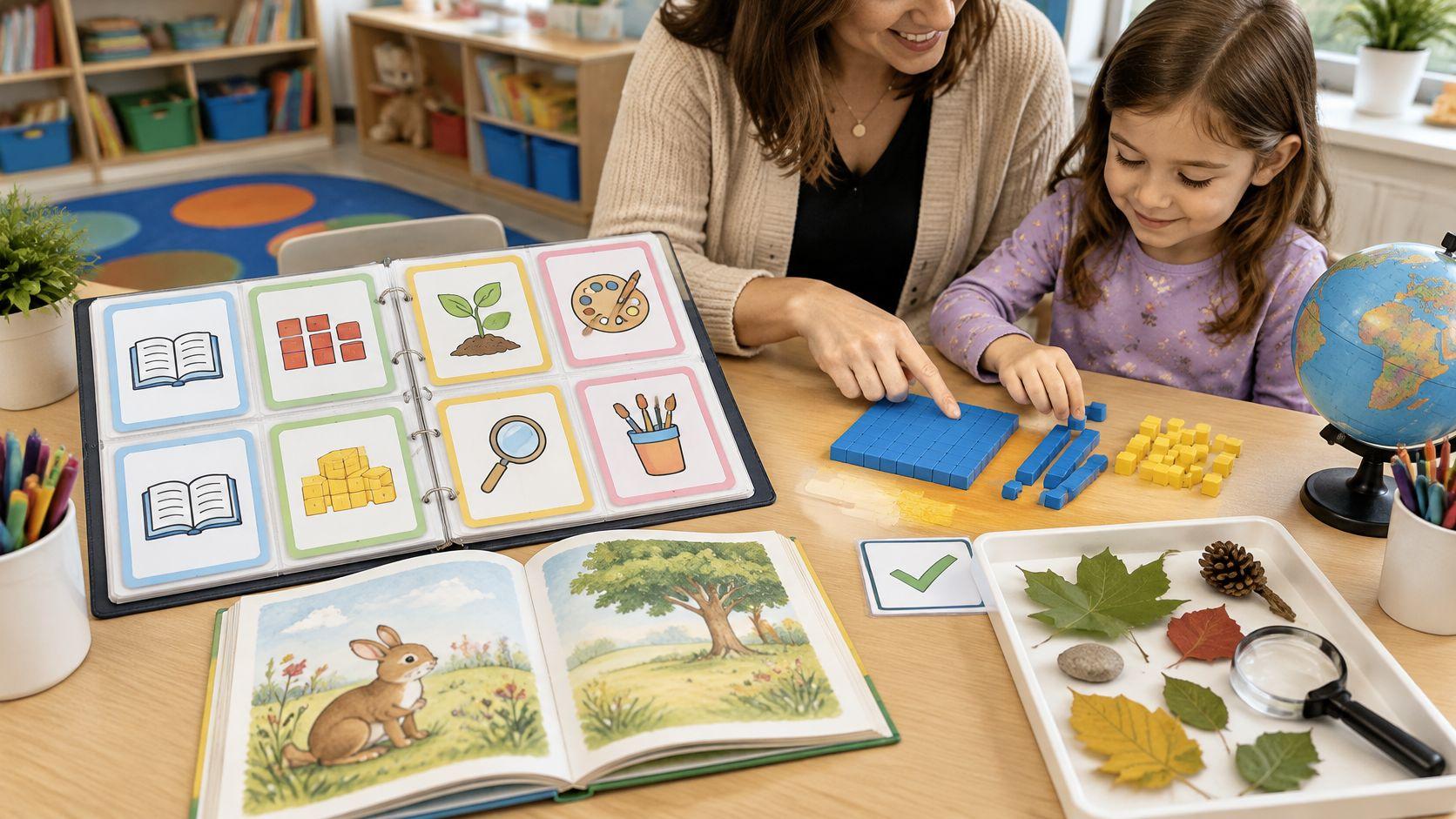
How do you know a lively lesson taught anything? Lesson plans for second graders work best when they pair one measurable objective with a short, hands-on routine and a quick check for understanding. The eight examples below cover math, reading, writing, science, and vocabulary. Each one breaks into the same four parts: objective, activity sequence, assessment idea, and a teacher-review checklist, so a plan can be adapted the same afternoon rather than rebuilt from scratch.
Second graders arrive with uneven strengths and unfinished skills, and a workable plan makes room for that range without splintering into unrelated activities. Adjust each example to your scope and sequence, the materials you have, and where students are right now. Teachers who later want to package their own classroom materials for other educators can browse ideas for creator-led digital products.
1. Daily Number Talk for Mental Math Strategies
A number talk gives students practice explaining how they think, not just naming an answer. Keep the routine brief, present one computation, and allow quiet thinking time before inviting students to share. The teacher records strategies as students explain them, making the class's reasoning visible.
Objective: Students will solve an addition problem mentally and explain a strategy using clear mathematical language.
Activity sequence: Write 34 + 19 on the board. After students think, invite several to share. One student might say, “I did 34 + 20 is 54, then took away 1 to get 53.” Another might split the numbers into tens and ones: 30 + 10 and 4 + 9, for a total of 53. Record both strategies, then use a number line to compare the steps.
Practical rule: Ask “Who can explain that in a different way?” before confirming the answer. The discussion should be about the reasoning, not a race to respond.
Assessment idea: Ask students to solve a second problem independently and write or sketch the strategy they used. Look for a sensible representation and an explanation that matches the answer.
Teacher-review checklist:
- Choose a problem that allows more than one strategy, such as 9 + 7 or 40 + 28.
- Keep a running anchor chart of strategies students can reuse.
- Check that the numbers fit current instruction and don't create unnecessary difficulty.
- Use a Lesson Plan Generator draft as a starting point, then review and edit the problem set before teaching.

2. Narrative Writing Unit with Small-Moment Stories
A small-moment story gives young writers a manageable subject. Instead of trying to cover an entire vacation or weekend, students focus on one event and add details that help a reader picture it. Keep each mini-lesson focused on a single craft move, then give students time to write and share.
Objective: Students will write a short personal narrative with a clear sequence and details that develop one moment.
Activity sequence: Model choosing a small event, such as helping at home, and think aloud about which details belong in the story. For a lesson on “zooming in,” students choose one moment from their week and draw a three-box storyboard. They then write about the middle box, adding at least three sensory details before sharing a sentence with a partner.
Assessment idea: Review the storyboard and draft for a focused event, a sequence the reader can follow, and details connected to the chosen moment. A simple revision checklist helps students check their own writing before a conference.
A useful unit can revisit the same story as students learn to add dialogue, use time-order words, or write an ending. The trade-off is that students may want to add more events; redirect them toward developing the one moment instead. Teachers looking for related prompts can browse writing activities for third graders and adapt the ideas to second-grade expectations.
Teacher-review checklist:
- Model a short story and show how a writer selects one moment.
- Keep the mini-lesson to one skill.
- Offer a drawing or storyboard as support for students who need help organizing ideas.
- Save organizers or drafts as printable materials and align each lesson's objective to the class's writing standards.

3. Small-Group Guided Reading Lesson
Small-group reading works when the teacher has a specific teaching point in mind and stays ready to adjust it based on what students do with the text. Group students by a shared instructional need, not by a label that stays fixed all year.
Objective: Students will use a decoding strategy to read unfamiliar words in a selected text.
Activity sequence: Introduce a text briefly, drawing attention to a useful feature or idea without telling students what happens. Have students read, then listen for a pattern in their reading. In an illustrative group of four, the teacher notices that students skip over multisyllable words. The teaching point becomes: “Break long words into chunks you know.” Model the strategy with a word from the text, then have students try it with another word.
A What Works Clearinghouse-reviewed study examined supplemental reading lessons for second graders that were deliberately aligned with the classroom program's strategies, sequence, concepts, and pacing. That alignment is a useful planning principle: a small group should reinforce and extend the core lesson, not introduce a disconnected routine.
Assessment idea: Note which students attempt to break a word into parts and whether that helps them read it. Use the observation to choose the next teaching point.
Teacher-review checklist:
- Plan a group schedule that gives each group regular opportunities to meet.
- Keep a simple, repeatable sequence: introduction, reading, teaching point, follow-up.
- Jot down specific reading behaviors during the lesson, then transfer useful notes to the planbook.
- Regroup when students' needs change rather than keeping groups fixed by habit.
4. Interactive Read-Aloud with Think-Alouds
A read-aloud lets the teacher model comprehension while students listen to a text they may not yet be ready to read independently. The teacher's pauses should demonstrate a way of thinking, not interrupt the story so often that students lose its thread.
Objective: Students will make a prediction and support it with a detail from the text.
Activity sequence: Before reading, mark a few stopping points and choose one strategy to emphasize. In a story about a lost pet, pause when the text shows muddy paw prints. Think aloud: “I predict the dog will come back because the author showed muddy paw prints.” Give partners a moment to share a prediction and the clue that supports it. Continue reading, then invite students to revisit or revise their ideas.
Assessment idea: Ask students to draw or write one prediction and identify the detail that prompted it. A prediction without a text-based clue shows what to model again.
Choose just one focus, such as predicting, questioning, or making connections, and rotate the focus across lessons. A short response after reading can help students transfer the thinking strategy into writing or drawing. For planning ideas organized around text comprehension, see lesson plans for reading comprehension.
Teacher-review checklist:
- Select a text that gives students meaningful opportunities to notice clues.
- Mark stopping points before class.
- Plan a brief partner response so every student gets a chance to think.
- Record the book title and strategy focus in the planbook to keep instruction purposeful.
5. Word Study with Picture and Word Sorts
Sorting asks students to notice what words share, which makes it more revealing than copying a spelling pattern. Start with a clear category so students can build confidence, then invite them to explain how they sorted.
Objective: Students will sort words by a vowel spelling pattern and explain why each word belongs in its category.
Activity sequence: Give students picture or word cards such as boat, coat, rain, and tree. First, model a closed sort with categories already named. Students read each word, place it under the matching heading, and explain the sound or spelling clue. Once students can use the categories reliably, offer an open sort where they decide how to group a fresh set.
Assessment idea: Ask each student to sort a few new words and explain one choice. A correct placement paired with an explanation gives stronger evidence of understanding than a completed page alone.
The main preparation cost is making and organizing cards. Reusable sets are worth the effort when they match the class's current phonics sequence; a polished sort that targets the wrong pattern is still the wrong lesson. For students who need more support, use fewer cards and keep the categories visible.
Teacher-review checklist:
- Begin with a closed sort before moving to open sorting.
- Choose a card set that matches the phonics pattern being taught.
- Ask students to explain why a word belongs, not just where it goes.
- Prepare different word sets for groups when assessment shows different needs.
- Use a printable recording sheet only if it captures student thinking, not just card placement.
6. Plant Needs Investigation for Life Science
A plant investigation gives students a reason to make a prediction, observe changes, and explain a conclusion. The plan needs careful setup: if more than one condition changes between groups, students may not know what caused the difference.
Objective: Students will compare plant growth under different conditions and use observations as evidence for a claim about plant needs.
Activity sequence: Set up three cups of beans: one with light and water, one with water in a dark closet, and one with light but no water. Have students predict what will happen, then record height and leaf color on day 1, day 3, and day 5. Assign classroom jobs such as waterer, recorder, and light checker so students know how to help without changing the setup.
The lesson aligns with the Common Core's broader emphasis on applying mathematics in context when students record and compare measurements; its science focus should be checked against the class's adopted standards and curriculum. Keep the observation chart visible and make the final discussion evidence-based: students should point to what they recorded rather than guess from memory.
Assessment idea: Have students complete a simple claim-evidence-reasoning response. For example, they can state whether the observations support a claim about sunlight or water, cite a recorded difference, and explain how it supports their thinking.
Teacher-review checklist:
- Confirm that each group differs in the intended condition.
- Prepare cups, seeds, labels, and a visible observation chart in advance.
- Schedule watering and data checks in the planbook.
- Review the setup for practical classroom concerns, including where the dark cup will be stored.

7. Base-Ten Place Value with Models
Students understand place value more clearly when they can build a number, represent it on paper, and connect the model to written notation. This lesson moves from concrete materials toward symbols without asking students to memorize a rule they can't explain.
Objective: Students will represent a three-digit number in hundreds, tens, and ones and compare it with another number using place-value reasoning.
Activity sequence: Give students base-ten blocks and ask them to build 245 with two flats, four rods, and five units. Have them draw the model and write its expanded form. Then ask them to compare 245 with 254 and explain which number is greater. Guide students to compare hundreds first, then tens when the hundreds are equal.
This lesson supports the Common Core focus on extending understanding of base-ten notation and on using models to reason about numbers, as described in the Oregon Department of Education's Grade 2 mathematics standards. A common pitfall is asking students to count every block rather than attend to the value of each group. Ask, “How many tens are in this number?” to draw attention to units and groups.
Assessment idea: Give students two new numbers to compare and ask them to show or explain the place-value decision. Check the reasoning, not only the greater-than or less-than symbol.
Teacher-review checklist:
- Use a build, draw, write sequence.
- Check that students can identify hundreds, tens, and ones in their models.
- Prepare an exit ticket with two numbers to compare.
- Review every number and model in any generated practice problems before using them.

8. Vocabulary Lesson Using the Frayer Model
A Frayer Model helps students connect a new word to examples and non-examples, rather than treating a definition as something to memorize and forget. Keep the word set focused so students have time to discuss how each word works.
Objective: Students will explain a target word using a definition, characteristics, examples, and non-examples, then use it correctly in a sentence.
Activity sequence: Model a four-square organizer for habitat. Write a student-friendly definition, list characteristics of a habitat, add examples such as a pond, and record a non-example such as a classroom desk. Students complete an organizer for a new word and finish by writing a sentence that uses it correctly.
Assessment idea: Review the organizer and sentence together. The example, non-example, and sentence should show that the student understands the word's meaning, not just its general topic.
For a word-list assessment after the lesson, the Vocabulary Quiz Maker supports entering words and grade level, reviewing and editing generated definitions, and creating a quiz. The definitions are editable drafts, so the teacher should check accuracy and age-appropriateness before students see them. A separate guide to making a vocabulary quiz from a word list can help shape the assessment.
Teacher-review checklist:
- Choose a small, useful set of target words.
- Model one complete organizer before students work independently.
- Check that examples and non-examples clarify the word's meaning.
- Review any generated definitions before using them in class.
Second-Grade Lesson Plan Examples at a Glance
| Item | Subject | Time Frame | Grouping | Best For |
|---|---|---|---|---|
| Daily Number Talk for Mental Math Strategies | Math | Daily, 10–15 minutes | Whole class | Building number sense and flexible mental math |
| Narrative Writing Unit with Small-Moment Stories | Writing | Multi-day unit | Whole class, independent writing, and teacher conferences | Developing personal narratives with detail and structure |
| Small-Group Guided Reading Lesson | Reading | Short lesson; meets several times per week | Groups of 3–5 students | Targeted reading instruction based on student needs |
| Interactive Read-Aloud with Think-Alouds | Reading comprehension | Usually 15–20 minutes | Whole class with partner responses | Modeling comprehension and building vocabulary |
| Word Study with Picture and Word Sorts | Phonics and spelling | Not specified; lesson-based | Partners or small groups | Recognizing and discussing spelling patterns |
| Plant Needs Investigation for Life Science | Science | Multi-day investigation | Student groups and whole-class discussion | Exploring plant needs through observation and experimentation |
| Base-Ten Place Value with Models | Math | One lesson | Partners or small groups | Understanding hundreds, tens, and ones with concrete models |
| Vocabulary Lesson Using the Frayer Model | Vocabulary | Not specified; lesson-based | Partners, then individual work | Building deeper understanding of target words |
Adapt These Plans to Your Week, Then Check Your Work
A lesson plan is ready when its objective, activity, and assessment point in the same direction. If students are meant to explain a mental-math strategy, a worksheet that only asks for answers won't show whether they can explain one. Adjust the materials or the quick check before class so the evidence matches the learning goal.
The trap for second-grade plans is the plan that looks complete but has no way to tell you whether it worked. A 15-minute number talk with a strong prompt and no capture of student thinking gives you nothing to act on Thursday. So the review below is less a checklist than a set of decisions, and each one costs prep time you should budget for.
- Confirm the objective: Match the skill to the standard or current unit goal, not to the activity you already planned.
- Time the routine: Leave room for modeling, student practice, and a short wrap-up. Seven-year-olds need the wrap-up to name what they learned.
- Choose the quick check: Decide what students will say, show, write, or build to demonstrate learning.
- Plan the next move: Decide whether the evidence will lead to reteaching, a new challenge, or a different representation.
- Schedule the lesson: Place it in the planbook and note any materials or follow-up dates.
The last two items are where most adaptations fall apart. A quick check you can't sort into two groups by the end of the block isn't a quick check, and a "next move" that isn't written down becomes a fresh decision at 8:40 the next morning.
Teacher Planner's browser-based planbook organizes lessons and units across Day, Week, Month, Unit Timeline, and Outline views. The Lesson Plan Generator drafts a plan from your topic, learning objectives, or standards, and the Worksheet Generator turns a topic or reading passage into a worksheet draft at a chosen grade level, from Pre-K through 12th grade plus university and adult education. Both outputs are drafts. Check facts, answers, difficulty, and wording before anything reaches students, and keep student names and other identifying details out of the tools.
When an assembly or a cancellation eats a block, Bump Forward moves the affected lesson and keeps the following lessons in sequence, so you aren't retyping plans at the end of a disrupted day. That matters more in second grade than the schedule suggests, because a guided reading group that gets skipped twice in a month loses its instructional thread. Save the adapted versions as resources so next year's planning starts from your edits, not from scratch.
Teacher Planner does not replace your LMS or gradebook, and grades and submissions stay outside it. What it does hold is the planning decision itself: what students should learn, what they'll do, and what you'll look for. That record makes it easier to revisit a lesson and adapt it for the next group.
When you're ready to file these eight plans somewhere you can find them, visit Teacher Planner to organize them in its browser-based planbook and keep the adapted versions in one place.