
It's 7:55 on a Monday. A sixth-grade class files in five minutes before the bell, the plan says "writing," and whatever prompt you hand out has to work without a ten-minute explanation. It has to produce something you can read and respond to, and it has to be worth using again next term.
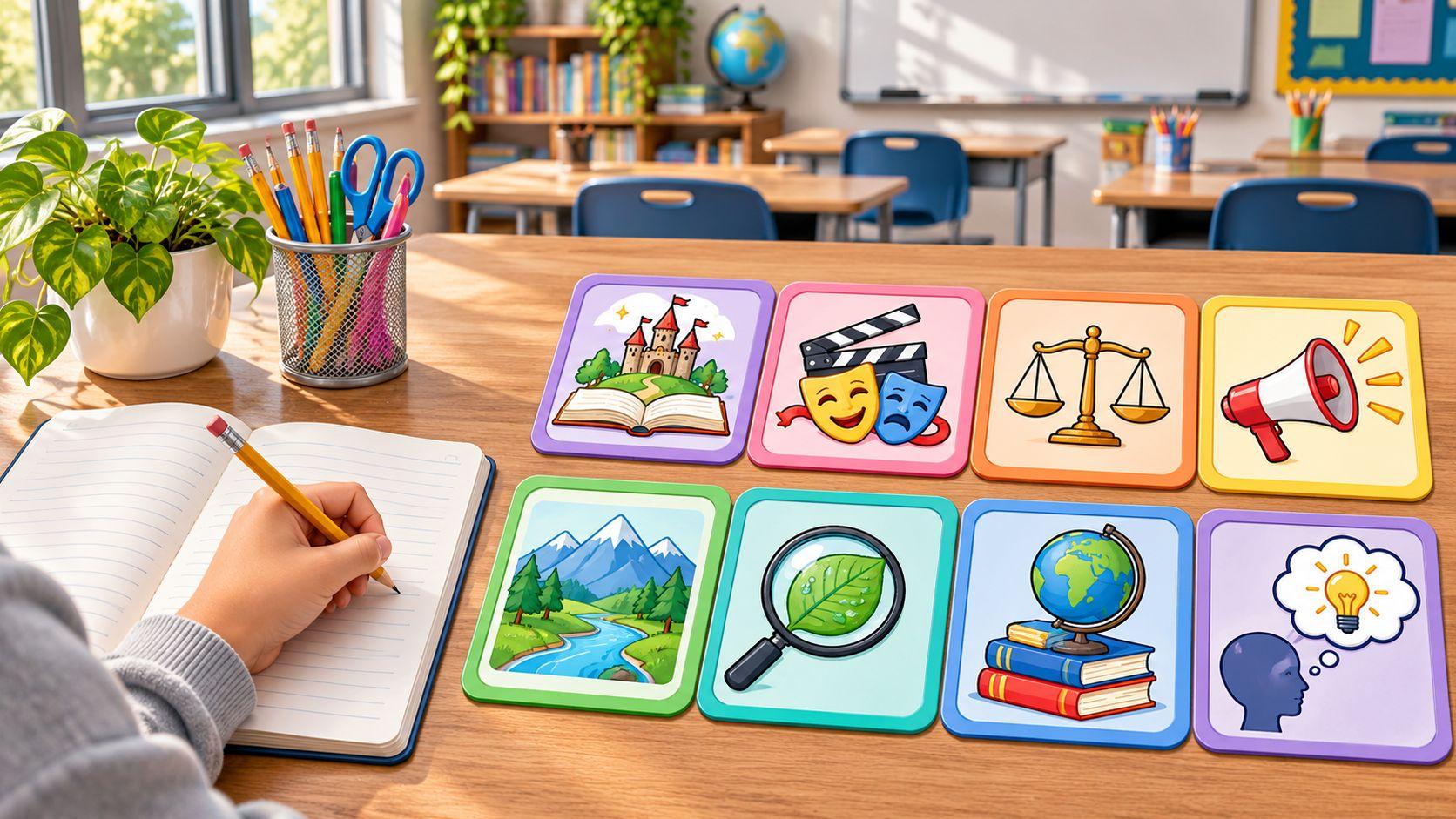
That's the standard these eight writing prompts for middle school are held to. Each one is sorted by genre and by the skill it builds. Each entry gives you a short classroom routine, a differentiation option, and a reuse step, so you're not rebuilding handouts from scratch on a Sunday night.
The gap you're working against is documented. The 2011 National Assessment of Educational Progress writing assessment put the average eighth-grade score at 150 on a 0 to 300 scale, with about 80% of students at or above Basic but only 27% at or above Proficient. Most middle schoolers can produce writing. Far fewer can organize and develop it consistently. A prompt that names the task, the audience, and the evidence is often the difference between those two groups.
Start with the prompt that matches your next unit.
1. Narrative Prompt About a Time When Plans Changed
Write about a moment when a plan changed without warning. A trip got canceled. The schedule flipped. The game moved indoors at the last hour.
Nearly every middle schooler has one of these memories, which is why this prompt works in the first week of school, before you know the class.
Keep the constraints simple and this prompt does most of the setup for you.

The task builds narrative structure rather than retelling. Students need a setting, a conflict, a response, and a closing reflection. The Common Core writing standards for grades 6 to 8 keep narrative writing as its own text type, separate from argument and explanation, and that's why this prompt asks for a turning point and a reflection instead of a summary of the day.
Illustrative classroom example. A sixth grader writes about a soccer game moved indoors at the last minute. She includes two lines of dialogue from the coach and ends with a sentence about handling change. That's a complete narrative in under a page.
Run the turning point first
Model two sentences of your own scene out loud. Then have students draft only the turning point, about five sentences, before they build an opening and a closing around it. The order matters. The moment of change is exactly where weak narratives turn vague, so you want to see it while you can still coach it.
- Story map: a five-box organizer with setting, characters, conflict, turning point, resolution.
- Sentence starters: "I thought we would ___ until ___" and "Looking back, I ___" get past the blank page without writing the story for them.
Differentiation. Students who would rather invent than remember can write about a character whose school trip is canceled the morning of departure. Same structure, no disclosure required. The writing prompts for elementary collection covers the same narrative moves with simpler constraints if you need a lower entry point.
Reuse. Save the prompt and its success criteria to the lesson they belong to, so the handout travels with the unit instead of sitting in a folder labeled "writing." Draft the organizer with the worksheet generator, then edit the wording and difficulty to match the class in front of you.
The instinct behind how to hook viewers with storytelling applies to twelve-year-olds too. Start inside the moment, not before it.
2. Argument Prompt on Whether Middle Schools Should Start Later
Should middle schools start later in the day? Take a position, give your reasons, and answer the strongest objection.
The topic lands because students already argue about it in the hallway. Sleep, bus schedules, practice times, and younger siblings all surface without you supplying them.
Students want structure more than they admit. A 2025 National Literacy Trust survey of 14,689 students aged 8 to 18 across 90 schools found that nearly half preferred clear, structured guidance from teachers on how to produce strong writing. A gripping topic gets them started. An organizer is what gets the paragraph finished.
Illustrative classroom example. Students list three reasons and one counterargument, such as bus schedules, before drafting a single paragraph. The paragraph has to name the counterclaim in one sentence and answer it in the next.

Let the organizer do the teaching
- Claim line: "Schools should ___ because ___."
- Evidence slots: two boxes, each requiring a source name plus a sentence explaining why that evidence matters.
- Counterclaim box: "Some people say ___. They have a point about ___, but ___."
Hand out two short teacher-selected texts. Students who search the open web spend the period reading opinion sites and copying headlines. The teenage writing topics list has more issue-style prompts in the same format if you want a second round later in the term.
Differentiation. Pairs write opposing letters to the principal, then swap and rebut each other's claims in a second draft. Two students arguing in writing produce sharper reasoning than one student hedging both sides.
Reuse. Before revision, students rate their own evidence as strong, partial, or weak. Most will downgrade at least one source, and that's the moment the lesson lands.
Try this first: If the class argues well out loud but freezes on paper, run the debate for five minutes and have everyone write only the counterargument paragraph.
3. Informative Prompt on Explaining How Something Works
Choose something you understand and explain it to a reader who has never seen it. A bicycle gear. A water filter. How the library catalog decides which book sits where.
Informative writing fails. Students write confidently to a reader who already knows the material, and the explanation collapses on the second read.
Purdue OWL's guidance on deciphering an assignment starts with purpose: is the writer informing, arguing, or analyzing? A prompt template that forces the answer looks like this. "Write a [text type] for [audience] about [focused topic]. Your purpose is to explain. Include [required elements]." Name the reader inside the prompt and half your word-choice problems solve themselves.
Illustrative classroom example. A seventh grader explains how a pulley lifts a load. The draft uses a numbered sequence, a labeled sketch, and the words "then" and "as a result" at the right joints.
What to require
- A named reader: a fourth grader, a visitor from another country, a substitute teacher on their first day.
- Three transitions minimum: or a labeled diagram, which does the same organizing work for students who think visually.
- Precise vocabulary: the technical term plus a plain definition in the same sentence.
Differentiation. Students who finish early write a how-to guide for a school process, such as checking out a library book, aimed at incoming sixth graders. Same skill, real audience down the hall.
Reuse. Run drafts through Writing Feedback with your success criteria attached, then confirm every suggestion against those criteria before students see the comments. An AI draft can flag a missing transition. It can't tell you whether the explanation would help a fourth grader. Save the finished guides to a unit folder and reread them at the end of term to see how the explanations changed.
4. Descriptive Prompt on a Place at Dawn
A place you know well, at 6:45 in the morning. What does it sound like? What's cold? What does it smell like before anyone else arrives?
Description is the cheapest writing skill to practice and the one students skip most often. A five-minute draft costs nothing and shows you immediately who writes in generalities.
The Purdue OWL creative writing activities use a constraint to force precision, asking students to describe an ordinary object without using its usual vocabulary. The classroom version is a familiar place at an unusual hour, which makes the known strange without demanding invention for its own sake.

Illustrative classroom example. A student describes a bus stop at 6:45 a.m. The crosswalk signal clicks. The bench is cold through a jacket. One car idles at the light and then is gone. Three details, and not one adjective like "nice" or "pretty."
The five-senses chart
Give a chart with five rows and require three filled in before drafting starts. Then model a revision out loud by swapping "the bench was nice" for "the bench held the cold through my jacket." Students copy that move within a week.
- Timed drafts: five to seven minutes, collected as a warm-up, ungraded.
- Comparison pairs: hand out two versions of one paragraph, one general and one sensory, and ask which they can see.
Differentiation. Students who freeze on memory describe the same place at 3 p.m. and then again at dawn, which turns the task into a contrast. The figurative language for middle school guide has more on simile and metaphor if the class is ready.
Reuse. Keep a bank of starter prompts in the planbook so the warm-up is ready at the top of a unit rather than invented at 7:55.
5. Reflective Prompt in a Letter to My Future Self
Write a letter to yourself at the end of the term. What are you working on? What's hard right now? What do you want to remember?
Time is the constraint. A 2025 daily-diary study of 105 middle and high school teachers, drawing on 8,557 lesson-level reports across 14 states and the District of Columbia, found that teachers included at least one writing practice in 66.3% of lessons, but students spent only 15.96 minutes per day planning, writing, and revising, as published in Reading and Writing. A reflective letter that needs two class periods won't survive that schedule. One that takes fifteen minutes will.
Illustrative classroom example. An eighth grader writes three goals for math, a paragraph about a group project that went badly, and one instruction to herself about keeping a reading log.
Keep it private by design
Students write more freely when nobody collects the letter. Say plainly that you won't read it unless they hand it over.
- Goal template: a measurable target, a first step, and a check-in date.
- No identifying details: if letters go into a digital folder, remind students to leave out full names and anything they wouldn't want a classmate to open.
A letter that nobody else reads is often the most honest page a twelve-year-old writes all term.
Differentiation. Students who don't want to write about themselves write the letter as advice to an incoming sixth grader. The reflective move survives and the disclosure doesn't have to.
Reuse. Schedule it in the planbook for the last week of the term so it repeats each year, and hand the letters back on the first day of the next one.
6. Persuasive Prompt on Student Input Into Class Rules
Write a letter to a teacher or principal proposing one change to a classroom or school rule. Give your reasons. Offer a compromise.
This prompt earns its place because the audience is real and the stakes are small enough to be safe. Seating charts, homework deadlines, and phone policies are all fair game once you name the boundaries first.
The writing time pays for itself. A meta-analysis of writing instruction in grades 6 to 12, covering 406 independent comparisons and 52,529 students, found a positive effect on writing performance of 0.47 standard deviations. A letter with a genuine recipient is the kind of task that carries that effect into an ordinary Tuesday.
Illustrative classroom example. A class drafts a letter proposing a ten-minute break during long writing blocks. It includes two reasons, a proposed three-week trial, and a line about what happens if the trial fails.
Structure the proposal
- Change: one sentence naming exactly what should be different.
- Reasons: two, each tied to something the class has observed.
- Compromise: what the class gives up or agrees to try first.
Differentiation. Students who want a lower-stakes version write a memo to the librarian about the checkout schedule, with a compromise option attached. Same moves, different reader.
Practical rule: If students can't name who will read the letter and what that person could say back, the assignment is a worksheet with a stamp on it.
Reuse. Swap drafts and require one specific revision suggestion per reader, not "it's good." Text Rewriter can produce a simpler or more formal version of a draft for comparison, and the student decides what to keep so the voice stays theirs.
7. Creative Prompt That Tells a Story From an Object's Point of View
Write a short story narrated by an everyday object. A backpack. A library book. The whiteboard at the front of the room.
Point of view is the skill hidden inside this one. A student who can hold a non-human narrator for 250 words has to make deliberate choices about what that narrator can see, know, and misread.

Illustrative classroom example. A sixth grader writes from the perspective of a lost mitten moving through the school lost-and-found, ending when a first grader claims it. The mitten can't read the room, so the conflict comes from what it misreads.
Model the voice before the plot
Read two paragraphs aloud, one narrated by a desk and one by a pencil, and ask the class what tells them apart. Then hand out a plot checklist with exposition, problem, rising action, climax, and resolution.
- Length limit: 250 words, so the story holds one incident.
- Voice check: students read a partner's first paragraph and guess what object is speaking before the partner reveals it.
Differentiation. Students who stall on plot write a single scene with one problem and no rising action. It still teaches voice, and it fits a 20-minute block at the end of a lab day.
Reuse. Draft a story-planning sheet with the worksheet generator, then edit the prompts and the length target to match your learning goals. Keep the finished stories in the resource library as mentor texts for next year.
8. Response Prompt on a Short Primary Source Quote
Read this excerpt. In one paragraph, explain the speaker's main claim and support your explanation with one direct quotation.
Content-area teachers need this one most. Extended writing in middle school science was used by 82% of participating teachers before COVID-19 and by 42% after schools reopened, and in social studies by 82% before and 64% after, according to IES-supported research on writing in middle school science and social studies. The short response paragraph is the easiest way back in.
Keep source passages to 50 to 100 words. A longer excerpt turns the task into reading comprehension with a writing chaser, and students copy whole sentences instead of choosing evidence.
Illustrative classroom example. Students read a short historical speech excerpt, then write a paragraph naming the speaker's main claim and quoting one sentence that supports it. In science, students respond to a line from a lab report and explain what the result suggests and what it doesn't prove.
The three-part frame
- Claim: "The speaker argues that ___."
- Quotation: "When the speaker says '___,' they mean ___."
- Explanation: "This is important because ___."
Differentiation. Attach a glossary of three or four hard words beside the excerpt, or a paraphrased version alongside the original for students still building English fluency. The thinking task stays the same.
Reuse. Save the excerpt and the response prompt together in the planbook so the materials stay aligned when a unit moves. Verify every quotation against the original document before you copy it, including the ones students will check against you.
How the eight middle school writing prompts compare
| Item | Writing Type | CCSS ELA Standard | Best For |
|---|---|---|---|
| Narrative Prompt: A Time Plans Changed Unexpectedly | Personal narrative | W.6-8.3 | Practicing story structure and sequencing |
| Argument Prompt: Should Middle Schools Start Later in the Day? | Argument writing | W.6-8.1 | Building claims, evidence, and counterarguments |
| Informative Prompt: Explain How Something Works | Informative/explanatory writing | W.6-8.2 | Explaining processes with clear organization |
| Descriptive Prompt: A Place at Dawn | Descriptive writing | Not specified | Practicing sensory detail and imagery |
| Reflective Prompt: A Letter to My Future Self | Reflective writing | Not specified | Goal-setting and personal reflection |
| Persuasive Prompt: Should Students Have a Say in Class Rules? | Persuasive letter or memo | Not specified | Practicing audience awareness and respectful proposals |
| Creative Prompt: Tell the Story from an Object's Point of View | Creative narrative | Not specified | Developing point of view and voice |
| Response Prompt: Respond to a Short Primary Source Quote | Evidence-based response | Not specified | Practicing close reading, quotation, and interpretation |
Start With One Prompt This Week
Pick the prompt that matches your next unit, not the one that looks most fun on a Friday. If the unit is a science reading, start with the primary-source response. If it's a culture-building week, the class-rules letter does double duty and gives you something to respond to.
Run the short routine once before you commit to a full assignment. Watch where the drafts stall. If everyone freezes on the counterclaim, your organizer is the problem, not the class. If half the room writes three lines and stops, the prompt is too broad and needs a named reader and a length.
The worksheet generator in Teacher Planner supports grade levels from Pre-K through 12th grade, so a middle school version and a simplified version can come from the same starting point and stay with the lesson they serve. Whatever drafts the materials, the review is yours to do.
Before you copy anything for students, run this check.
- Match the mode to the standard: narrative, argument, informative, or response, not a blur of two.
- Name the reader and the length: a missing audience is the most common reason a middle school draft wanders.
- Verify the sources: every quotation checked against the original document, every cited text one you've read.
- Read the organizer as a student would: if a box can be filled with "because it is," rewrite the box.
One more practical note. For students who draft by dictation or use captioning to keep up, a roundup of live caption and speech-to-text apps is worth bookmarking before you assign the next paragraph, since the bottleneck is often transcription rather than ideas.
Teacher Planner combines a browser-based planbook with AI drafting tools, so the prompts above can live in the lesson they belong to and the handouts can be drafted, edited, and printed from the same place. The Worksheet Generator turns a topic or reading passage into an editable worksheet draft for the grade you choose, and Writing Feedback drafts comments against your own criteria. Visit Teacher Planner to start with one prompt and see how the routine fits your week.