
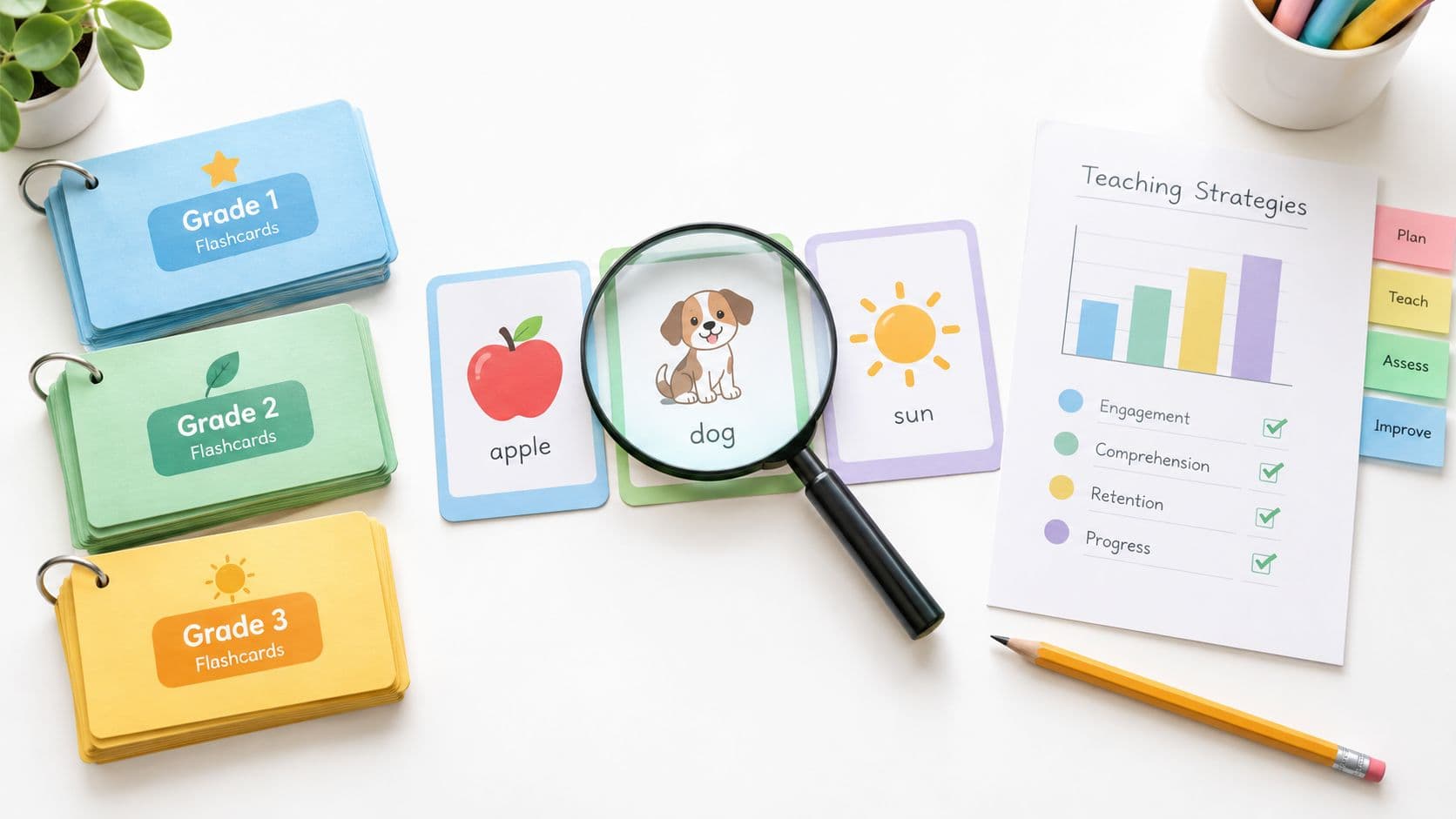
You're printing a vocabulary quiz tonight, and the easiest mistake is to write the correct answer first, then add three random words around it. A strong multiple choice vocabulary quiz starts with the distractors. Exactly one option should fit the sentence, while each wrong option should reveal a specific misreading, such as a shared rhyme, a shared root, a familiar near-synonym, or a word students associate with the same topic.
The seven grade-banded examples below give you ready-to-adapt questions, answer keys, and distractor audits. Choose the closest match to your class, replace the contexts with words from your current unit, and adjust the support or challenge notes before you print. For a useful follow-up, pair recognition questions with self-testing strategies for students, so students explain or use the word after selecting an answer.
1. Grade 2 Basic Sight Words Quiz
Young readers need short sentences, familiar situations, and answer choices they can decode. Read each question aloud as students follow the printed text. The quiz below checks meaning in context rather than asking children to memorize isolated definitions.
Questions
-
The sun is bright in the sky. What is the sun?
A. A star
B. A shoe
C. A spoon
D. A bed -
Mia can run to the gate. What does run mean?
A. Move quickly with your feet
B. Sleep in a bed
C. Eat a snack
D. Draw a picture -
Please open the door. What does open mean?
A. Move it so people can go through
B. Make it darker
C. Put it in a box
D. Drop it on the floor -
The puppy is little. What does little mean?
A. Small
B. Loud
C. Wet
D. Fast -
We eat lunch at school. What does eat mean?
A. Have food
B. Read a book
C. Wash your hands
D. Build a tower -
The bird can fly. What does fly mean?
A. Move through the air
B. Crawl under a chair
C. Stand still
D. Swim in a pond -
I see a red apple. What does red tell us?
A. Its color
B. Its size
C. Its taste
D. Its sound -
Dad is home. Where is Dad?
A. At the place where he lives
B. At the playground
C. In the ocean
D. On a bus -
The baby is happy. How does the baby feel?
A. Glad
B. Angry
C. Sleepy
D. Cold -
Put the book under the desk. Where should the book go?
A. Below the desk
B. On top of the desk
C. Beside the door
D. Inside the backpack
Answer key and distractor audit
The answer key is 1 A, 2 A, 3 A, 4 A, 5 A, 6 A, 7 A, 8 A, 9 A, 10 A. Before using this as a scored quiz, shuffle the answer positions so students don't learn a pattern.
Each distractor targets a different early misunderstanding. In question 1, “shoe,” “spoon,” and “bed” are familiar nouns, but they don't belong in the sky. In question 2, “sleep,” “eat,” and “draw” are common actions, so students must connect run to the sentence rather than select any action word. In question 7, the wrong choices test whether students confuse color with size, taste, or sound. Question 10 distinguishes under from on, beside, and inside, which are related location words.
Practical rule: Read the stem and choices aloud, but ask students to point to or circle the answer independently.
For students who need support, use a picture beside each option, reduce the choices temporarily, or give the sentence orally before showing it in print. For advanced readers, keep all four options and ask them to write a new sentence using the target word. Use the results as a pre-assessment for small-group instruction, then cluster missed words by pattern or frequency for short review sessions.

2. Grade 5 Academic Vocabulary Quiz
By fifth grade, students should apply science vocabulary inside a sentence. A definition-only question can tell you whether a child remembers a word pair, but a context question shows whether the child understands the term's role in an ecosystem or weather explanation.
Questions
-
Green plants are producers because they make their own food. What is a producer?
A. An organism that makes its own food
B. An animal that hunts other animals
C. An organism that breaks down dead matter
D. A place where animals sleep -
A rabbit eats grass in a food chain. The rabbit is a consumer because it
A. gets energy by eating another organism
B. makes sunlight for plants
C. changes weather conditions
D. breaks rocks into soil -
A hawk eats the rabbit. The hawk is a predator. What is a predator?
A. An animal that hunts another animal
B. A plant that makes seeds
C. An animal that eats only grass
D. A nonliving part of an ecosystem -
The rabbit is the hawk's prey. What does prey mean?
A. An animal hunted by another animal
B. An animal that does the hunting
C. A plant that needs sunlight
D. A place where animals find shelter -
A long period with very little rain is a drought. A drought can
A. make water supplies smaller
B. make every river overflow
C. create more rainfall each day
D. freeze all living things -
Water vapor cools and forms tiny drops in the air. This is condensation.
A. Gas changes into liquid
B. Liquid changes into solid
C. Solid changes into gas
D. Water disappears forever -
An ecosystem includes living things and nonliving parts. Which is nonliving?
A. Sunlight
B. Grass
C. Rabbit
D. Bacteria -
A habitat is the place where an organism
A. gets what it needs to live
B. changes from liquid to gas
C. hunts every other animal
D. produces all the food in a food chain -
When two organisms need the same limited food, they may compete. What does compete mean?
A. Try to get the same resource
B. Help one another grow
C. Sleep through the winter
D. Move water through the soil -
A food chain shows
A. how energy moves from one organism to another
B. how clouds form in the sky
C. how rocks change shape
D. how animals build shelters -
A thermometer measures temperature. Temperature tells us
A. how hot or cold something is
B. how much food an animal eats
C. how fast a plant grows
D. how deep a river is -
A population is a group of the same kind of organism living in one area. Which is a population?
A. All the rabbits in one meadow
B. A rabbit, a hawk, and a tree
C. All the living and nonliving parts of a forest
D. One rock beside a pond
Answer key and distractor audit
The answer key is 1 A, 2 A, 3 A, 4 A, 5 A, 6 A, 7 A, 8 A, 9 A, 10 A, 11 A, 12 A. Shuffle the choices before distributing the quiz.
The distractors deliberately come from nearby science concepts. In question 1, the hunter and decomposer options are real ecosystem roles, but they confuse producers with consumers and decomposers. Questions 3 and 4 reverse predator and prey, a common relational error. Question 6 uses the names of other changes of state to test whether students understand the direction of the change. Question 12 contrasts a population with a community, an ecosystem, and an individual object.
For a supported version, provide a word bank with the twelve terms and add a small diagram for the food-chain questions. For a stronger version, remove the definition clause from each stem and ask students to infer the term from context. You can also group the questions by food-chain roles, weather, and ecosystems, then reteach the group that produced the most confusion. A science-focused guide to multiple-choice questions can help you vary stems without turning every question into a definition match.

3. Grade 7 Literary Vocabulary Quiz
Middle-school readers often recognize literary terms but apply them too broadly. Give them a short excerpt or paraphrase, then make the choices represent concepts that naturally overlap. The correct answer should depend on what the passage is doing, not on which term sounds most familiar.
Questions
-
Lena wants to win the race, but an injury keeps her from training. This is an example of
A. conflict
B. setting
C. theme
D. point of view -
“The old house leaned toward the road, its broken windows watching every traveler.” The description uses
A. personification
B. plot
C. dialogue
D. first-person point of view -
A narrator describes only what Maya thinks and feels. The story uses
A. third-person limited point of view
B. first-person point of view
C. setting
D. climax -
The repeated idea that honesty builds trust is the story's
A. theme
B. conflict
C. characterization
D. setting -
The author reveals that Amir is patient by showing him help a younger student. This is
A. characterization
B. foreshadowing
C. setting
D. resolution -
A character hears a warning about a storm before the storm arrives. The warning is
A. foreshadowing
B. theme
C. conflict
D. characterization -
The most intense turning point in a story is usually the
A. climax
B. exposition
C. setting
D. narrator -
The place and time of a story form its
A. setting
B. theme
C. conflict
D. resolution -
“The hallway was as quiet as a sleeping forest.” This comparison is a
A. simile
B. metaphor
C. plot
D. hyperbole -
“The hallway was a sleeping forest.” This comparison is a
A. metaphor
B. simile
C. dialogue
D. conflict -
The struggle between a character and a dangerous storm is
A. character versus nature
B. character versus self
C. setting
D. theme -
The events that solve the main problem make up the
A. resolution
B. exposition
C. point of view
D. characterization -
A narrator who uses “I” is usually using
A. first-person point of view
B. third-person omniscient point of view
C. setting
D. theme -
A story's sequence of connected events is its
A. plot
B. conflict
C. tone
D. characterization -
The feeling created by a dark, silent forest is the story's
A. mood
B. theme
C. climax
D. narrator
Answer key and distractor audit
The answer key is 1 A, 2 A, 3 A, 4 A, 5 A, 6 A, 7 A, 8 A, 9 A, 10 A, 11 A, 12 A, 13 A, 14 A, 15 A. Move the answer positions when you create the student version.
The wrong answers target predictable terminology mix-ups. In question 2, students may choose setting because the sentence describes a house, but the house is given a human action, making personification the better answer. Questions 9 and 10 place simile and metaphor side by side so students must notice the comparison signal in one sentence and its absence in the other. Questions 3 and 13 separate narrator perspective from the character's thoughts and from the pronoun used. Question 15 distinguishes the reader's emotional response, mood, from the story's message, theme.
Adaptation notes
For students below level, post an anchor chart with one short definition and one color-coded example per term. Read each passage aloud and ask students to underline the evidence that supports their choice. For advanced students, remove the answer clues, use an original excerpt from your current novel, and require a one-sentence justification after each selection.
A useful review routine is to project the most-missed item, ask students to eliminate two choices, and then explain why the remaining distractor still fails. That conversation makes terminology precise instead of turning the quiz into a vocabulary guessing game.

4. Grade 10 Academic Vocabulary Quiz
High-school students encounter academic words across history, science, and literature. A strong quiz should make students distinguish words with similar forms or overlapping meanings, not merely recognize a familiar root.
Questions
-
The historian used several letters to corroborate the witness's account.
A. Confirm
B. Challenge
C. Hide
D. Predict -
The proposal was ambiguous, so committee members interpreted it differently.
A. Open to more than one meaning
B. Supported by clear evidence
C. Unrelated to the topic
D. Written in chronological order -
The scientist made a tentative claim because more evidence was needed.
A. Not yet certain
B. Completely impossible
C. Widely repeated
D. Carefully measured -
The article contrasts rural and urban transportation.
A. Shows differences between
B. Lists events in time order
C. Gives a definition of
D. Repeats the same idea -
The writer's evidence supports the central claim.
A. Provides reasons for
B. Replaces
C. Confuses
D. Opposes -
The law had an unintended consequence.
A. Not planned
B. Carefully measured
C. Publicly announced
D. Legally required -
The author implies that the character regrets her decision.
A. Suggests without stating directly
B. Proves with a table
C. Announces in a heading
D. Denies completely -
The new evidence may invalidate the earlier conclusion.
A. Show that it isn't sound
B. Repeat it exactly
C. Make it easier to understand
D. Place it in historical order -
The two accounts are consistent with each other.
A. In agreement
B. In competition
C. In conflict
D. Incomplete -
The essay uses a hierarchical structure, moving from broad ideas to smaller categories.
A. Organized by levels of importance or rank
B. Organized by opposing opinions
C. Organized by time alone
D. Organized without categories -
The speaker's rationale explains why the policy was chosen.
A. Reasoning
B. Result
C. Rule
D. Reaction -
The word justifiable means able to be
A. Supported with good reasons
B. Changed into a question
C. Divided into equal parts
D. Removed from a text -
The scientist tried to differentiate the two samples.
A. Identify how they differ
B. Combine them
C. Copy them
D. Ignore them -
The conclusion synthesizes evidence from several sources.
A. Combines ideas into a whole
B. Removes every detail
C. Questions the spelling
D. Places sources in alphabetical order
Answer key and distractor audit
The answer key is 1 A, 2 A, 3 A, 4 A, 5 A, 6 A, 7 A, 8 A, 9 A, 10 A, 11 A, 12 A, 13 A, 14 A. Shuffle the options before use.
Several distractors exploit morphology. In question 11, students may select rule because it shares the opening sound with rationale, but the sentence asks for reasoning. Question 12 tests the relationship between justify and justifiable, while the wrong choices target unrelated meanings. Questions 4 and 14 distinguish comparing differences from combining ideas. Questions 2 and 9 address different kinds of clarity, ambiguity allows multiple interpretations, while consistency describes agreement between accounts.
Use academic words repeatedly across subjects before assessing them. For students who need support, provide a word-family poster and let them annotate the sentence for signal words. For advanced learners, replace the definitions with excerpts from your own history or science texts, then ask them to write a second sentence where the same word has a different grammatical form.
For a careful review of stem construction, distractor quality, and alignment, use these multiple-choice question design principles.
5. Grade 4 Social Studies Vocabulary Quiz
Fourth graders understand civic and economic vocabulary more securely when the sentence describes something they can act out. A classroom election, a mock store, or a community decision gives the terms a concrete reference point before students meet them on paper.
Questions
-
In a classroom election, students choose a class representative. This is an example of
A. voting
B. trading
C. producing
D. saving -
A citizen is a person who
A. belongs to a country or community
B. owns every business in a town
C. makes all classroom rules alone
D. travels without a home -
A law is a rule made by a government to
A. guide behavior in a community
B. describe a family recipe
C. measure the weather
D. choose a favorite sport -
When people share ideas before a town decision, they take part in
A. civic participation
B. evaporation
C. transportation
D. private property -
A person who buys a notebook is a
A. consumer
B. producer
C. representative
D. citizen leader -
A bakery that makes bread is a
A. producer
B. consumer
C. voter
D. resource -
If Maya wants a bicycle but has limited money, she must make a
A. choice
B. law
C. government
D. election district -
The materials people use to make goods are called
A. resources
B. rights
C. votes
D. citizens -
A right is a freedom or protection that
A. people are entitled to have
B. a store sells for money
C. a producer makes in a factory
D. changes with the weather -
A representative speaks or acts for
A. a group of people
B. one type of product
C. a natural resource
D. a private building
Answer key and distractor audit
The answer key is 1 A, 2 A, 3 A, 4 A, 5 A, 6 A, 7 A, 8 A, 9 A, 10 A. Reorder the choices so the key doesn't remain in one position.
The distractors draw from neighboring concepts. Questions 5 and 6 reverse consumer and producer, a confusion that becomes visible when students connect each word to an action. Question 7 uses “law,” “government,” and “election district” as distractors because students may associate all three with civic life without reading the money context. Question 9 separates a legal or civic protection from something bought or manufactured.
Make it concrete
Before the quiz, run a classroom election and let students label each action: voting, citizen participation, representative, and law. During a mock store, assign some students as producers and others as consumers. Keep a picture-supported word wall visible while you teach, then remove only the pictures for a later version.
For students who need support, shorten the sentences and add a scenario illustration. For advanced students, ask them to explain why a distractor belongs to a different category, then write a new scenario for the target word. Encourage students to record examples they notice outside class in a weekly vocabulary journal.
6. Grade 6 Language Arts Quiz
Roots can help students decipher unfamiliar words, but a shared root doesn't guarantee a shared definition. Ask students to use the prefix, suffix, and full sentence together rather than treating the root as the whole answer.
Questions
-
A transport carries people from one place to another. The root port relates to
A. carry
B. write
C. see
D. sound -
A preview shows something before it happens. The prefix pre- means
A. before
B. after
C. against
D. many -
An autobiography is a life story written by the person who lived it. The root bio means
A. life
B. earth
C. word
D. measure -
A microscope helps scientists see very small objects. The prefix micro- means
A. small
B. large
C. around
D. again -
To rewrite a paragraph is to
A. write it again
B. write it before reading it
C. write against it
D. write many paragraphs at once -
A telephone sends sound over a distance. The root tele means
A. far
B. same
C. light
D. under -
A geothermal system uses heat from inside Earth. The root geo means
A. Earth
B. water
C. life
D. time -
A person who is careless does not pay enough attention. The suffix -less means
A. without
B. full of
C. able to
D. one who -
A joyful person is full of joy. The suffix -ful means
A. full of
B. without
C. before
D. under -
To inspect something is to look at it closely. The root spect relates to
A. look
B. carry
C. break
D. lead -
An audible sound can be heard. The root aud relates to
A. hear
B. write
C. move
D. join -
A submarine travels below the surface of the water. The prefix sub- means
A. under
B. across
C. before
D. together
Answer key and distractor audit
The answer key is 1 A, 2 A, 3 A, 4 A, 5 A, 6 A, 7 A, 8 A, 9 A, 10 A, 11 A, 12 A. Shuffle the choices when you prepare the final copy.
The wrong answers target root and affix reversals. In question 2, “after” is the opposite of pre-, while “against” and “many” are real meanings connected to other prefixes. Questions 8 and 9 contrast -less and -ful, so students must read the whole word instead of treating every suffix as interchangeable. Questions 1 and 10 use different roots that students may recognize vaguely, but the sentence supplies the needed meaning.
A root is evidence, not the entire definition.
For below-level learners, teach one root family at a time, add a word-family tree, and let students separate each word into visible parts. Use a morphology journal where they record the root, affixes, complete word, and an original sentence. For advanced learners, provide unfamiliar words containing a known root and ask them to infer a likely meaning, then confirm or revise their prediction using context.

7. Grade 9 English Vocabulary Quiz
Novel-study vocabulary works best when the words stay attached to the author's situation. Use a short quotation or a faithful paraphrase from the assigned text, then ask what the word means there. A distractor can be a familiar synonym, another word from the same novel, or a meaning the target word has in a different context.
Questions
-
The character was reluctant to enter the abandoned house, even after her friends called her. Reluctant means
A. Unwilling or hesitant
B. Eager and excited
C. Certain and confident
D. Unable to remember -
The narrator describes the town as desolate, with empty streets and boarded windows. Desolate means
A. Empty and lonely
B. Crowded and cheerful
C. Bright and modern
D. Noisy and dangerous -
After losing the competition, the character speaks in a defiant voice. Defiant means
A. Resisting or refusing to obey
B. Apologizing with shame
C. Asking for help
D. Speaking without emotion -
The mentor gives the student a candid answer. Candid means
A. Honest and direct
B. Complicated and secret
C. Funny and exaggerated
D. Uncertain and weak -
The narrator's ominous description of the clouds makes readers expect trouble. Ominous means
A. Suggesting something bad may happen
B. Showing that the weather is pleasant
C. Explaining a character's history
D. Proving that the narrator is correct -
The character feels ambivalent about leaving home because she wants freedom but worries about her family. Ambivalent means
A. Having mixed feelings
B. Having no feelings
C. Feeling certain about one choice
D. Feeling angry at everyone -
The soldier's valor is shown when he protects others despite danger. Valor means
A. Courage
B. Wealth
C. Confusion
D. Patience -
The narrator calls the brief celebration ephemeral because it ends before sunset. Ephemeral means
A. Short-lived
B. Carefully planned
C. Extremely loud
D. Difficult to understand -
The character's pragmatic choice focuses on what will work in real life. Pragmatic means
A. Practical
B. Imaginative
C. Traditional
D. Emotional -
The description of the river as “a silver ribbon” is a
A. metaphor
B. conflict
C. flashback
D. character trait -
The narrator is reticent, answering questions with only a few words. Reticent means
A. Quiet or unwilling to speak
B. Ready to argue
C. Skilled at telling jokes
D. Unable to understand the question -
The character's melancholy mood follows the departure of her closest friend. Melancholy means
A. Extremely sad
B. Wildly excited
C. Mildly annoyed
D. Proud of an achievement -
The villain's mercurial behavior changes from friendly to threatening without warning. Mercurial means
A. Unpredictable and changeable
B. Calm and dependable
C. Slow and deliberate
D. Honest and generous -
The author uses foreshadowing when a cracked bridge appears before the characters begin their journey. Foreshadowing
A. Hints at a later event
B. Explains the setting after the ending
C. States the theme directly
D. Describes a character's appearance -
The final paragraph conveys the idea that forgiveness requires courage. Conveys means
A. Communicates or expresses
B. Hides or removes
C. Interrupts or delays
D. Measures or compares -
The narrator's perspective shapes how readers understand the disagreement. Perspective means
A. A particular point of view
B. A sequence of events
C. A physical location
D. A repeated sound
Answer key and distractor audit
The answer key is 1 A, 2 A, 3 A, 4 A, 5 A, 6 A, 7 A, 8 A, 9 A, 10 A, 11 A, 12 A, 13 A, 14 A, 15 A, 16 A. Shuffle answer positions and preserve the context when you adapt the quiz to your novel.
The distractors reflect common reading errors. In question 1, “eager” is the opposite of reluctant, while “certain” confuses hesitation with confidence. Question 6 requires students to notice the two competing feelings rather than choose a general emotion. In question 10, the wrong literary terms may all seem plausible in a novel unit, but only metaphor describes the comparison. Question 14 separates foreshadowing from theme, setting, and characterization by focusing on a hint about a later event.
For students who need support, pre-teach dense words with short excerpts and page references, then provide a plain-language gloss beside the first occurrence. For advanced students, use a second context in which the word changes meaning or part of speech, and ask them to justify the answer with evidence from the passage. After grading, display anchor sentences for the most-missed words beside the novel so students encounter them again during reading.
For additional practice distinguishing figurative devices, use this guide to figurative language in middle school.
7-Quiz Multiple-Choice Vocabulary Comparison
| Quiz | Implementation complexity | Resource requirements | Expected outcomes | Ideal use cases | Key advantages |
|---|---|---|---|---|---|
| Grade 2 Basic Sight Words Quiz (10 Items) | Low, short MC items, simple context sentences | Minimal, printed quiz/flashcards, read-aloud support, optional images | Improved high‑frequency word recognition and basic decoding | K–2 fluency practice, quick pre‑assessments, small‑group targeting | Fast to administer; phonics‑aligned; easy to adapt |
| Grade 5 Academic Vocabulary Quiz (12 Items), Science Focus | Medium, needs discipline‑specific contexts and plausible misconceptions | Science contexts/diagrams, teacher content knowledge, possible image supports | Better concept‑specific vocabulary and identification of misconceptions | Unit checks in ecosystems/weather/matter; formative reteach planning | Discipline‑aligned; uses real science terms to assess depth |
| Grade 7 Literary Vocabulary Quiz (15 Items), Fiction Elements | Medium‑High, authentic excerpts and closely related distractors | Text excerpts, glossary or visual examples for support | Improved discrimination of literary devices and analytic vocabulary | ELA literary units, formative assessment before analysis tasks | Text‑grounded items force precise term use; fosters analytical reading |
| Grade 10 Academic Vocabulary Quiz (14 Items), Cross‑Disciplinary Focus | High, multi‑syllabic contexts across subjects, nuanced distractors | Authentic prose (articles/textbooks), etymology/word‑family refs, prep time | Increased Tier‑2 academic vocabulary and cross‑subject transfer | College‑readiness vocabulary instruction; cross‑curricular units | Builds transferable academic language; supports complex text comprehension |
| Grade 4 Social Studies Vocabulary Quiz (10 Items), Economics & Civics | Low‑Medium, scenario‑based items with near‑synonym distractors | Real‑world scenarios, illustrated cards, classroom simulations | Better civic/economic term comprehension and everyday application | Civics/economics units, classroom elections/simulations, formative checks | Real‑world contexts; scaffolds civic literacy appropriate to grade |
| Grade 6 Language Arts Vocabulary Quiz (12 Items), Greek & Latin Roots | Medium, shared‑root distractors require careful design | Morphology charts, prefix/suffix reference sheets, practice activities | Stronger morphological decoding and ability to infer meanings | Morphology units, root‑family instruction, decoding interventions | Teaches structural word knowledge; promotes durable vocabulary growth |
| Grade 9 English Vocabulary Quiz (16 Items), Novel Study & Literary Analysis | High, requires alignment to assigned text and complex distractors | Assigned text extracts, close‑reading scaffolds, time for extended items | Precise word‑in‑context understanding and improved close reading | Novel units, chapter‑level checks, summative/formative ELA assessments | Uses authentic authorial language; reinforces textual analysis and nuance |
Turn Each Example Into Your Next Quiz
Choose the grade band closest to your class, then replace each context sentence with one from your current unit. Keep the learning target narrow. If you're assessing prey, don't also require students to interpret a complex sentence structure, recall a separate science process, and decode an unfamiliar idiom. One clearly defined idea gives you a more useful result.
Write the correct answer independently before drafting the choices. Then create distractors from mistakes you've seen in student work. A student who confuses predator and prey needs a relationship-based distractor. A student who treats every word with -ful as a noun needs a morphology-based distractor. A student who selects "setting" for every literary question needs a passage where the action, not the location, determines the answer.
A repeatable preparation workflow
- Select the target word and skill. Decide whether students must recognize a definition, interpret a context, identify a word relationship, or apply a literary term.
- Write the stem first. Make sure a student could predict the answer before seeing the choices.
- Add one accurate key. Check that the word fits grammatically and logically.
- Build three purposeful distractors. Name the exact misreading each one represents.
- Review the language load. Shorten the sentence, explain an unrelated proper noun, or add visual support when the item wording is testing reading difficulty instead of vocabulary.
- Create a second check. Ask students to write a sentence, explain the choice, complete a gap-fill, or retrieve the word after a delay.
Multiple-choice questions are efficient because they're easier to score consistently than open responses, which helps with large classes and repeated formative checks. Yet recognition isn't the same as independent use. A correct answer may reflect understanding, a process of elimination, or a fortunate guess, so follow the quiz with a productive task.
For multilingual learners, inspect every item for unnecessary cultural references, difficult grammar, and vocabulary unrelated to the target. Plain-language stems, controlled sentence length, broad examples, optional glosses, and parallel versions can help you distinguish a vocabulary gap from difficulty decoding the question. For a wider comparison of quiz makers, read the multiple-choice vocabulary quiz maker comparison.
You can also run a simple before-and-after cycle. Give a short diagnostic, teach or review the words, then use parallel rather than identical questions after a delay. Track which items students miss, which distractors they choose, and whether they can use the word without choices. Repurposing examples into additional practice can help you turn one well-written context into a sentence-generation prompt, a short dictation, or a retrieval exercise.
To start from an editable draft, try the Multiple Choice Quiz Generator. It can draft vocabulary questions and an answer key from a topic or standard, but the output is an editable draft. Review every stem, key, and distractor yourself, then copy, download, or print the version you're ready to use.
Teacher Planner combines a browser-based planbook with AI drafting tools, including a Multiple Choice Quiz Generator for vocabulary practice, plus tools for lesson plans, worksheets, adapted texts, and writing feedback. Visit Teacher Planner to draft a quiz for your next unit, inspect every distractor, and keep the finished resource ready for classroom preparation.