

A unit plan is a structured sequence of lessons organized around a single theme, topic, skill, or essential question. It typically spans about six to nine lessons over roughly two weeks.
You may be looking at a six-week curriculum map, a textbook chapter, and a blank planning document, wondering where Monday morning's lesson fits. The yearly map is too broad to guide today's decisions, while a single lesson can feel disconnected from what students need to learn next. A unit plan gives you the middle layer that connects those two levels.
A Working Definition of a Unit Plan
A unit plan is a structured sequence of interconnected lessons organized around one theme, topic, skill, or essential question. It's larger than a daily lesson plan but smaller and more practical than a full course outline. The University at Buffalo's guidance on unit planning describes a unit as a purposeful grouping of sequential lessons whose content, materials, activities, outcomes, and assessments support a shared result.
A typical unit covers about two weeks and six to nine lessons, according to teacher-education guidance on understanding unit plans and their place in instruction. The exact length depends on your subject, timetable, students' readiness, and the complexity of the learning target. The important point is that lessons belong to a planned progression rather than appearing as unrelated activities.
Think of the planning hierarchy this way:
- Yearly curriculum or course outline: What students need to learn across the year.
- Unit plan: How one major idea or set of skills will develop across several lessons.
- Daily lesson plan: What students will do and learn during one class period.
A unit plan usually includes the standards, learning objectives, essential question, lesson sequence, resources, checks for understanding, and final assessment. It answers practical questions such as What comes first? What must students understand before they can apply the skill? When will I check progress? What evidence will show mastery?
Practical rule: If you can't explain how today's lesson prepares students for a later task, the unit sequence probably needs more work.
The unit plan also gives you room to respond. If students need reteaching, an assembly removes a class period, or a lesson takes longer than expected, you can adjust the sequence without losing sight of the destination.
Core Components of a Strong Unit Plan
A strong unit plan isn't a list of topics copied from a textbook. Each part makes a different planning decision visible, so you can see whether the lessons, activities, and assessments point toward the same learning goal.
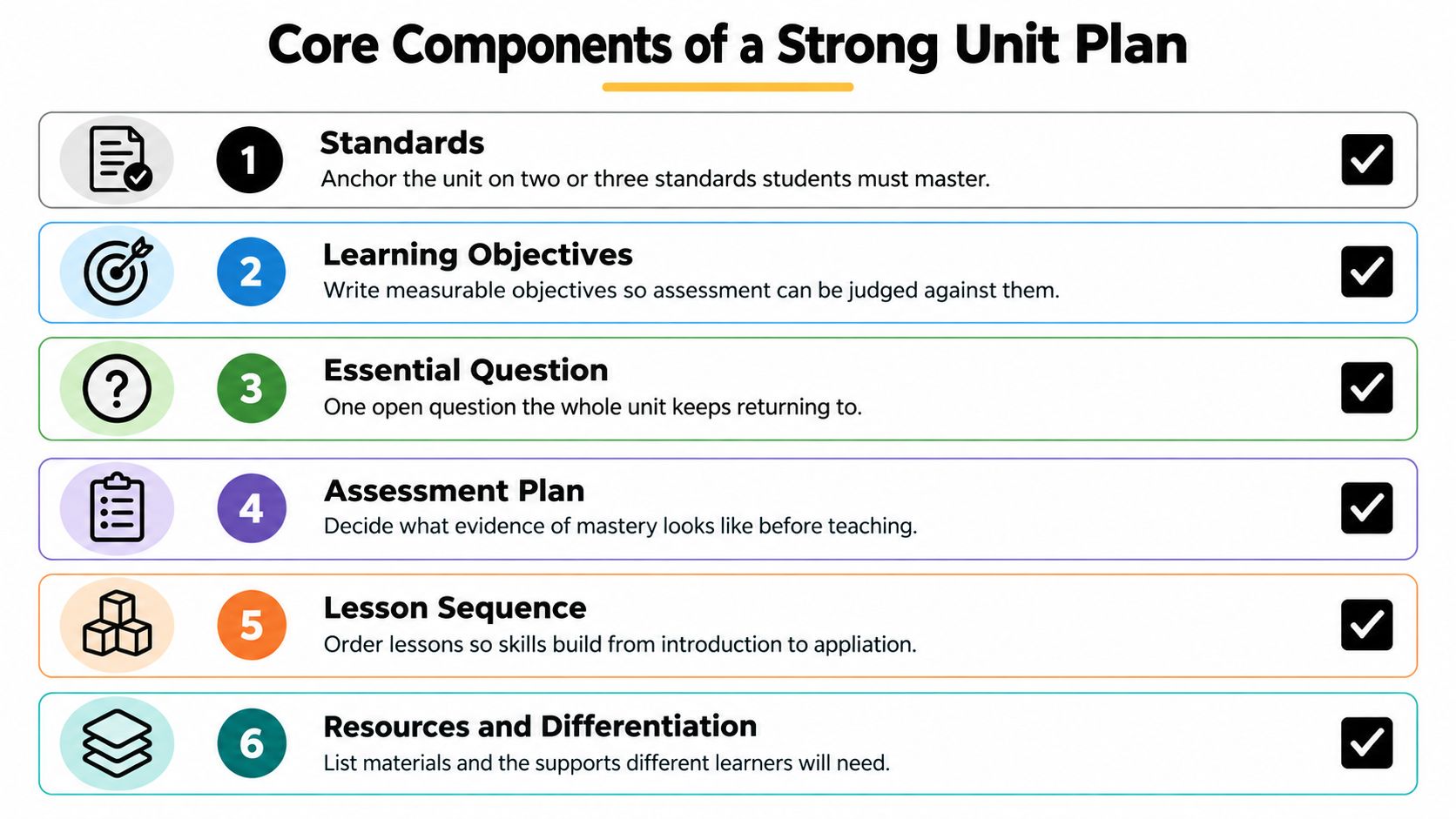
Standards and learning objectives
Begin with the standards students are expected to address. You don't need to turn the unit into a standards list, but you should identify the specific knowledge and skills that matter.
Then translate those standards into measurable learning objectives. “Understand fractions” is too broad to guide assessment. “Students will multiply a fraction by a whole number and explain the meaning of the product in a measurement context” gives you a clearer target.
The standard identifies the expectation. The objective tells you what students will do to demonstrate progress toward it.
Essential question
An essential question gives the unit a frame that students can return to. It should be open enough to support several lessons, but focused enough to keep the work from drifting.
For a science unit, the question might be, “How do changes in an environment affect living things?” For a social studies unit, it might ask, “How does a community decide what is fair?” The question matters because it helps students connect individual activities to a larger purpose.
Lesson sequence
List each lesson in order and describe its role. A sequence might move from activating prior knowledge, to direct instruction, to guided practice, to independent application.
The order should reflect how the skill develops. Students generally need access to the vocabulary and foundational ideas before they can analyze, design, justify, or transfer their learning. Unit-construction guidance from K-12 instructional design emphasizes sequencing and scaffolding content over time rather than treating lessons as isolated events.
Assessment plan
Decide what evidence will show learning before you fill the calendar with activities. Include a final task or assessment, the criteria for success, and smaller formative checks that tell you whether students are ready to continue.
An engaging activity isn't automatically evidence of mastery. A quick explanation, annotated example, exit response, or short conference can reveal a misconception while you still have time to address it.
Resources and differentiation
Identify the texts, models, manipulatives, technology, vocabulary supports, and other resources that will recur across the unit. Then note how you'll support students who need more access, more practice, or more challenge.
The New South Wales unit-planning guide recommends connecting prior knowledge to new knowledge, identifying key vocabulary, planning repeated opportunities to meet learning intentions, and checking understanding before introducing the next chunk of learning. In classroom terms, that might mean adding worked examples, partner rehearsal, sentence frames, or an extension task before moving forward.
How a Unit Plan Differs From a Daily Lesson Plan
The two documents work together, but they solve different problems. A unit plan establishes the destination and route. A daily lesson plan handles the decisions required for one stop along that route.
| Feature | Unit Plan | Daily Lesson Plan |
|---|---|---|
| Purpose | Organizes learning around a shared goal | Plans one class session |
| Time horizon | Several days or weeks | One class period |
| Scope | A theme, topic, skill, or essential question | A specific lesson objective |
| Level of detail | Sequence, pacing, assessment points, and supports | Procedures, timing, grouping, materials, and transitions |
| Primary planning decisions | What students will learn, in what order, and how mastery will be shown | What the teacher and students will do next, and how the lesson will run |
| Example contents | Standards, essential question, lesson map, final task, checkpoints | Opening task, mini-lesson, guided practice, independent work, closure |
A unit plan answers what students will learn and why. A daily lesson plan answers what happens in the next class period and how you'll make it happen. The unit may say that students will move from comparing fractions to solving measurement problems; the daily plan identifies the model, questions, grouping, and practice students will use today.
The difference is especially useful when school events change your calendar. The unit plan helps you decide which lesson can move, combine, or receive more time. The daily plan helps you adjust the activity, timing, and transitions once you know what the class needs.
If you're building a daily plan inside a larger sequence, this lesson plan outline example can help you separate the details of one class from the decisions that belong at unit level. Write the unit first, because it sets the destination. Then write daily plans inside that structure.
A Compact Worked Example for a Two-Week Unit
Consider a Grade 5 mathematics unit on multiplying fractions. The example uses CCSS 5.NF.B.4 as its anchor and keeps one question in view:
Essential question: How can we use fractional parts to solve real measurement problems?
The unit's enduring understandings are that students will recognize that multiplying by a fraction can describe part of a quantity, represent multiplication with models and equations, connect visual representations to written reasoning, check whether an answer makes sense, and apply fraction multiplication to practical situations.
The final task is a recipe-scaling design problem. Students receive a recipe, scale the quantities for a different number of servings, show their calculations, and explain one result using a visual model or written reasoning. The task gives students a reason to use the skill rather than just repeat a procedure.
| Lesson | Focus | Assessment Check |
|---|---|---|
| 1 | Launch with a measurement problem and review fraction meaning | Students represent the problem with a drawing or model |
| 2 | Model multiplying a fraction by a whole number | Teacher checks models and listens for misconceptions |
| 3 | Connect area or length models to fraction multiplication equations | Students explain how the model matches the equation |
| 4 | Multiply fractions in guided examples | Short independent problems reveal readiness |
| 5 | Solve measurement problems with partner reasoning | Students justify which operation they chose |
| 6 | Compare strategies and analyze incorrect solutions | Error analysis response |
| 7 | Plan the recipe-scaling task and receive feedback | Draft calculations and peer check |
| 8 | Complete and explain the final recipe design | Rubric-based performance assessment |
The sequence starts with meaning, moves into representation and procedure, then asks students to apply the skill in context. That order is deliberate. Students aren't asked to scale a recipe before they've had opportunities to connect fractional parts, models, and equations.
The formative checks also have a job. If students can calculate but can't explain what the product represents, the next lesson might return to a visual model. If they understand the model but make errors with notation, you can provide targeted practice without reteaching the entire unit.
This is a compact unit plan, not eight fully written lesson plans. Each daily plan still needs its own objective, materials, instructional moves, timing, grouping, and closure. The unit document merely ensures those daily decisions build toward the same final performance.
A Practical Workflow for Building a Unit
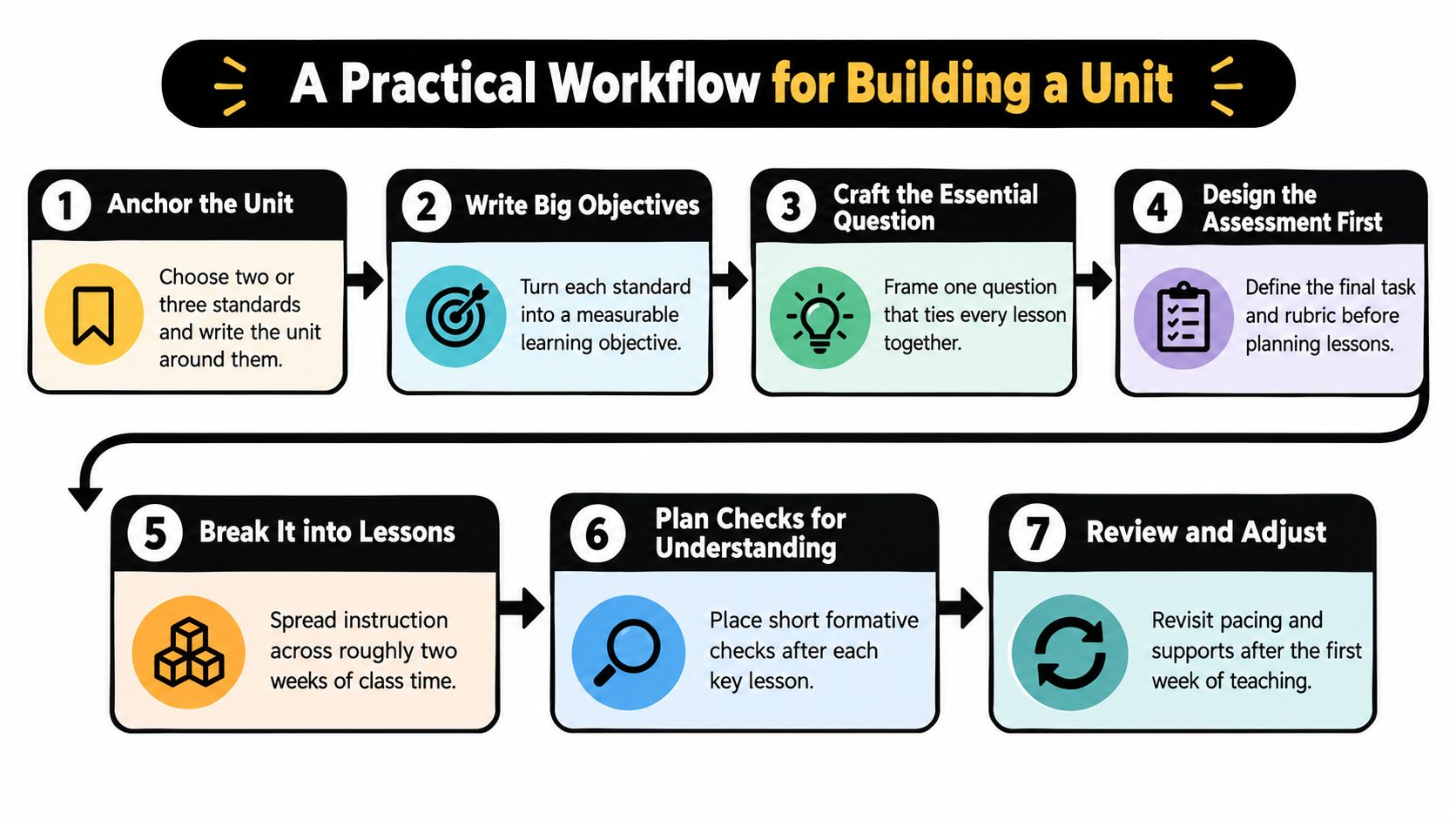
You can build a workable unit without writing every lesson first. Use a standards-first, assessment-first process so the calendar serves the learning rather than dictating it.
-
Anchor the unit in two or three standards. Choose the standards that belong together, then write a student-friendly description of what learners should be able to do. Avoid collecting every possible standard under one topic.
-
Turn the standards into measurable objectives. Decide what students will explain, compare, create, solve, interpret, or demonstrate. These verbs will later shape your assessment and lesson activities.
-
Design the final assessment before the lessons. Draft the performance task, test, product, presentation, or written response first. Add the rubric or success criteria while the target is still clear. The standards-based unit-planning sequence places the post-assessment and grading criteria before the daily sequence for this reason.
-
Group the learning into progressions. Cluster the standards and objectives into a few stages, such as background knowledge, modeled skill, guided practice, independent application, and transfer. This gives each lesson a role.
-
Write the essential question and enduring understandings. The question should give students a reason to care about the work. The understandings describe what should remain after individual activities and vocabulary have faded.
-
Map the lessons and checkpoints. Place the launch, direct teaching, guided practice, independent work, and final task on the calendar. Add a short check after each important learning step. A checkpoint might be an exit ticket, observation record, quick conference, annotated example, or student explanation.
-
Review the sequence after teaching begins. Look at the evidence, then adjust pacing and support. If students need more practice, add it before the next dependent skill. If they're ready, use the available time for application or enrichment.
Assemblies, snow days, testing windows, and reteaching will interrupt the original calendar. Don't treat the plan as a contract that must be followed regardless of evidence. Keep the learning target and final assessment stable, then adjust the order, combine lessons where appropriate, or insert a support lesson.
For daily drafts that sit inside this larger process, a Lesson Plan Generator can help you create an editable starting point from a topic, objective, or standard. Review every generated draft for accuracy, age appropriateness, alignment, accessibility, and fit with the unit sequence before using it with students.
Common Misconceptions About Unit Planning
The first misconception is that a unit is merely a textbook chapter or topic list. A chapter may provide useful content, but it doesn't automatically tell you what students should master, how ideas connect, or what evidence will reveal understanding. Coverage can look complete while important misconceptions remain invisible.
A second misconception is that the daily lesson plan and unit plan are interchangeable. They aren't. The daily plan manages one class period, including grouping, timing, questioning, materials, and transitions. The unit plan manages the larger sequence, pacing, standards, and assessment evidence across several lessons.
A third misconception is that unit planning is mostly paperwork. The document matters because it records instructional decisions that would otherwise be made reactively. When you decide the final task before the activities, you can ask whether each lesson prepares students for that task.
A unit plan should make the learning pathway easier to see, not make your planning folder thicker.
Treating a unit as an assessment and standards design exercise changes the questions you ask. Instead of beginning with “What activity could fill this period?” you begin with “What must students understand next, and what evidence will show that they're ready?” That shift protects instructional time and makes reteaching more purposeful.
Key Takeaways and Next Steps
A unit plan is a structured sequence of lessons built around a shared theme, topic, skill, or essential question. It typically covers roughly two weeks of instruction, while the daily lesson plan focuses on the decisions required during one class period.
The strongest units are designed standards-first and assessment-first. Standards identify the destination, objectives make the destination observable, the final assessment defines the evidence, and the lesson sequence creates a path toward that evidence. Activities still matter, but they earn their place by helping students reach the intended learning target.
Unit planning and daily lesson planning also solve different problems. The unit plan controls scope, sequence, pacing, and assessment design. The daily plan controls grouping, timing, teacher moves, student practice, and transitions. When the two documents align, a change to one lesson doesn't have to derail the whole learning sequence.
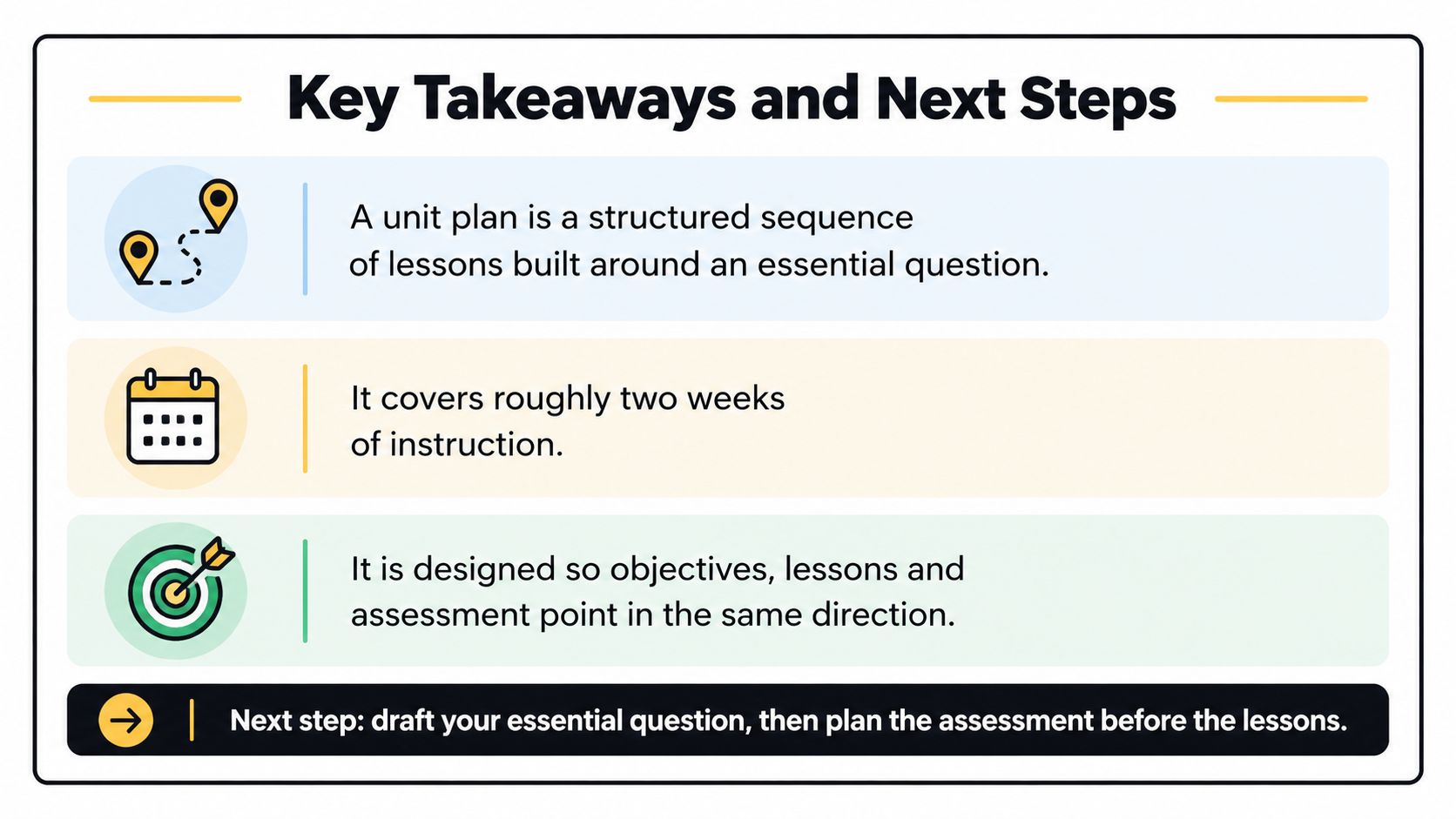
Your next step can be small. Open the Grade 5 fractions example in your planning template, replace the mathematics standard with one from your own grade level, and draft the essential question before you sequence the lessons. If you want a practical way to organize lessons, units, and standards across planning periods, this guide to using a teacher planner can help you choose a workflow that fits your classroom.
Teacher Planner combines a browser-based planbook with planning views for daily lessons, units, timelines, and outlines, plus AI tools that create editable drafts for lesson plans, worksheets, quizzes, adapted texts, and writing feedback. Review the draft, connect it to your unit objectives, and visit Teacher Planner to explore a planning workspace for keeping the sequence visible as your timetable changes.