
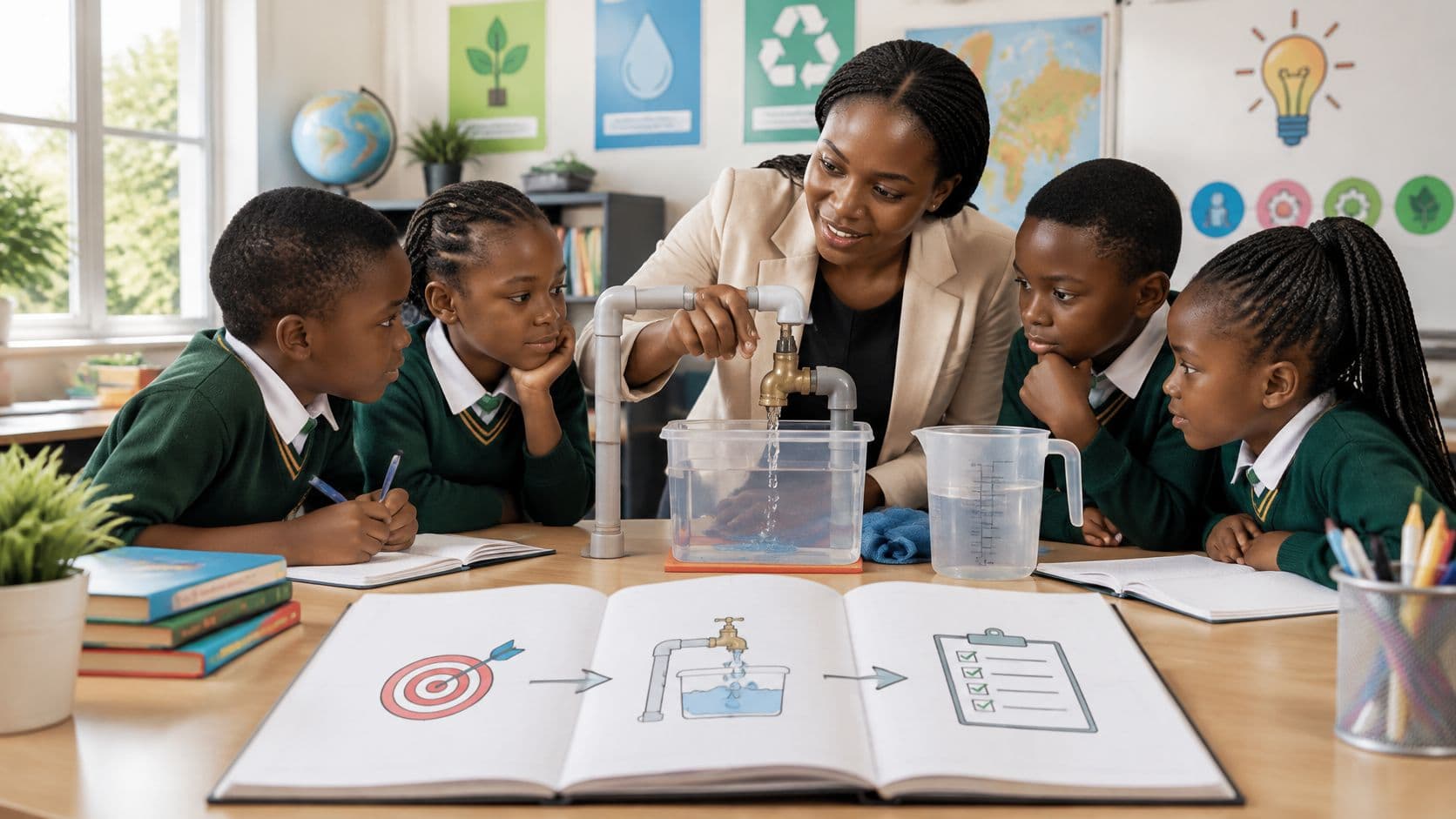
What makes a lesson competency-based if learners are already busy, talking, and completing tasks? The answer is alignment, not activity. Strong CBC lesson planning names a general competence, writes the matching lesson goal as something learners will do, and collects evidence that shows whether that goal was met. When the competence, goal, activity, and evidence point in different directions, the lesson may look active while still functioning as ordinary topic coverage. When they line up, each field in the plan supports the next one.
The Core Parts of a CBC Lesson Plan
A CBC lesson plan names one general competence, states the lesson goal as a learner performance, and links each activity to evidence that shows whether the goal was met. The UNESCO curriculum study describes the approach as emphasizing expected learner performance rather than focusing mainly on expected knowledge. That's why the planning question changes from "What topic comes next?" to "What will learners show by the end?"
The fields work as a chain. The goal tells a teacher what to observe, the activity gives learners a chance to produce it, and the evidence tells the teacher what to collect. The final field then turns that evidence into a decision instead of leaving the plan finished when the worksheet ends.
| Field | What to Write | Illustrative Entry |
|---|---|---|
| Subject and class | Name the subject, grade and lesson number | Grade 5 Science, Lesson 7 |
| General competence | One competence from the curriculum list | Critical Thinking |
| Lesson goal | Numbered learner achievements, one per competence | 1. Learners will identify a problem and suggest possible solutions |
| Success criteria | Observable signs that the goal is met | Names the problem, proposes two solutions, gives one reason for each |
| Learning activities | Ordered tasks that produce evidence | Groups observe a leaking tap and list possible causes |
| Assessment evidence | The product or action the teacher will collect | Each learner's written solution with one reason |
| Next step | The decision taken after reviewing the evidence | Reteach if reasons are missing, extend if solutions are tested |
A longer plan may list several competences, but each one needs its own numbered goal. Teachers who want a wider planning frame can compare this structure with a lesson plan outline example, then keep the CBC evidence chain intact.
If a draft can't show what a learner will do by the end of the lesson, it's still a topic list.
That single test catches most weak drafts. A topic names content. A CBC goal names a performance.
Matching General Competence to Lesson Goal
Every general competence on a plan needs a lesson goal that matches it. If four competences are listed, the goals must reflect all four. Leaving one competence without a goal creates a claim the lesson never tests, while adding a goal without a competence leaves the teacher with no clear reason for collecting that evidence.
The matching table below gives the basic pairings. The verb in each goal follows from the competence, not from habit or from the nearest textbook objective.
| General Competence | Corresponding Lesson Goal |
|---|---|
| Critical Thinking | Learners will identify a problem and suggest possible solutions. |
| Collaboration | Learners will work together in groups to complete a practical task. |
| Communication | Learners will explain what they have discovered or done. |
| Creativity | Learners will develop their own ideas and create something using locally available materials. |
| Citizenship | Learners will demonstrate responsibility by caring for their environment and respecting others. |
Writing the goal without repeating the competence
The lesson goal doesn't repeat the name of the competence. A teacher numbers the expected learner achievements in the same order as the competences listed earlier in the plan. Goal 1 answers competence 1, goal 2 answers competence 2, and so on, which keeps the document short and makes later review easier, including work on tracking standards in lesson plans.
Mismatches are easy to miss on a crowded form. Creativity paired with "Learners will listen to a story" fails because listening doesn't require a learner to develop an idea or make anything. Changing the goal to "Learners will create a different ending using locally available materials" restores the match and gives the teacher something visible to assess.
A quick check catches that problem before teaching. The teacher reads the competence and goal together and asks whether a learner could show the goal while using that competence. If the honest answer needs a long explanation, the pairing probably doesn't fit. A well matched goal rarely needs more than one clear line.
How to Write Observable Learner Achievements
A weak goal hides the performance inside a vague verb. "Learners will understand the water cycle" can't be observed, collected, or corrected during a lesson. A stronger version, "Learners will label the four stages of the water cycle and explain one stage using a diagram," tells the teacher exactly what to look for.
That distinction matters because the National Center for Education Statistics overview of competency-based education describes progress after learners demonstrate mastery of clearly defined objectives. Time spent on a topic doesn't count as the achievement. The learner's visible work does.

Five steps for a checkable goal
- Start with competence and topic. The competence sets the kind of performance, while the topic supplies the content. Skipping the competence often produces a neat content objective that doesn't match the CBC field above it.
- Choose a visible verb. Verbs such as identify, explain, build, compare, and demonstrate name actions a teacher can watch or collect. Verbs such as understand, know, and appreciate describe internal states, so they need a performance added after them.
- Add the condition. The condition names the materials, group size, support, or setting, such as "in pairs," "using the class rain gauge," or "from two sources." Leaving it out makes two very different performances look equally acceptable.
- Number achievements in competence order. The numbering preserves the match without repeating competence names. It also prevents a common drafting slip where two goals both describe communication and none describes collaboration.
- Test for evidence. The teacher asks what could be seen, heard, read, or collected before the lesson ends. If nothing specific comes to mind, the verb or condition needs revision.
An achievement also needs the right size. A full competence may take weeks to build, but a lesson goal must still be checkable within that lesson. "Explain one stage" is a fair slice of Communication for one period, while "communicate scientific ideas confidently" belongs at unit level. Small, observable steps give the teacher usable evidence now and still build toward the larger competence over time.
Assessment Evidence and Rubrics for Each Lesson
One end of lesson task rarely tells the whole story. A stronger plan builds a three-part assessment route into the lesson, so the teacher can spot misunderstanding early, collect a final performance, and respond when mastery isn't there yet. The Institute of Education Sciences CBE Mastery Framework supports a balanced system that can include open-ended, performance-based, project-based, computer-adaptive, and presentation-based assessments.
The first part is a quick formative check during teaching, such as two hinge questions or a partner explanation. The second is a performance task near the end, such as a short written solution or a built model. The third is the planned response, such as a model-based mini-lesson followed by a parallel task for learners who aren't ready to move on.

An illustrative Grade 5 example
In an illustrative fraction equivalence lesson, learners answer two hinge questions, explain a visual model to a partner, and submit a number line task. A learner who can't justify equivalence receives a short model-based lesson and tries a parallel task. A learner who demonstrates mastery applies the same idea to a word problem instead of repeating identical questions.
| Dimension | Shows Mastery When | Shows Not Yet When |
|---|---|---|
| Accuracy | The answer or model is correct with no unresolved errors | The answer is wrong or a required step is missing |
| Reasoning | The student explains why the method works | The student states a result without a justification |
| Evidence | The student cites two relevant data points or examples | The student offers opinion or uses one vague example |
| Communication | The explanation is clear enough for a partner to follow | The explanation is incomplete or cannot be followed |
Recording needs the same precision. "Correct model plus written explanation" helps the next decision, while "completed worksheet" only proves that paper changed hands. Teachers collecting short digital responses may also compare alternatives to Google Forms when a simple form would make hinge questions easier to review.
Each result should lead to one decision written in the plan. The teacher continues, reteaches, extends, or reassesses, and the rubric shows which choice fits. A learner with accurate answers but no reasoning needs a different next step from a learner whose model itself is wrong.
How to Split a 40-Minute CBC Lesson
Timing is where many otherwise sound plans fall apart. Teacher explanation expands, group work gets squeezed, and the final evidence task becomes homework that nobody reviews against the goal. A CBC plan protects time for performance, feedback, reflection, and checking from the start.
A documented competence-oriented sequence in a Springer classroom study used about 5 minutes for contextual problem presentation, 10 to 12 minutes for collaborative design thinking, and 8 to 10 minutes for peer presentation and critique. The remaining time went to reflective consolidation and competency assessment. Those proportions give teachers a practical starting split rather than a rigid script.
| Phase | Minutes | Observable Student Action |
|---|---|---|
| Contextual problem presentation | About 5 | Students predict or name the problem from a real situation |
| Collaborative design work | 10 to 12 | Groups design or build a solution and record their reasoning |
| Peer presentation and critique | 8 to 10 | Groups present and receive specific feedback from peers |
| Reflection and competency check | 13 to 17 | Each learner writes evidence against the success criteria |
| Total | 40 | One action and one feedback point minimum |
The order creates a useful chain. A real context gives learners something to transfer their knowledge to, and collaborative work makes their reasoning visible while there's still time to improve it. Peer critique then supplies immediate feedback, and the final reflection turns group activity into individual evidence.
Timing rule: Every lesson needs at least one observable student action and one feedback opportunity, plus protected time to review and correct the evidence.
A plan that spends most of its 40 minutes on explanation fails that rule even when the written goal is strong. Cutting two minutes of teacher talk often matters less than protecting the final check. Without that closing evidence, the teacher leaves with a memory of a busy room rather than a record of who met the goal.
A Grade 5 Collaboration Lesson
The following plan is a clearly labeled illustrative example, not a record of a real classroom. It uses the same field order as the opening template, so a teacher can copy the structure and replace the science content with another subject. The point is the alignment between fields, not the rain gauge itself.
Subject and class comes first: Grade 5 Science, Lesson 7, The Water Cycle. That heading anchors the lesson in a sequence and prevents the plan from floating as a one-off activity. Next, the general competence is Collaboration, chosen because the practical task requires shared work rather than parallel individual work at the same table.

Goal, criteria, and activities
The lesson goal follows the competence directly: "1. Learners will work together in groups to complete a practical task." It doesn't repeat the word Collaboration, because the numbering carries the match. The goal is also narrow enough to check in one lesson, even though collaborative skill will keep developing across the term.
Success criteria then make that goal observable. Each group member holds a labeled role, such as measurer, recorder, materials manager, or reporter. The group marks its rain gauge to the same agreed scale, and daily readings go into one shared table rather than four private notebooks. Those details matter because they let the teacher distinguish real collaboration from one confident learner doing everything while others watch.
- Problem launch, 5 minutes: The teacher shows a leaking outdoor tap or a photo of one and asks groups how the class could measure rainfall accurately near the school garden.
- Build, 12 minutes: Each group constructs a simple rain gauge from a clear plastic bottle, marks the scale together, and places it in the agreed outdoor spot.
- Presentation, 10 minutes: Groups show their gauge, name each member's role, and receive one specific question or suggestion from another group.
- Individual reflection, 13 minutes: Each learner records the first reading and writes two sentences explaining one reading that looks unexpected or uncertain.
Evidence and next step
The assessment evidence has two layers. The shared reading log shows whether the group produced a common product, while each learner's two-sentence explanation shows whether that learner can interpret the data without leaning on the group. Collecting only the finished gauge would hide both weak participation and weak understanding.
The next step is written before the lesson begins. Groups with missing readings repeat the measurement with closer role checks, while groups with complete logs compare their readings with the local weather report and explain any difference. At the end, the teacher can answer two separate questions: did each group complete a shared practical task, and can each learner explain the resulting data? That's the difference between recording activity and assessing Collaboration.
Adapting Timing and Pacing Without Losing the Goal
Adaptation starts with a fixed point. The goal and success criteria stay the same, while grouping, materials, support, and timing change around them. Changing the goal every time the timetable shifts makes progress impossible to track, but changing the route to the goal is ordinary responsive teaching.
A 20-minute lesson keeps the goal, one observable task, and one feedback check. Group critique becomes brief partner talk, and the reflection becomes a short exit ticket against the same criteria. A 40-minute lesson can run the full four-phase sequence and add either a support route or an extension route, depending on what the class needs most.
A 60-minute lesson earns its extra time through depth, not extra explanation. The collaborative task can run longer, two support routes can operate side by side, and an extension task can challenge learners who finish with secure evidence. Leaving a reassessment slot also prevents unfinished mastery from rolling into the next topic.
Large classes, limited materials, and uneven pace
Scarce materials don't require a weaker goal. Pairs can share one set of equipment, stations can rotate a single kit, or one shared graph on the board can replace individual printed copies. The teacher still collects individual evidence at the end, even when the practice stage was shared, a practical concern also raised in guidance on ways to differentiate instruction.
Pacing works the same way. The class begins together, then learners take different routes, such as a scaffolded graph with labeled axes, an unfamiliar data set, or a critique of a misleading graph. Every route submits evidence against the same criteria.
Advance after the learner interprets the trend, cites two data points, and explains one limitation.
Writing that advancement rule into the plan stops speed from being mistaken for mastery. When an assembly or cancellation shifts the week, the teacher moves the performance task rather than deleting it and changing the goal. Preserving the competence sequence keeps later lessons built on evidence instead of assumption.
Check Each Plan Before You Teach It
A five-minute review catches most alignment problems while they're still cheap to fix. The teacher works down the plan once, in order, and repairs the first failure before polishing anything else.

- Competence match: Each general competence has a matching lesson goal.
- Numbering: Goals appear in the same order as the competences.
- Observable performance: Every goal names something a teacher can see or collect.
- Student action: Each activity produces work, talk, or a product from learners.
- Timing: The phases add up to the actual lesson length.
- Specific evidence: The plan records quality, not mere completion.
- Next step: The continue, reteach, extend, or reassess decision is written down.
A drafting tool can speed the first version. Teacher Planner's Lesson Plan Generator drafts a plan from a topic, learning objectives, or standards, but that output is an editable draft. Accuracy, difficulty, wording, and fit for the class all need teacher review before learners see the material.
The practical move for this week is small. A teacher runs the checklist on one upcoming lesson, fixes the first item that fails, and teaches that revised plan before rewriting anything else.
Teachers who want one browser-based planbook for drafting CBC plans, organizing lessons by day or week, and keeping goals beside their evidence can start with Teacher Planner. Its Lesson Plan Generator produces an editable draft from a topic, objectives, or standards, ready to run through the checklist above. A free account is required for generation, and every draft still deserves a careful teacher check before class.