
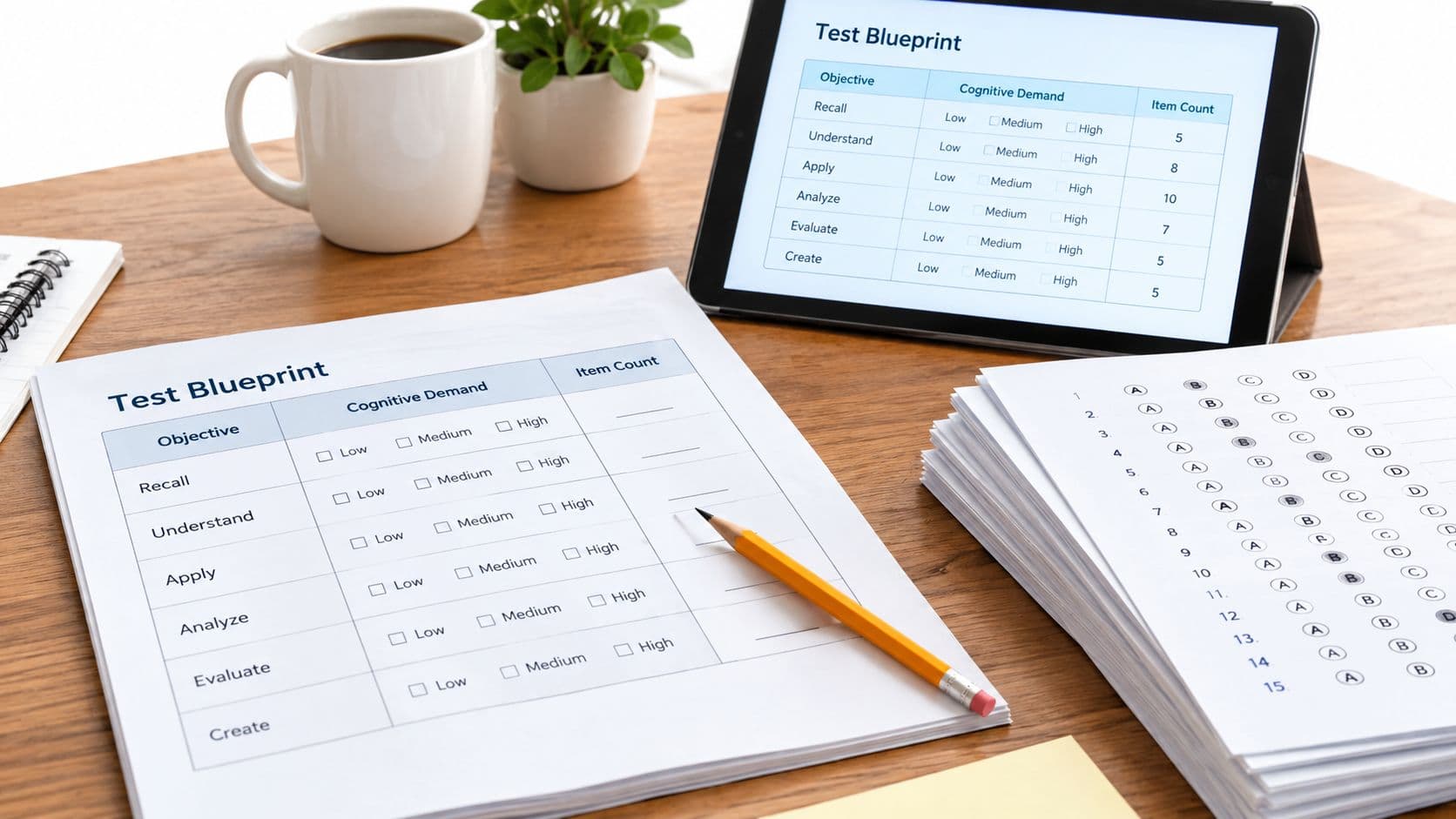
A good multiple choice test isn't a list of questions you race to finish before first period. It's a measurement tool you blueprint, draft, review, and then read for evidence about what to teach next. If you build it in that order, you won't just get faster scoring. You'll get scores you can trust, wrong answers you can learn from, and a quiz worth reusing next term.
Why Your Tuesday Morning Quiz Is Probably Not Doing Its Job
It's Tuesday, your coffee's gone cold, and you're staring at two problems at once. On your desk there's a stack of unscored papers from last week. On your screen there's a half-written quiz for third period, with three solid questions, two you borrowed from somewhere, and a final item where you can't tell if B or D is more correct.
That ambiguity is the tell. When you handed back the last quiz, half the class passed, several strong students missed easy items, and a few students who hadn't done the reading scored surprisingly well. You couldn't tell who'd mastered the material, who'd guessed well, and who'd been tripped up by your wording. The quiz produced grades, but it didn't produce usable information.

The Symptom Is Design, Not Effort
Teachers usually blame effort first. Students didn't study, or they rushed. Sometimes that's true, but inconsistent results often point to reliability, meaning whether scores stay consistent enough to support the decision you're making from them. A 2021 study of university multiple-choice assessments found a mean reliability of 0.77 across 50-item tests, with a standard deviation of 0.12 and values ranging from 0.20 to 0.92, showing that labeling an assessment multiple choice doesn't guarantee dependable results.
That range should change how you plan. A short quiz built from whatever questions come to mind can rank students by luck, reading speed, or tolerance for tricky phrasing. A designed quiz samples your objectives deliberately, uses distractors tied to real misconceptions, and gives you enough items that one lucky guess doesn't swing the outcome.
Practical rule: If you can't explain what a wrong answer tells you, the item isn't finished yet.
For K-12 classrooms, that matters because most quizzes are low-stakes measurement tools, not final verdicts. Their job is to feed instruction while there's still time to act. Spending a little more time on design before printing saves you from regrading disputes, reteaching the wrong topic, and wondering whether a low score means low learning.
Build the Test Blueprint Before You Write a Single Question
Start with objectives, not questions. List what students were supposed to learn in the unit, in the language you'd use to report progress. Then decide how much evidence you need for each objective before you'll trust a conclusion about it.
A one-week unit on photosynthesis might have four objectives worth assessing. If you write questions first, you'll probably over-sample Friday's lesson because it's freshest in your mind. A blueprint prevents that drift by forcing the coverage decision up front, while you're still thinking like a planner instead of a question writer.
A Copyable Blueprint for a Short Unit Quiz
Decide total length first. For a classroom quiz, length is a trade-off between coverage and fatigue, so choose a number you can score and review while the results still matter. Then assign items by importance and instructional time, not by how easy an objective is to turn into a question.
Sample Blueprint for a 20-Question Photosynthesis Quiz
| Objective | Cognitive Demand | Item Count |
|---|---|---|
| Identify inputs and outputs of photosynthesis | Remember and understand | 4 |
| Explain the role of chlorophyll and chloroplasts | Understand | 4 |
| Predict effects of changed light, water, or carbon dioxide | Apply and analyze | 7 |
| Evaluate evidence from a simple plant-growth experiment | Analyze and evaluate | 5 |
Notice the cognitive mix. Recall items confirm vocabulary and basic facts, but they shouldn't dominate if your lessons asked students to predict, explain, and interpret data. If your blueprint is mostly remembering, your instruction and assessment aren't aligned, no matter how clean the questions look. The same blueprint logic works when you're building a multiple choice vocabulary quiz for a shorter word-study unit, where definitions need to sit alongside use in context.
How to Adapt the Template
Keep three columns and add a fourth for your source lesson or standard if your school requires traceability. For a longer unit, split a broad objective rather than inflating one row until it means everything. For a quick check, cut objectives instead of cutting every objective down to a single item, because one question can't reliably tell you whether a student understands a whole idea.
Write the blueprint on one page and keep it with the quiz. Later, when scores look odd, that page tells you whether you have a teaching problem, a coverage problem, or a single weak item.
Draft Stems and Distractors That Actually Discriminate
A strong item puts the thinking in the stem and keeps the options short, parallel, and plausible. Students should be able to cover the options, read the stem, and know what kind of answer you're asking for. If they need the options to figure out the question, the stem isn't carrying its weight.
Write the correct answer first, then build three distractors from errors you've seen in student work. Don't invent silly opposites to fill space. A distractor no one chooses gives you no information, and it turns a four-option item into a coin flip between the two answers students take seriously.

Worked Example You Can Copy
Stem: A plant is placed in bright light but its leaves are coated so carbon dioxide cannot enter. What will happen to glucose production?
- A: It will increase because light energy is more available.
- B: It will decrease because a required raw material is missing.
- C: It will stay the same because the plant can use oxygen instead.
- D: It will stop only if water is also removed from the soil.
The correct answer is B. Each wrong answer diagnoses something specific. A reveals a student who overweights light, C swaps gases, and D suggests the student thinks one missing input can be ignored. That's why the item can discriminate. It separates students who understand the relationship among inputs from students who've memorized the equation without grasping it. You'll find the same misconception-first approach useful in these examples of multiple choice questions for science.
Four Common Flaws and the One-Line Fix
- Clue in the stem: If grammar or length points to the answer, rewrite all options in the same form and similar length.
- Overlapping options: If two answers can both be defended, narrow the stem or change one option so only one fits.
- Buried negative: If you must use NOT or EXCEPT, capitalize it and keep the rest of the stem simple.
- Absurd distractor: Replace the joke option with a misconception from homework, discussion, or last year's quiz.
Avoid all of the above. It rewards partial recognition and makes item analysis messy because you can't tell which part a student knew. Before you save a draft, read each item aloud, check that the correct answer isn't always the longest, and confirm every distractor has a reason a real student would pick it.
A distractor should be wrong for an instructive reason, not wrong because it's ridiculous.
Review AI-Drafted Items Like a Department Chair
AI can draft a multiple choice test quickly, but speed isn't the same as assessment quality. The risky assumption is that polished grammar means a finished item. In practice, generated questions often sound clean while testing less than your lessons taught.
That concern is concrete, not theoretical. A 2025 study of 80 ChatGPT-4-generated psychology questions found that 73.75% assessed only remembering or understanding, just 8.75% assessed analyzing or evaluating, and 11.25% showed poor discrimination, with distractor quality as the weakest validity dimension. If you print that kind of draft unreviewed, you can narrow a rich unit down to recall and then misread the results as mastery.

Run a Short Review Rubric Before Printing
Tools such as Teacher Planner's Multiple Choice Quiz Generator can draft questions and an answer key from a topic or standard, and you can save, copy, download, or print the output. Treat that output as an editable draft requiring teacher review, not as a student-ready test. Then check each item against six questions.
- Answer uniqueness: Can a knowledgeable colleague defend only one option as correct?
- Distractor plausibility: Would a student with a specific misconception choose each wrong answer?
- Cognitive demand: Does the item match the demand in your blueprint, or did an analyze objective collapse into recall?
- Curriculum alignment: Does it assess what you taught, at the depth and vocabulary you taught it?
- Difficulty: Is it too easy because the distractors give it away, or too hard because of unfamiliar context?
- Discrimination potential: Will students who understand the idea reliably outperform students who don't?
Apply the same skepticism elsewhere. When you interpret AI detector results for student writing, a score is a prompt to investigate, not a verdict on its own. AI-generated quiz items deserve the same posture. Rewrite stems that only ask for definitions, replace generic distractors with classroom misconceptions, verify every answer independently, and delete items you can't align to the blueprint. Deleting is a legitimate review outcome. A shorter quiz with defensible items beats a longer one padded with fluent filler.
Read the Item Analysis Table Before You Hand Back the Quiz
Don't hand back scores until you've looked at the items themselves. A class average tells you almost nothing about whether to reteach, revise a question, or move on. Item analysis turns the stack of answered quizzes into evidence you can act on.
Build a simple spreadsheet with one row per item. You'll track how many students chose each option, then calculate two core measures by hand or with basic formulas. You don't need specialist software for a classroom quiz, but you do need consistent columns so you can compare items across units.
The Three Columns That Matter Most
Difficulty, often shown as a p-value, is the share of students who answered correctly. Very high values can mean the item was too easy to separate levels of understanding, while very low values can signal untaught content, confusing wording, or a genuinely hard concept. Neither is automatically bad. Context from your blueprint decides whether the result makes sense.
Discrimination asks whether students who scored well overall also tended to get this item right. A practical classroom method is to compare performance on the item between your highest-scoring and lowest-scoring groups. If your strongest students miss an item as often as everyone else, inspect the wording and answer key before blaming the class.
Distractor function is where the diagnostic value lives. Count choices for A, B, C, and D. A distractor nobody picks isn't working, and a wrong option that attracts many strong students may be ambiguously worded or arguably correct.
Item Analysis for Three Photosynthesis Items
| Item | Difficulty (p-value) | Discrimination Index | Action |
|---|---|---|---|
| Inputs and outputs | 0.87 in this worked example | Low positive | Keep for confidence, but don't weight it as evidence of deep understanding |
| Carbon dioxide blocked from leaves | 0.58 in this worked example | Strong positive | Keep, and use wrong options to plan reteaching |
| Evaluate plant-growth evidence | 0.31 in this worked example | Near zero | Review before scoring, because top students chose a distractor heavily |
Read the third row carefully. If a distractor outdraws the correct answer among strong students, reread the item as if you're seeing it cold. Check the key, look for a second defensible answer, and decide whether the data table in the stem supports your intended conclusion. Flag the item, note the suspected flaw, and revise it before reuse. That note is more valuable than the original score because it makes next year's quiz stronger.
Score, Feedback, and Reteaching Based on the Data
Score with your item analysis open, not after you've already entered grades. For each flagged item, make one decision and write it down on the blueprint. Documentation sounds bureaucratic until next term, when you can't remember why a question was changed.
- Keep: The item worked, so score it as planned and retain it for the item bank.
- Revise: The objective is sound but the wording, key, or a distractor needs repair before reuse.
- Throw out: The item can't support a fair score, so remove it from this grading and record why.
Group Misses by Objective, Not by Question Number
Sort missed items back into blueprint rows. If students missed items across the experiment-evidence objective, reteach how to read growth data rather than reviewing isolated questions one by one. If misses concentrate on one distractor, teach that misconception directly. For photosynthesis, students choosing the oxygen-swap option need a focused comparison of gases entering and leaving the leaf, not a repeat of the whole unit.
Plan the reteaching block around the largest, most teachable gaps first. Students who've mastered an objective can tackle an extension prompt while you work with the group that needs the concept rebuilt. That approach is easier to sustain when your drafting workflow is repeatable, which is why a structured multiple choice vocabulary quiz maker process follows the same blueprint, review, and revise habits.
Give Feedback Students Can Use
Return more than a percentage. A printable answer key can include the item number, correct answer, objective, and a one-line note on the most common misconception. Students then mark whether they missed because of vocabulary, a swapped concept, or misread evidence. That small reflection step turns a multiple choice test from a sorting event into the start of your next lesson, and it gives you a Monday morning plan grounded in what students chose.
Build your next quiz from a blueprint, then use Teacher Planner to draft editable multiple-choice items and an answer key you can review, save, copy, download, or print alongside your plans. Bring your review rubric to the draft, revise what doesn't match your objectives, and keep the item notes with your planbook so the next unit starts from evidence instead of a blank page.