
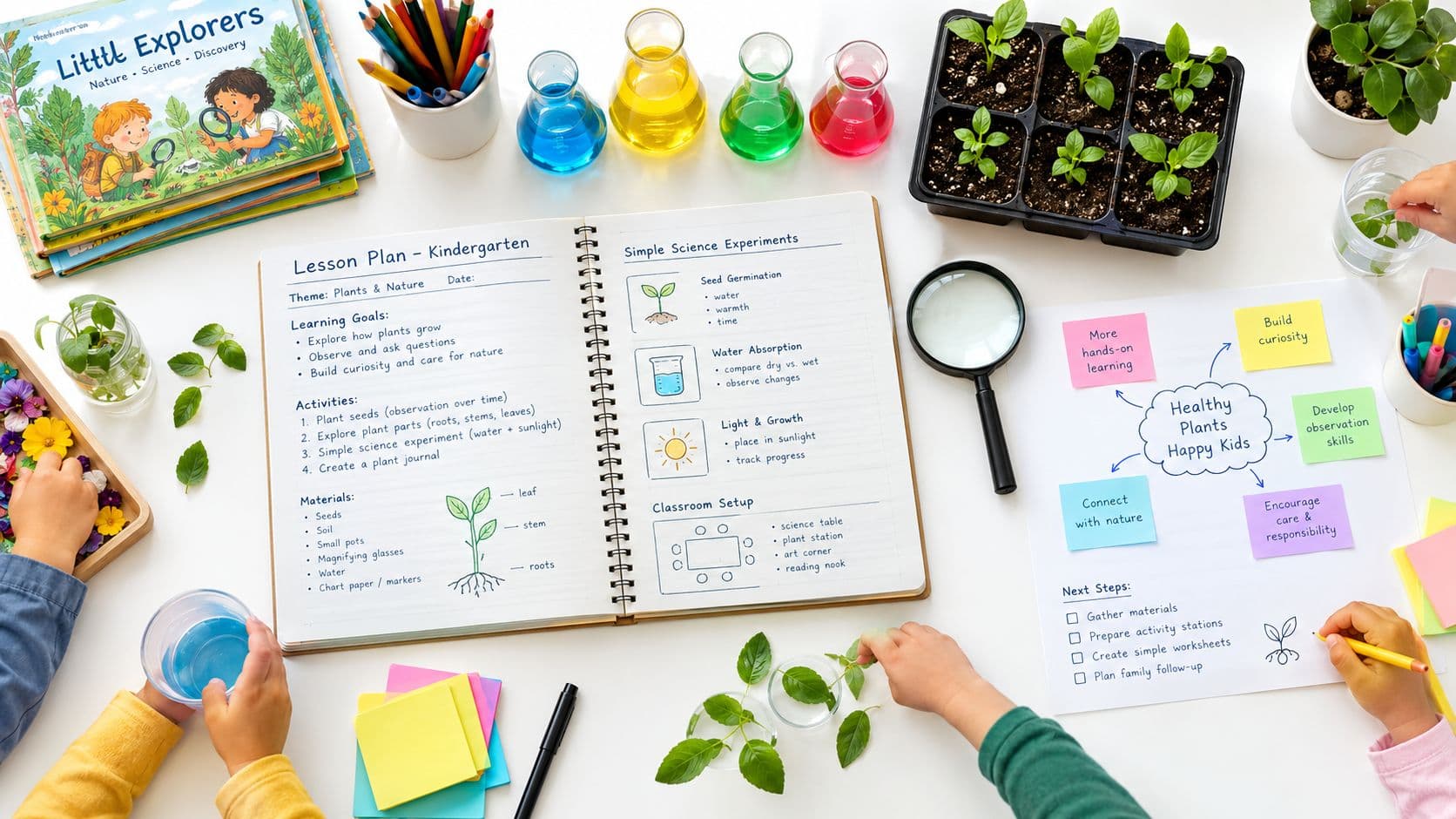
Your science block is about to start, but the plan still has only a topic and a pile of materials. These five science lesson plan for kindergarten examples give you ready-to-adapt structures with objectives, hands-on investigations, vocabulary, formative assessment ideas, materials, and differentiation. Each example uses a different inquiry type, so you can choose an activity that fits your schedule, standards, classroom resources, and learners.
The sequence is practical: begin with an observable question, guide children through an investigation, listen for evidence of thinking, and adapt the task without removing the science. You'll also see how to turn a single activity into a repeatable lesson routine. For additional classroom activity inspiration, explore this kindergarten activity guide. Teacher Planner can also help you organize recurring lessons and draft editable planning materials, but teacher review and assessment decisions remain essential.
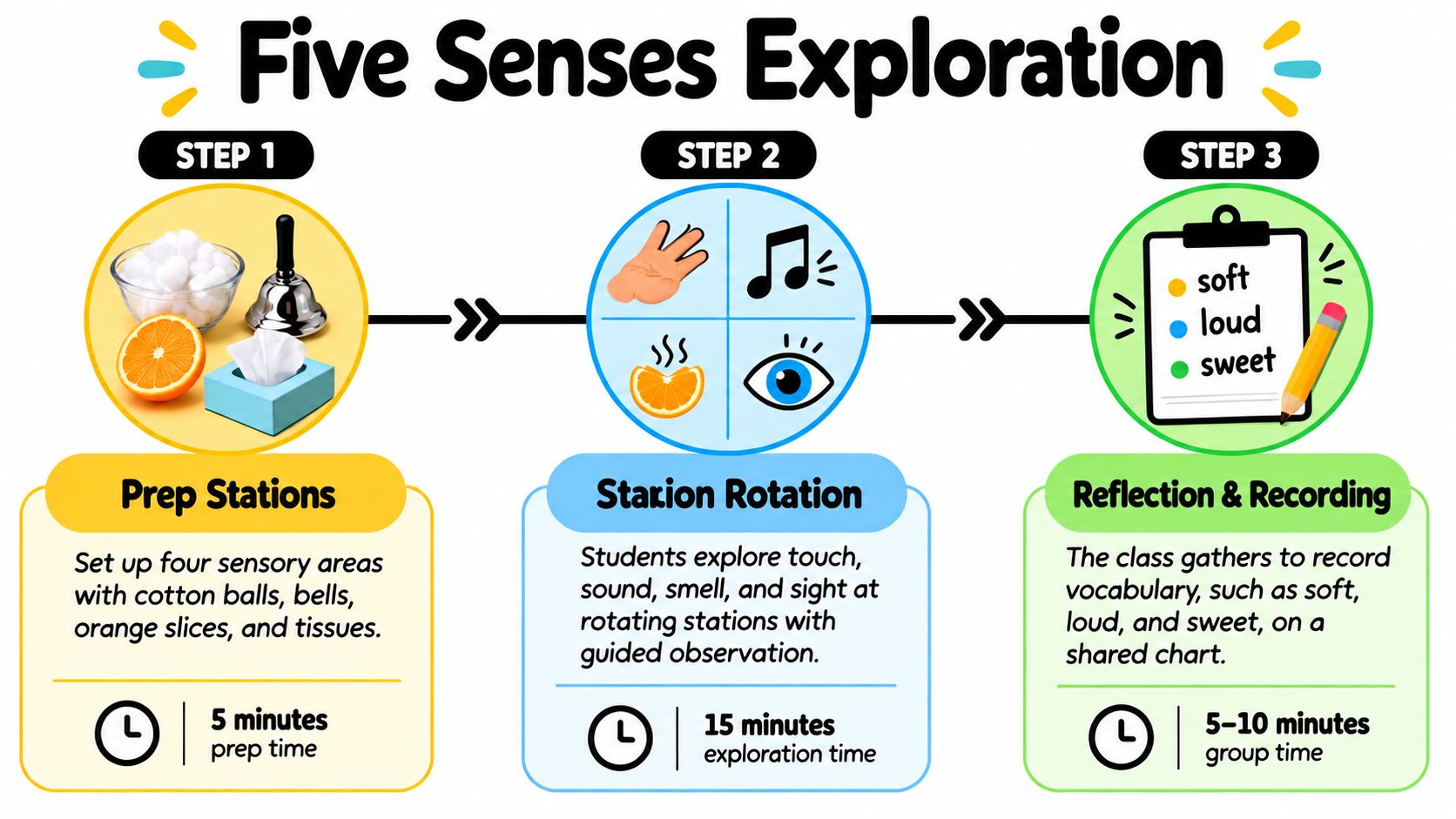
1. Five Senses Exploration Lesson Plan with Sensory Station Rotation
A sensory rotation works well when children need to connect scientific observation with precise language. Instead of asking students to memorize the names of the senses, give them objects they can investigate and ask, “What do you notice?” The objective is: Students will use sight, smell, hearing, and touch to describe an object with at least one observable word and identify the sense used.
Use familiar, low-cost materials. Set up four stations with a picture cue showing the sense children should use. A two-period sequence gives you time to introduce the routine, rotate safely, and revisit the evidence without rushing.
- Touch station: Provide cotton balls, sandpaper, silk fabric, and plastic wrap. Children close their eyes, when appropriate, and describe whether each object feels soft, rough, smooth, or slippery.
- Smell station: Offer an orange peel, cinnamon stick, mint leaf, and vanilla extract on a cotton pad. Children predict what they might smell before taking a careful sniff.
- Sound station: Use bells, wooden blocks, rice in a sealed container, and crinkly paper. Children predict whether each item will sound loud, soft, shaky, or scratchy.
- Sight station: Display colored tissue paper, feathers, sequins, and small mirrors. Children describe colors, shapes, patterns, and reflections.
Make the rotation manageable
A visual timer helps children anticipate movement, while a bell, whistle, or chime can signal each transition. Pre-teach that signal during morning meeting. A laminated poster with a picture of an ear, eye, nose, or hand gives multilingual learners a quick reference without requiring them to remember every word.
If you have an aide or parent volunteer, assign one adult to a station to redirect behavior and keep the pace consistent. Students can record through drawings, partner talk, teacher-scribed statements, or a class chart. Photographing the stations can support a sensory book or parent newsletter.
Listen for evidence: A child who says “It feels rough” is showing more than a child who only names “touch.” Ask, “What makes you say rough?” and record the description.
Check learning by showing a new classroom object and asking children to name the sense they'd use and one property they might observe. For adaptation, offer gloves or tools for students who avoid direct touch, let children observe the smell station without smelling, and provide sentence frames such as “I notice ___” or “I used my ___ to learn about it.” Teacher Planner's Lesson Plan Generator can draft station directions, and its editable output can be turned into station cards for your planbook week view.
2. Plant Growth Observation Lesson Plan with Weekly Seed Journal
A seed journal turns plant growth into a biological-change investigation that children can revisit. The child-friendly objective is: Students will observe, draw, compare, and describe how a plant changes over time, using evidence from their journal. The clear cup matters because children can see roots as well as stems and leaves.
Use lima beans, clear cups with drainage holes, moist potting soil, water, and paper or digital journals. Prepare the cups before the lesson so planting time stays focused. Schedule observation lessons twice weekly for 10–15 minutes, with independent journaling on alternate days. The timing is part of the supplied classroom example, not a performance guarantee.
Build the journal across four weeks
- Week 1: Children plant a seed, draw the cup and seed, and dictate “What I did today.” Keep the first entry as baseline evidence.
- Week 2: When sprouts appear, children draw roots and tiny leaves. Compare plant heights with paper clips or blocks instead of requiring standard measurement.
- Week 3: Children observe longer stems and new leaves, water their plants, and dictate “How my plant changed.”
- Week 4: Create a class chart answering, “What does our plant need to grow?” Invite children to contribute sun, water, soil, and air.
The investigation becomes stronger when children revisit the same plant rather than complete a one-time craft. Assign 2–3 Plant Helpers each week to check moisture and report observations. A bulletin-board chart can show the tallest and shortest plants, while weekly photographs create a visual growth sequence.
“My plant has more leaves than before” is a useful explanation because it compares evidence across dates.
Assess through three checks. Can the child draw an observable plant part? Can the child describe a change using “before” and “now”? Can the child identify a need and connect it to an observation? If a plant dies, ask, “What do you think happened? What could we do differently?” The event can prompt investigation rather than embarrassment.
Give children alternatives to handwriting, including teacher dictation, speech recording, picture choices, or pre-drawn journal boxes. Prepare a large model cup for children with visual or mobility needs. In Teacher Planner, the Worksheet Generator can draft a simple observation sheet with drawing space and dictation lines. Save or print the draft only after checking that the page suits your students.
3. Weather and Seasons Unit Lesson Plan with Daily Weather Graph and Sorting Activities
Weather observation is most meaningful when children collect evidence repeatedly. K-ESS2-1 asks kindergarten students to use and share observations of local weather conditions to describe patterns over time, so a single weather drawing won't provide enough evidence. The objective is: Students will record daily weather observations and describe one repeated or changing condition using their class graph. See the NGSS kindergarten document for the standard language.
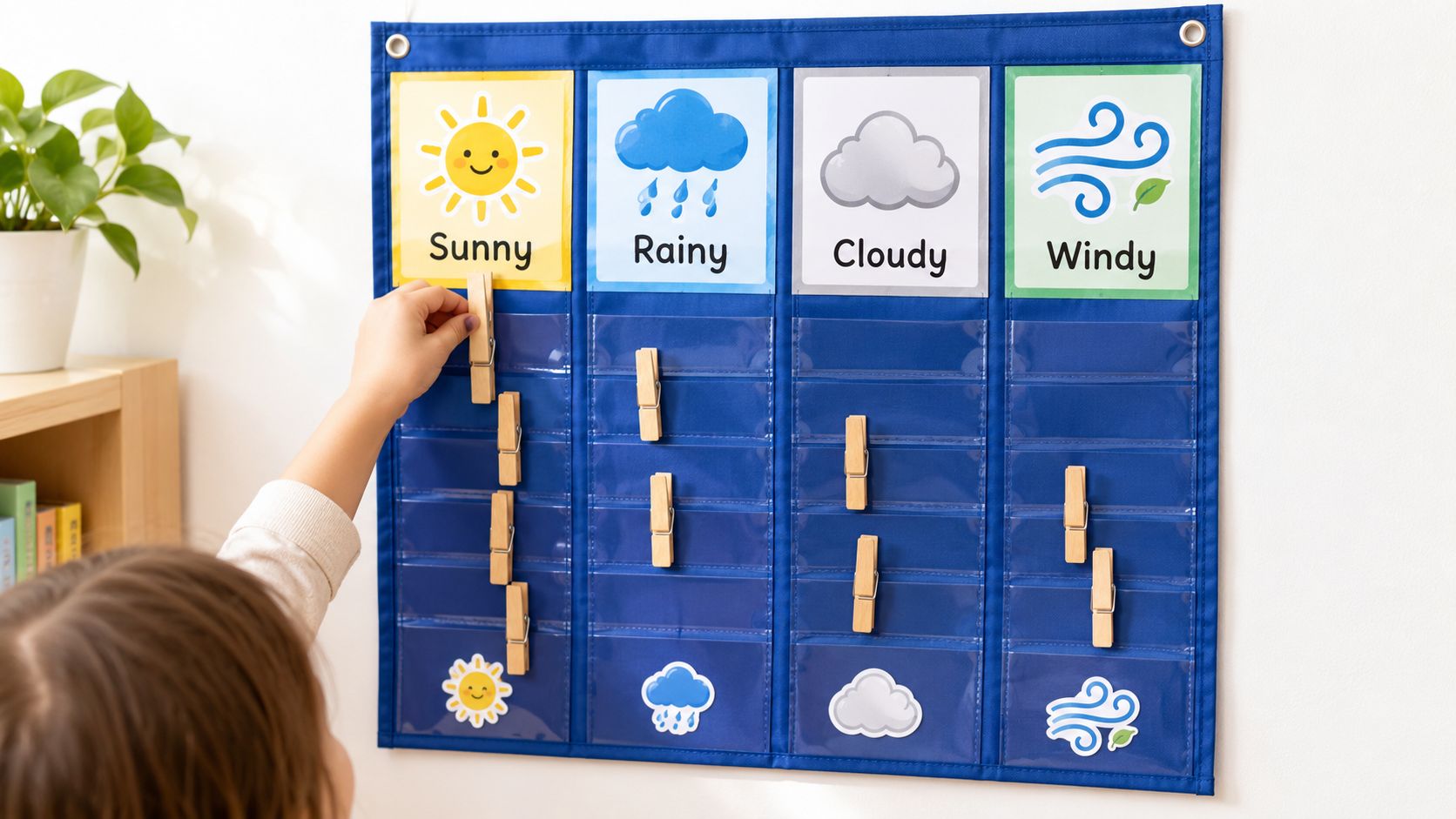
Create a large pocket-chart graph with columns for sunny, rainy, cloudy, and windy weather. Add a daily weather pocket with matching words and picture symbols. Each morning, the Weather Reporter looks outside, places a clothespin or sticker on the appropriate column, and explains the choice.
Turn observations into comparisons
On Monday, ask, “Look outside. Is it sunny, rainy, cloudy, or windy?” On Wednesday, compare the cloudy and sunny columns. On Friday, count the week's marks and discuss which condition appears most often. The supplied example uses this class record: Sunny = 3, Rainy = 1, Cloudy = 2, Windy = 1. Those values belong to the example only, so replace them with your actual observations.
Use a second routine for seasonal classification. Place baskets labeled with season names around the room. Show a picture of snow and ask children to place it in winter. Repeat with a spring flower, fall leaf, and summer beach scene. Children should explain their choice with an observable feature, not only repeat a season name.
A useful distinction is observation versus prediction. “The sky has dark clouds” describes what children see. “Rain may come” is an interpretation or prediction. Ask children to use words such as same, different, warmer, cooler, windier, and less cloudy.
Practical rule: Keep the symbols and graph format consistent. Children need to compare data, not decode a new display every morning.
Assess by asking each child to point to a graph column and complete, “We had more ___ than ___.” For language support, provide picture cards, gestures, home-language discussion, and partner rehearsal. For sensory access, use a classroom thermometer, wind ribbons, or recorded weather sounds alongside outdoor viewing. If time is limited, maintain the daily observation and move sorting to one weekly small-group session.
A repeating “Morning Weather” block in Teacher Planner can keep the routine visible. The unit plan guide can help you connect daily observations, weekly graph discussions, and the final pattern share-out.
4. Living Things Classification Lesson Plan with Nature Collection Sort and Habitat Match
Classification gives children a reason to compare attributes and defend a category choice. Use the schoolyard or a classroom nature corner, but set collection boundaries before children begin. The objective is: Students will sort familiar items as living or not living and match selected plants or animals to a suitable habitat using observable characteristics.
Start with a walk. On the first day, ask each child to find one living thing and one not-living thing, following school rules about what can be touched or collected. Rocks, leaves, bugs, sticks, and flowers can prompt discussion, but use photographs or teacher-collected samples when handling an item could harm a living thing.
Develop the sort across two weeks
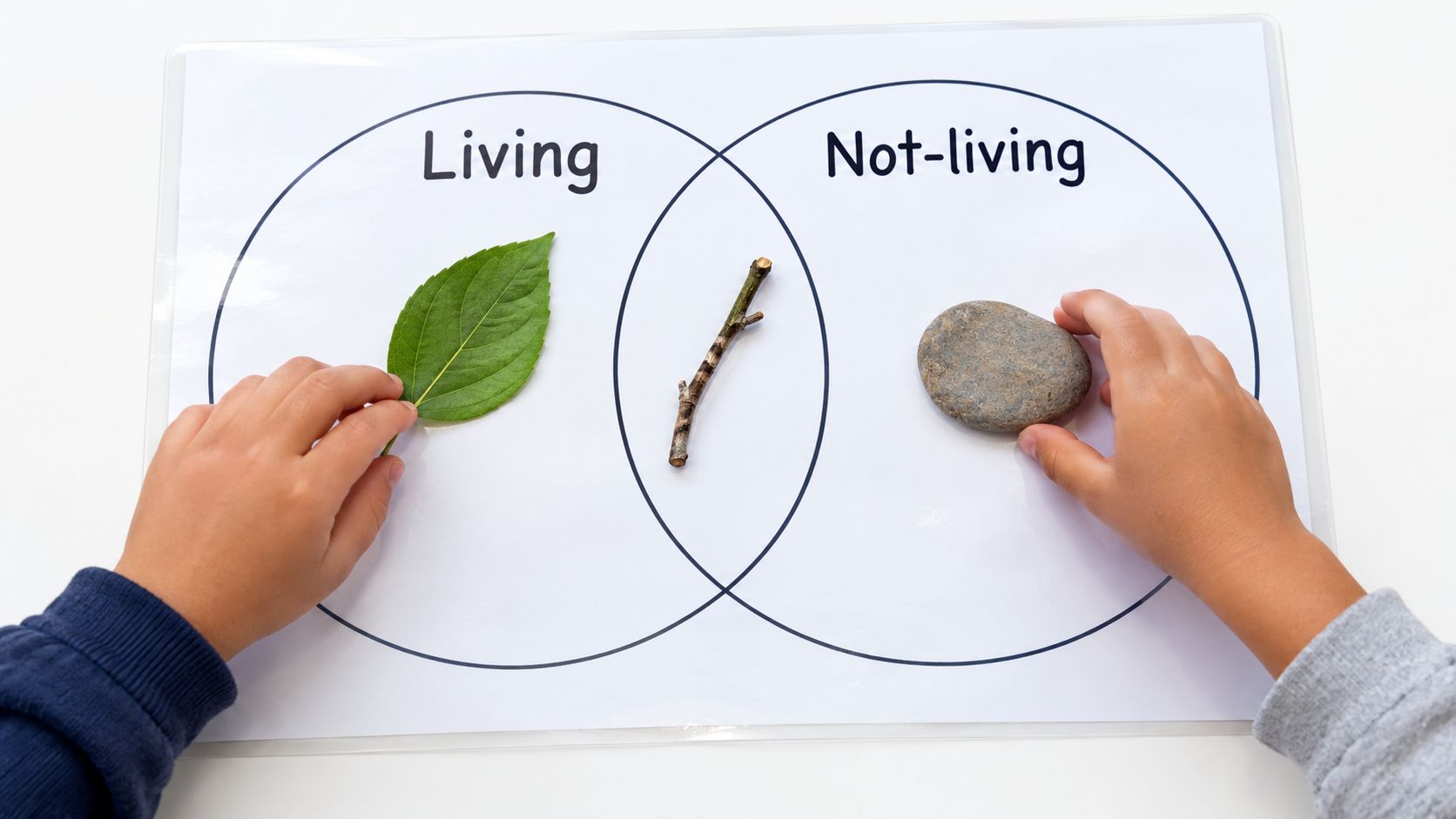
In Week 1, place a large laminated Venn diagram on the floor with clear labels, Living things and Not-living things. Introduce the idea that living things grow, need resources, and carry out life processes. Then ask, “Where does your rock go? Where does your leaf go?” Avoid treating every child answer as a final definition. Ask what evidence supports the placement.
In Week 2, introduce four habitat images: a forest with trees, a pond with water, a desert with sand, and the sky with clouds. Mix animal and plant cards. Children match a bird to the sky, fish to the pond, and other images to likely habitats, explaining which feature helped them decide.
A nature detective can lead naming and observation while classmates check the chart. Local field guides and picture books help children identify items without turning the lesson into a vocabulary test. Photographing the sorted collections can create a class review book.
The strongest response isn't “It goes there.” Ask, “What do you notice that helped you choose that place?”
Formative assessment can be a new item sort. Give a child a picture of a mushroom, a rock, or a tree and ask for a category plus an explanation. For habitat assessment, remove the habitat labels and ask children to rebuild the matches with a partner. Record whether students name an observable attribute, listen to another idea, and revise a placement when new evidence appears.
Use color-coded baskets, enlarged images, tactile objects, and partner talk for access. Children who can't collect outdoors can photograph items, point to teacher-held samples, or sort picture cards. The Multiple Choice Quiz Generator can help create a short teacher-reviewed review resource, but a quiz should supplement, not replace, observation and explanation. Teacher Planner's Lesson Plan Generator can also outline both weeks and produce a sorting guide.
For more hands-on extension ideas, explore these nature STEM activity crafts.
5. Five Senses and Safety Lesson Plan with Tasting and Touching Rules
Safety is part of the science objective, not a warning added after the activity. This lesson combines sensory description with boundaries children can use in later investigations. The objective is: Students will identify the sense used in an approved exploration, describe a sensory property, and explain one safe classroom rule.
Teach the first session with approved touch objects, such as a soft blanket, smooth stone, bumpy pinecone, and cold ice pack. Place scissors, a marker, and a dry-erase eraser in a separate Not Safe to Touch basket. Say clearly, “These are not safe for touching. Only the teacher handles these.” Children can sort picture cards before handling materials.
Make tasting optional and prepared
Send a home note one week before the tasting session with the planned foods. Ask families to report allergies or sensitivities, and follow school policy. Offer pre-cut, labeled apple slices, lemon wedges, salt crackers, and yogurt. Children can describe crunchy, sweet, sour, salty, smooth, or cold with teacher-provided choices.
Use a new tasting utensil or spoon for each child and each food to reduce cross-contamination. Children who don't want to taste can observe, smell, or describe a peer's experience. A peer buddy can work as the speaker and listener, with the listener naming the sense being used.
Create two anchor charts. One can show Safe Classroom Touches, such as a soft blanket, smooth rock, and clean hands. The other can show tastes and textures. The class should practice the routine before food appears: listen to the rule, wait for approval, use the assigned utensil, describe the experience, and stop when asked.
Safety boundary: Children may explore only materials the teacher has approved, and tasting is never required.
Assess through a brief demonstration. Show an object and ask, “Is this safe for you to touch?” Then ask, “Which sense could you use, and what word might describe it?” A child can answer orally, point to a picture, use a gesture, or communicate through a partner. For children with sensory sensitivities, offer a no-taste pathway and alternatives to direct contact. For multilingual learners, pair every vocabulary word with an image, gesture, and home-language option.
Teacher Planner's Lesson Plan Generator can draft the two-day sequence and a pre-tasting safety prompt. Its Worksheet Generator can produce an editable family form, but check every ingredient, instruction, and privacy detail before printing.
Comparison of 5 Kindergarten Science Lesson Plans
| Lesson | Implementation complexity | Resource requirements | Expected outcomes | Ideal use cases | Key advantages |
|---|---|---|---|---|---|
| Five Senses Exploration, Sensory Station Rotation | Moderate, set up multiple stations, manage rotations and transitions | Low, common classroom/household items, visual timer, volunteers recommended | Builds sensory vocabulary and observational language; increases engagement | Short center-based lessons, mixed-ability groups, active learners | High engagement, low prep, reusable chart for reference |
| Plant Growth Observation, Weekly Seed Journal | Moderate, multi-week scheduling and ongoing plant care | Low–Moderate, seeds, clear cups/soil, space/light, journals, measuring objects | Understanding of growth, cause-and-effect, measurement practice, documented learning | Long-term units, responsibility projects, home-school extension | Visible tangible results, low per-student cost, authentic assessment via journals |
| Weather & Seasons Unit, Daily Weather Graph | Low, daily routine maintenance and brief classroom discussion | Low, chart/pocket chart, clothespins/stickers, weather picture cards | Data-collection skills, pattern recognition, seasonal vocabulary, basic counting/graphing | Morning routines, month-long units, classrooms emphasizing routine and data | Minimal materials, routine builds autonomy, integrates math and science |
| Living Things Classification, Nature Collection & Habitat Match | Moderate, coordinates outdoor collection and two-week sequencing | Low, laminated Venn, sorting baskets, picture cards, outdoor access | Ability to classify living vs nonliving, basic habitat awareness, hands-on observation | Nature walks, two-week exploration, inquiry-based learning | Promotes discovery learning, reusable graphic organizer, adaptable settings |
| Five Senses & Safety, Tasting with Rules | Moderate, requires safety planning, allergy checks, supervised tasting | Moderate, labeled baskets, pre-portioned foods, individual utensils, allergy forms | Reinforced safety norms, descriptive sensory vocabulary, controlled tasting experience | Early-year safety introductions, lessons involving food exploration, supervised groups | Teaches boundaries alongside exploration, memorable tasting activity, strong safety focus |
Turn One Investigation Into a Reusable Planning Routine
These five examples use different inquiry patterns, but the planning logic stays consistent. Begin with something children can observe, such as a texture, sprout, cloud, natural item, or food property. State a child-friendly objective that asks children to do something visible. Prepare a manageable investigation, teach a small vocabulary set, and collect evidence through talk, drawings, sorting, charts, journals, or demonstrations.
Research supports treating kindergarten children as capable participants in science learning. The National Academies review concluded that children enter school with substantial capacity for science learning and that a research-based framework can begin as early as kindergarten. That supports lessons that move beyond naming and toward observing, predicting, explaining, using evidence, and discussing ideas.
Protected time still matters. A study of 240 prekindergarten and 730 kindergarten classrooms across six U.S. states reported that kindergarten children spent about 11% of observed instructional time in science, while preschool children spent about 7% in science, with different literacy and mathematics figures reported in the same comparison. A separate analysis reported approximately 26 minutes of science learning opportunities, representing about 25% of instructional time in the classrooms examined. Because these studies used different samples and methods, the practical conclusion is qualitative: science access varies, so teachers should schedule it rather than assume it will happen.
Use this adaptation check before teaching:
- Time: Keep the question and evidence routine, even if you shorten the materials or discussion.
- Materials: Replace specialized equipment with household or outdoor objects that preserve the scientific idea.
- Sensory access: Offer visual, tactile, auditory, oral, and movement-based ways to participate.
- Language support: Use picture vocabulary, gestures, partner talk, sentence frames, and home-language discussion.
- Assessment: Accept drawings, pointing, dictation, demonstrations, sorting, and spoken explanations instead of relying only on independent writing.
Teacher Planner can organize repeated observations, unit sequences, and editable drafts or printable resources in a browser-based planbook. Its AI tools produce drafts, not finished professional judgments, so review each objective, material, question, adaptation, and safety instruction before classroom use. You can learn more at Teacher Planner.
Teacher Planner combines a browser-based planbook with tools for drafting lesson plans, worksheets, quizzes, adapted texts, and writing feedback. Use it to schedule a recurring weather routine, map a plant journal sequence, or prepare editable materials for a kindergarten science lesson, then review the output before teaching. Visit Teacher Planner to explore the planning workspace.