

Why does a holiday built around ghosts, costumes, candy, and fire deserve a place in a science classroom? Because each familiar tradition raises a testable question. Why does darkness make an ordinary shape seem threatening? Why does fog stay low? Why do some liquids form layers while others mix? Why does a candle turn decoration into a serious hazard?
Halloween offers a memorable setting for cause and effect, structure and function, systems, energy, materials, human behavior, and risk analysis. Its history also gives students a way to connect seasonal change with culture. The holiday's documented roots reach back about 2,000 years, and its modern form combines harvest traditions, nighttime imagery, ritualized play, and consumer behavior (U.S. Census Bureau).
Why Halloween Is a Legitimate Science Topic
A costume can launch a materials-science investigation. Students can compare how fabric blocks light, traps heat, stretches, or restricts movement. A jack-o’-lantern connects plant biology with geometry because a student must work with a hollow fruit, a thick rind, curved surfaces, and a limited opening. Candy turns food chemistry into a practical question about mixtures, texture, melting, energy, packaging, and allergens.
The science of Halloween becomes especially powerful when teachers connect spectacle to evidence. A fog effect isn't just mysterious. It provides a model for a solid changing directly into a gas and for water vapor forming visible droplets. A layered potion isn't magic. It demonstrates density, polarity, and miscibility. A frightening sound invites students to examine amplitude, frequency, prediction, and the body's response to sudden stimuli.
Four questions students can investigate
- Why does fog flow along a surface? Students can observe dry ice, discuss sublimation, and record how temperature and airflow change the effect.
- Why do potion layers remain separate? A density column lets learners predict, observe, and explain the arrangement of liquids.
- Why do pumpkin shapes matter? Students can model a pumpkin as a curved structure and explore how triangular or polygonal faces approximate a rounded form.
- Why do some people enjoy a scare? A harmless, voluntary startle demonstration can lead to discussion of stimulus, body response, recovery, and individual differences.
These activities support NGSS crosscutting concepts such as patterns, cause and effect, systems models, and structure and function. They also encourage students to distinguish observation from interpretation. “The fog sank” is an observation. “The gas is denser than the surrounding air” is a hypothesis that students can test and refine.
Safety first: Never treat a Halloween prop as automatically safe. Review costume materials, keep heat sources away from decorations, and use clear rules for every demonstration involving chemicals, food, flames, or sudden sounds.
The best Halloween lesson doesn't ask students to memorize spooky trivia. It gives them a familiar phenomenon, a measurable question, and enough structure to discover that the explanation is more interesting than the myth.
The Ancient Roots of the Holiday and Why the Date Matters
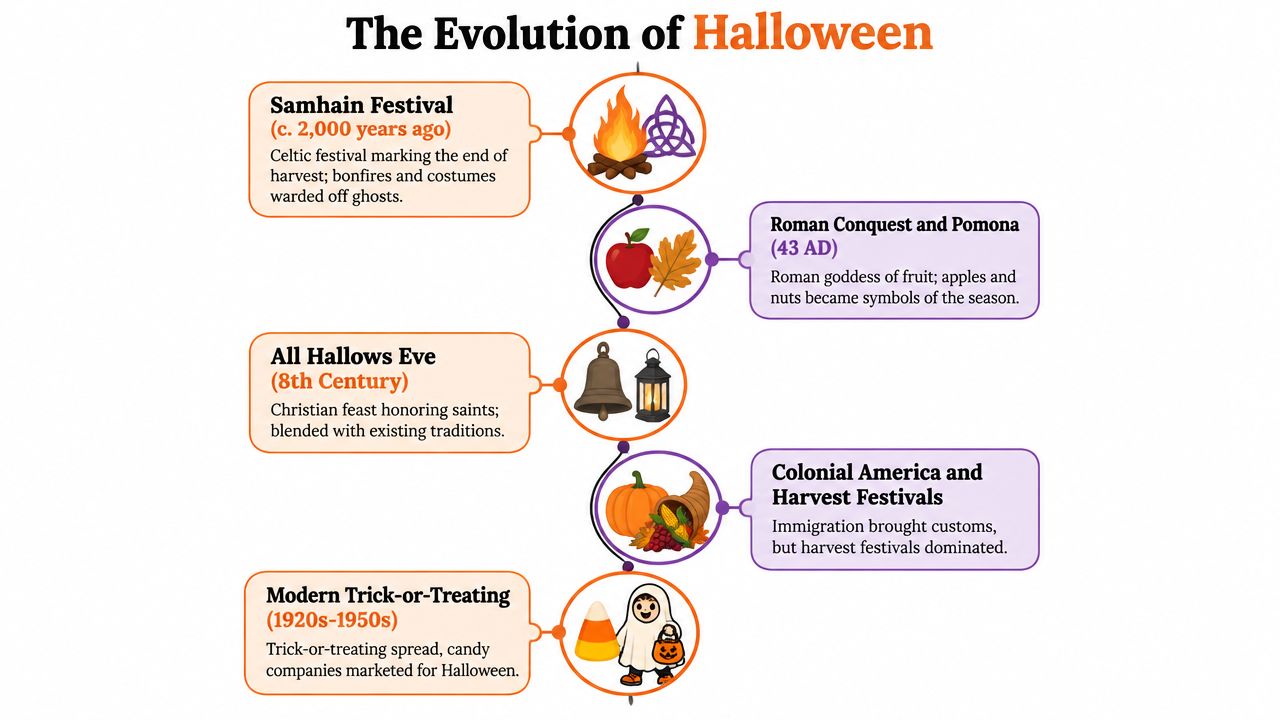
Why does Halloween arrive as autumn darkens and temperatures drop? The calendar date connects cultural history with observable changes in Earth systems. The U.S. Census Bureau's history of Halloween traces the holiday back about 2,000 years to Samhain, a Celtic festival linked with the end of harvest and the beginning of winter. Irish and other immigrants brought the custom to the United States beginning in the mid-19th century. By the 20th century, Halloween had become a major October 31 observance, especially for children.
Students can treat this history as a case study in cultural transmission. Traditions change as communities enter new environments and belief systems. Symbols, dates, foods, costumes, nighttime stories, religious observances, neighborhood gatherings, and commercial practices combined over time into the holiday many families recognize today.
A seasonal investigation
Halloween falls in the Northern Hemisphere after the September equinox and before the December solstice. Daylight is shortening, and evenings are becoming colder. Students can record local sunrise and sunset times, graph the changing photoperiod, and investigate how reduced light may affect human activity, plant behavior, and animal movement. The lesson connects to Earth and space science through patterns, seasonal cycles, and evidence-based explanations.
The harvest connection opens a biology investigation. As daylight decreases and temperatures change, many plants alter the pigments in their leaves. Students can compare leaves from different stages of seasonal change and explain why green chlorophyll becomes less visually dominant. They can also connect colder evenings with historical reliance on fire, indoor gatherings, and seasonal food storage.
A teacher-ready prompt is: How could the changing angle of sunlight affect both climate and culture? Students can trace the geometry from Earth's axial tilt to daylight length, then reason about effects on temperature, agriculture, and community routines. A simple model using a lamp and a tilted globe makes the pattern visible. The standards-friendly takeaway is that physical conditions can shape human choices without determining culture by themselves.
What Happens in the Brain When Halloween Feels Scary
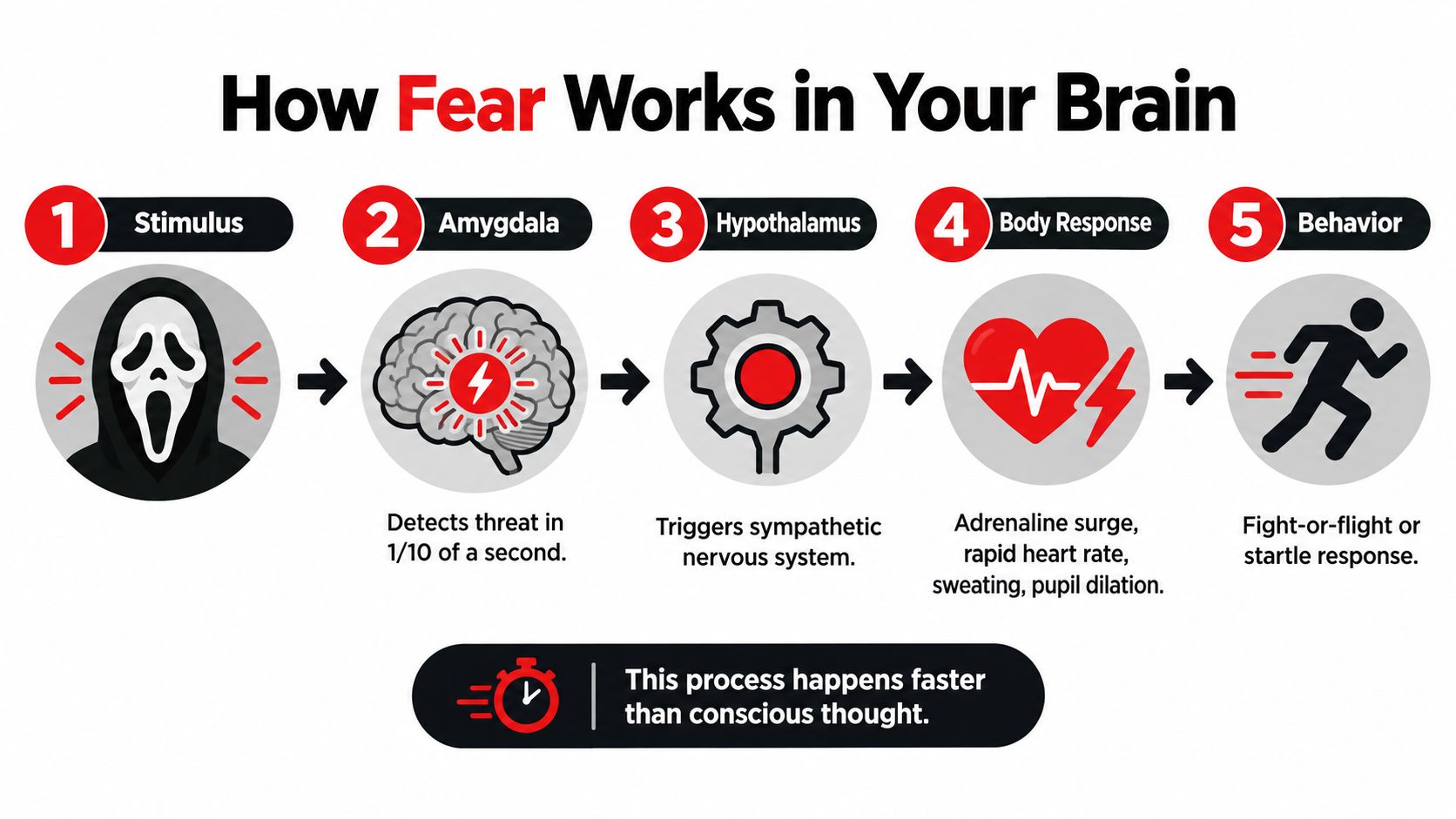
Fear begins with information, not certainty. A student sees a shape in a dim hallway, hears a sudden sound, or encounters a familiar person in an unfamiliar mask. The brain rapidly evaluates whether the stimulus might signal danger, and the body can begin preparing for action before conscious reasoning finishes identifying the source.
The amygdala helps detect emotionally important patterns. The hypothalamus can activate the sympathetic nervous system, producing familiar effects such as faster heartbeat, sweating, widened pupils, and increased alertness. Students don't need to reduce this process to a cartoon “fear button.” They should understand it as a coordinated system that helps the body respond quickly when information is incomplete.
Why ambiguity feels spooky
Low light removes visual detail. A mask hides facial cues. A sudden noise arrives before the listener knows its location. Under those conditions, the brain uses incomplete evidence and prior experience to interpret patterns. A coat on a chair may become a person for a moment because the cost of missing a possible threat can feel greater than the cost of checking a harmless object.
That response varies. Age, previous experiences, sensory sensitivity, expectations, and personal preference all influence whether a stimulus feels exciting, amusing, irritating, or overwhelming. A classroom demonstration must respect those differences. Students should be allowed to observe without participating, and no activity should use humiliation or surprise without consent.
A measured classroom demonstration
Use a balloon or a harmless visual stimulus only after explaining the procedure and offering an opt-out. Students can record a resting pulse, encounter the stimulus, and measure recovery at regular intervals using a paper pulse timer or a classroom heart-rate sensor. The meaningful variable isn't who appears “bravest.” It's the pattern of change and return toward baseline.
Ask students to separate three observations:
- Stimulus: What happened in the environment?
- Response: What did the body do?
- Interpretation: What might explain the response?
That structure supports biology and social-emotional learning at the same time. A controlled thrill can create curiosity, while overwhelming fear shuts down participation. Good teaching keeps the stimulus mild, predictable, and voluntary.
Hands-On Experiments for the Halloween Classroom
A successful Halloween investigation needs more than a dramatic appearance. Students should make a prediction, identify variables, record observations, and explain the result using a scientific model. The following activities can be adapted for different ages, but teachers should follow local chemical-safety rules and product labels.
Dry-ice fog
Guiding question: Why does the “smoke” move downward?
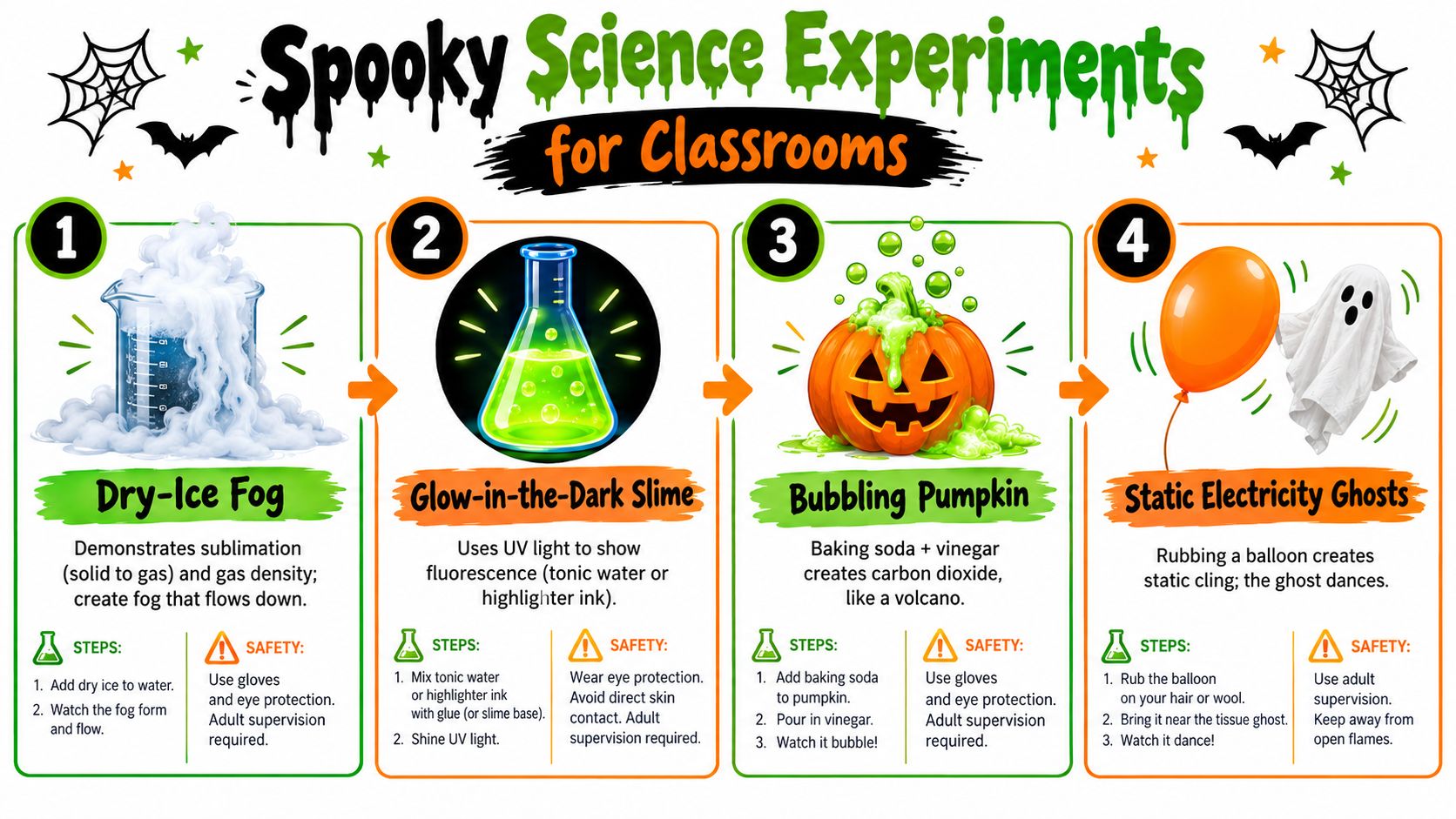
Place a small amount of dry ice in warm water inside a sturdy container. The solid carbon dioxide changes directly into gas, while the cooling effect causes water vapor to condense into tiny visible droplets. Students can sketch the fog's movement and compare containers with different water temperatures.
Use insulated gloves or tongs, eye protection, ventilation, and direct adult supervision. Never place dry ice in a sealed container, and never allow students to touch or ingest it.
Record: water temperature, fog height, movement direction, and duration of the visible cloud.
Density-layer potions
Guiding question: Why do some liquids form layers?
Pour liquids carefully down the side of a clear container. Honey, dish soap, water, oil, and rubbing alcohol can create contrasting layers when handled appropriately. Students predict the order, observe the final arrangement, and discuss how density and miscibility affect the result.
Don't invite students to taste any “potion.” Keep rubbing alcohol away from flames and use a well-ventilated space.
Record: predicted order, observed order, whether each pair mixes, and the evidence supporting the explanation. A printable recording sheet can be drafted with a worksheet generator.
Pumpkin crystal growth
Guiding question: How do dissolved particles become crystals?
Use a small pumpkin-shaped object or a pumpkin surface as a visual theme while students prepare a saturated borax or sugar solution under teacher direction. As the solution cools or evaporates, crystals can form at nucleation sites. Learners examine crystal shape, coverage, and the effect of solution concentration.
Students must not consume laboratory materials. Label containers clearly, use eye protection, and follow the safety guidance for the selected solute.
Record: solution description, location of crystal formation, crystal appearance, and changes over time.
Oobleck investigation
Guiding question: Can a material behave like both a liquid and a solid?
Mix cornstarch and water gradually until the mixture flows slowly under gentle pressure but resists a sudden force. Students can compare a slow finger movement with a quick tap and describe how the material responds. This introduces shear thickening, a behavior that doesn't fit neatly into everyday categories of solid and liquid.
Avoid pouring the mixture down drains. Let it dry or dispose of it according to school procedures.
Record: force or motion applied, observed response, and a claim about how the mixture's behavior changes with stress.
The Candy Question Myth Versus Real Risk
The poisoned-candy story is emotionally powerful because it turns a familiar adult into a hidden threat. Yet the evidence does not support the image of strangers routinely contaminating trick-or-treat sweets. A Vanderbilt medical toxicology review describes such reports as mostly urban legends or hoaxes, and notes Joel Best's finding of no verified case in which a child was killed or seriously injured by contaminated trick-or-treat candy.
That doesn't mean families should ignore candy inspection. The practical rule is simpler and less sensational: reject unwrapped or visibly damaged items, check original packaging, consider known allergies, and supervise younger children according to their needs. Another Vanderbilt poison-control summary explains why routine X-ray screening isn't recommended and points attention toward ordinary packaging and food-safety decisions.
Halloween Risk in Proportion
| Risk Category | Reported Incidents | Daily Baseline |
|---|---|---|
| Random poisoned candy | No verified child deaths or serious injuries identified in Joel Best's review | Ordinary packaging, allergy, choking, and food-handling concerns |
| Damaged or unwrapped candy | Requires inspection and judgment | Similar to checking packaged food at any time |
| Allergens | Depends on the individual child and ingredient label | Ongoing food-allergy management |
| Choking hazards | Greater concern for children who can't safely manage particular foods | Routine age-appropriate supervision |
Use the myth as a media-literacy lesson. Give students a viral claim, ask what evidence would verify it, and have them distinguish an anecdote from a documented case. The strongest answer isn't merely “the myth is false.” It's a decision rule based on observable evidence.
Fire Safety Science Behind Decorations and Costumes
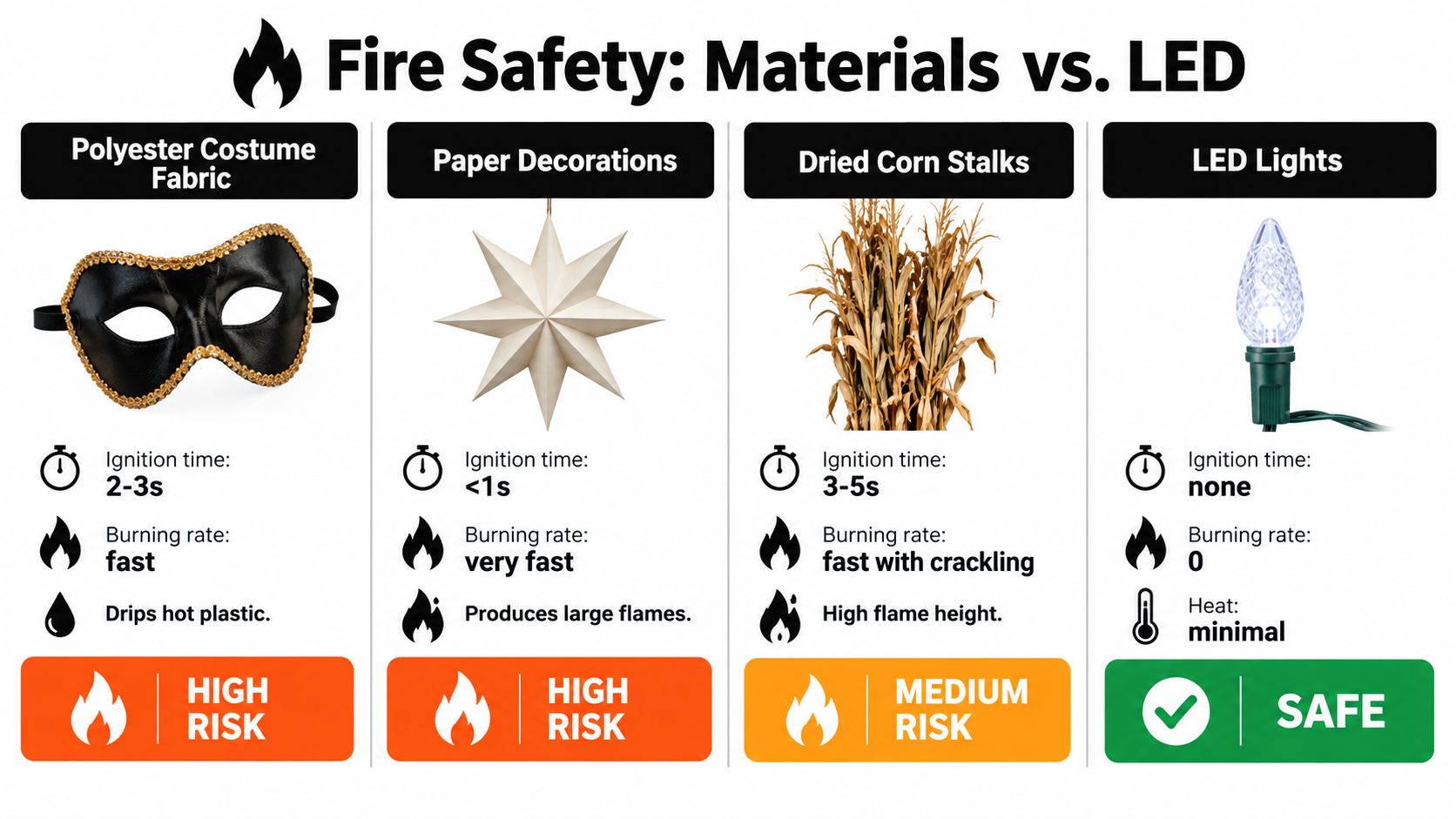
Fire safety becomes clearer when students study fuel, heat, and oxygen rather than memorize a warning. Paper decorations can ignite quickly, dried plant material can burn readily, and some synthetic fabrics can melt or burn in ways that create additional injury. LED lights produce far less heat than an exposed flame, so replacing a candle with an LED source changes the energy input in the system.
The National Fire Protection Association's Halloween guidance reports an annual average of 835 home structure fires started by decorations during 2020 to 2024. Those fires caused an annual average of 3 civilian deaths, 29 injuries, and about $18 million in direct property damage. Nearly half, 47%, began when decorations were too close to heat sources, and 33% started with candles.
See combustion as a design problem
A teacher can demonstrate ignition distance with a candle and a meter stick, but students should never handle the flame. Keep the demonstration behind a safety barrier, use a small controlled sample only if school policy permits, and stop immediately if smoke or unexpected burning occurs. Students can observe how distance, material thickness, and airflow change the conditions for ignition.
A safer engineering challenge uses no flame. Teams redesign a paper decoration so it stays spooky while increasing distance from a heat source, reducing exposed fuel, or replacing the light source with an LED. They can sketch a prototype, identify constraints, and defend their choices with a materials-and-energy explanation.
Design rule: The most effective control is often the simplest one. Keep decorations away from heat and use flame-resistant or nonflammable alternatives whenever possible.
Lesson Hooks That Turn the Holiday Into Inquiry
Halloween works best as a context for an existing unit, not as a detached activity day. A teacher can turn a familiar image into a short investigation that activates prior knowledge, exposes a misconception, and produces evidence.
Human body systems
Driving question: Why can a harmless surprise make the body react before a person has identified it?
For a 10-minute opener, show a neutral image after warning students that a visual stimulus is coming. Students describe the stimulus, record a subjective response or pulse observation, and discuss why anticipation changes the experience. Connect the conversation to sensory input, nervous-system signaling, and homeostasis. A standards-friendly hook can support MS-LS1-8, while also reinforcing the boundary between biological response and personal interpretation.
Matter and density
Driving question: Why don't all potion ingredients form one liquid?
Students predict the order of a density column before the teacher pours it. They then compare prediction with observation and explain the result using density and miscibility. The strongest student explanations use evidence from the arrangement rather than relying on color alone. This fits MS-PS1-2, especially when students model how observable properties help identify and compare substances.
Engineering and fire prevention
Driving question: How can a decoration keep its appearance while reducing ignition risk?
Teams examine paper, fabric, dried plant material, and LED-based designs without lighting anything. They identify the fuel, heat source, oxygen access, and design constraint, then propose a safer version. This supports MS-ETS1-2 because students compare possible solutions against criteria and constraints.
Risk perception and media literacy
Driving question: Why do dramatic safety stories spread even when documented evidence is absent?
Students read the poison-control summaries, list the claim's implied evidence, and create a two-column argument separating verified findings from assumptions. They can then write a short family advisory based on packaging integrity, allergies, choking awareness, and supervision. This exercise makes risk proportionality concrete without dismissing students' concerns.
For assessment, ask learners to complete this sentence: “The Halloween claim I investigated is supported or unsupported because...” Require one observation, one source-based fact, and one practical recommendation. A ready-made lesson plan outline example can help teachers fit the activity into an existing sequence without turning the holiday into a separate unit.
A Teacher Playbook for the Week of Halloween
A short sequence can connect history, biology, chemistry, physics, and engineering without requiring a new course plan.
| Experiment | Grades 3-5 | Grades 6-8 | Grades 9-12 |
|---|---|---|---|
| Fear response | Observe startle and discuss senses | Record pulse patterns and recovery | Analyze variables, controls, and response data |
| Density potion | Sort liquids by observable behavior | Model density and miscibility | Explain intermolecular behavior qualitatively |
| Dry-ice fog | Observe state change with teacher demonstration | Model sublimation and condensation | Analyze gas behavior, temperature, and uncertainty |
| Crystal growth | Observe patterns and shapes | Connect saturation to crystal formation | Compare nucleation, concentration, and variables |
| Oobleck | Describe solid-like and liquid-like behavior | Investigate force and response | Evaluate shear thickening as a material model |
A Monday-to-Friday skeleton
- Monday: Use Samhain and seasonal daylight as a bell-ringer for astronomy, Earth science, and cultural transmission.
- Tuesday: Run a voluntary fear-response observation with a harmless stimulus and a clear opt-out.
- Wednesday: Analyze the poisoned-candy myth through source evaluation and proportional risk.
- Thursday: Conduct a density, oobleck, crystal, or teacher-led dry-ice investigation.
- Friday: Ask students to write which Halloween phenomenon they can now explain with evidence and a model.
History can examine how traditions change as communities move and adapt. Mathematics can examine how people compare dramatic but unsupported stories with documented risks. Before any lab day, share the materials, procedures, supervision plan, and accessibility adaptations with the front office.
A lesson plan generator can help turn these prompts into editable activities, but the teacher's judgment should set the safety limits, participation choices, and level of challenge.
Teacher Planner helps educators organize lessons, units, schedules, and standards while drafting worksheets, quizzes, adapted texts, and lesson materials with AI tools. Use it to turn the science of Halloween into a ready-to-teach sequence, then visit Teacher Planner to plan your week in one place.