
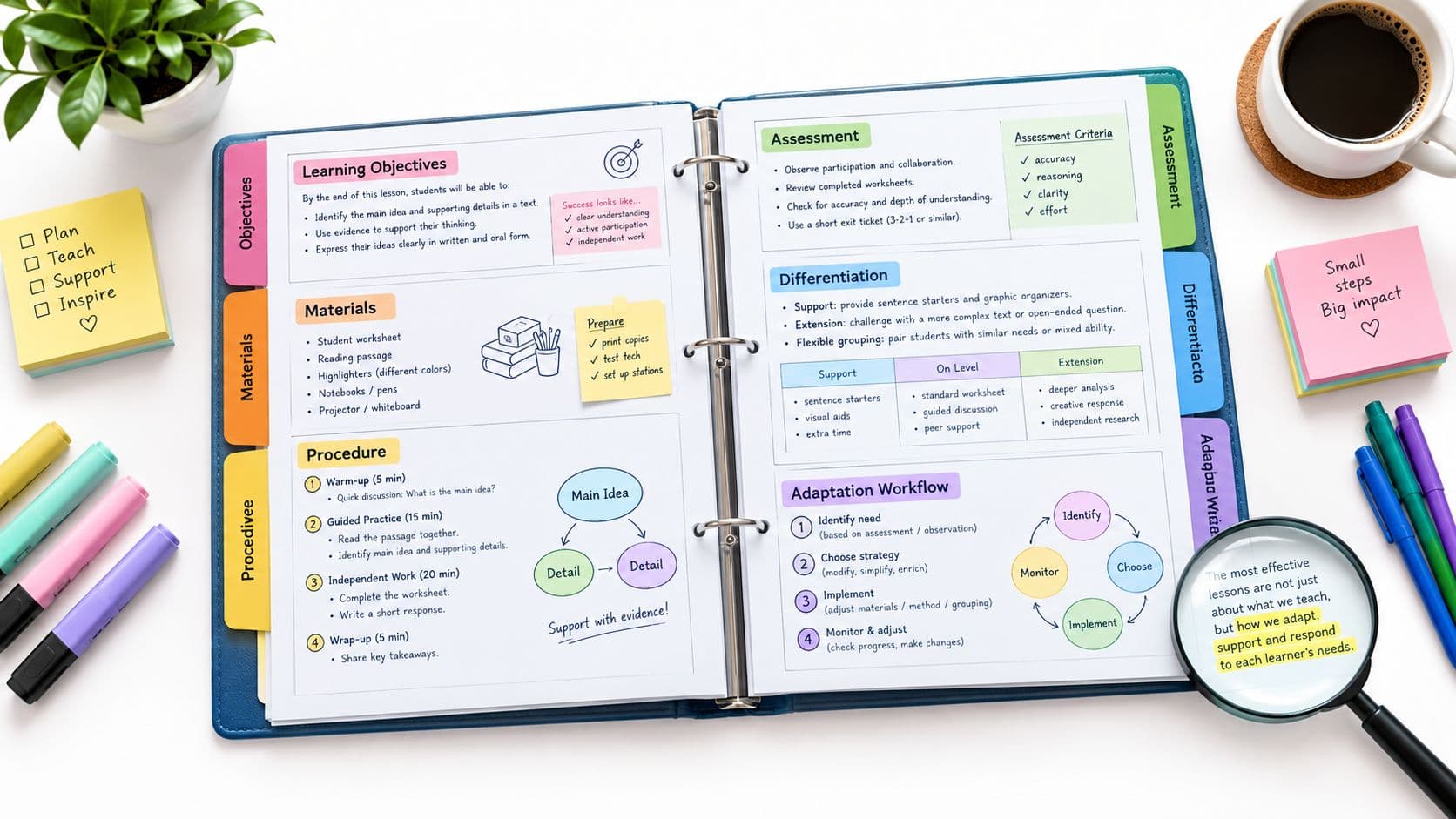
Teachers often sit down to plan reading instruction with a standard, a worksheet, and too little time to decide what students should actually understand. This collection of lesson plans for reading comprehension provides seven ready-to-adapt examples across early literacy, elementary comprehension, and middle-grade analysis. Each plan connects an objective to materials, a timed procedure, evidence of learning, differentiation, and a practical adaptation pathway. Begin with the grade-appropriate example, then adjust the text complexity, supports, grouping, and student product rather than treating any plan as a script. Teacher Planner can help organize lesson sequences and prepare editable draft materials, but teacher review remains essential.
1. Grades K–1 Phonemic Awareness and Rhyming Lesson
Young readers need to hear and manipulate sounds before they can use print confidently. This short, playful routine builds phonemic awareness and rhyme recognition through listening, movement, and oral language. The student product is simple: each child identifies whether two words rhyme, then produces a rhyming word of their own.
Objective and procedure
Set the objective in child-friendly language: “I can hear when words rhyme and say a word that rhymes.” Gather picture cards, a few classroom objects, and a familiar song or finger play. If picture cards aren't available, use objects such as a cup, book, sock, or block.
Use this 15-minute daily sequence:
- Listen and notice: Say two words, such as cat and hat, and ask students to show a thumbs-up if they rhyme.
- Teacher modeling: Stretch the ending sounds and explain that rhyming words have the same ending sound.
- Call and response: Say a word and invite students to complete a phrase, such as “I see a fox. It is wearing…”
- Sort and move: Students place picture cards into a rhyming group, clap for each match, or move to one side of the room for “rhymes” and the other for “doesn't rhyme.”
- Exit check: Ask each child to respond to one rhyme pair or produce a rhyme for a familiar word.
Keep the routine short and predictable. Praise attempts, not only correct answers, because oral risk-taking gives children more opportunities to work with sounds.
Adaptation and evidence
For a child who needs more support, offer two picture choices and repeat the final sound clearly. For a child ready for more challenge, ask for a rhyme without visual choices or invite them to explain why two words belong together. Add rhyme practice during transitions and circle time so the skill appears outside the formal lesson.
The visible evidence is the child's oral response, not a completed worksheet. Note whether the child can recognize a rhyme, produce a rhyme, or needs a model. That observation tells you whether the next lesson should focus on listening, vocabulary access, or independent production.
2. Grade 2 Retelling and Sequencing Lesson
A retelling lesson turns a student's memory of a story into visible evidence. Second-grade readers can often name characters and events, but they may present them out of order or omit the problem and resolution. Sequence cards provide a concrete bridge from oral storytelling to written narrative.
Objective and materials
Set the objective as: “I can retell a story in order using the beginning, middle, and end.” Choose a short narrative with a clear problem and resolution. Prepare three large cards labeled beginning, middle, and end, plus smaller picture or event cards from the story.
During the first session, read the story aloud and pause briefly to clarify important words or events. Model a retelling by placing one card under each section. Think aloud: “This event belongs at the beginning because it introduces the character and the problem.” Students then work with a partner to arrange the remaining cards and explain their choices.
During the second session, reread selected pages and ask students to revise their sequences if the text changes their understanding. Each student orally retells the story while pointing to the cards. The final product can be a three-part drawing, a dictated retelling, or a short written paragraph using transition words such as first, next, and finally.
Practical rule: If a student can arrange the cards but can't explain the sequence, the next lesson should strengthen oral language before requiring more writing.
Adaptation and evidence
Use fewer cards and offer sentence stems for students who need support. Pair a student who benefits from verbal rehearsal with a patient partner, and allow drawing or dictation before independent writing. For students ready for more challenge, remove the labels and ask them to identify the story structure themselves.
Photograph each student's completed sequence to create a class digital book, or send copies of the cards home for family retelling practice. Reusing the same book across several days can build confidence while allowing you to collect clearer evidence of whether students understand the story or are just copying a partner's order.
3. Grade 3 Guided Reading Lesson
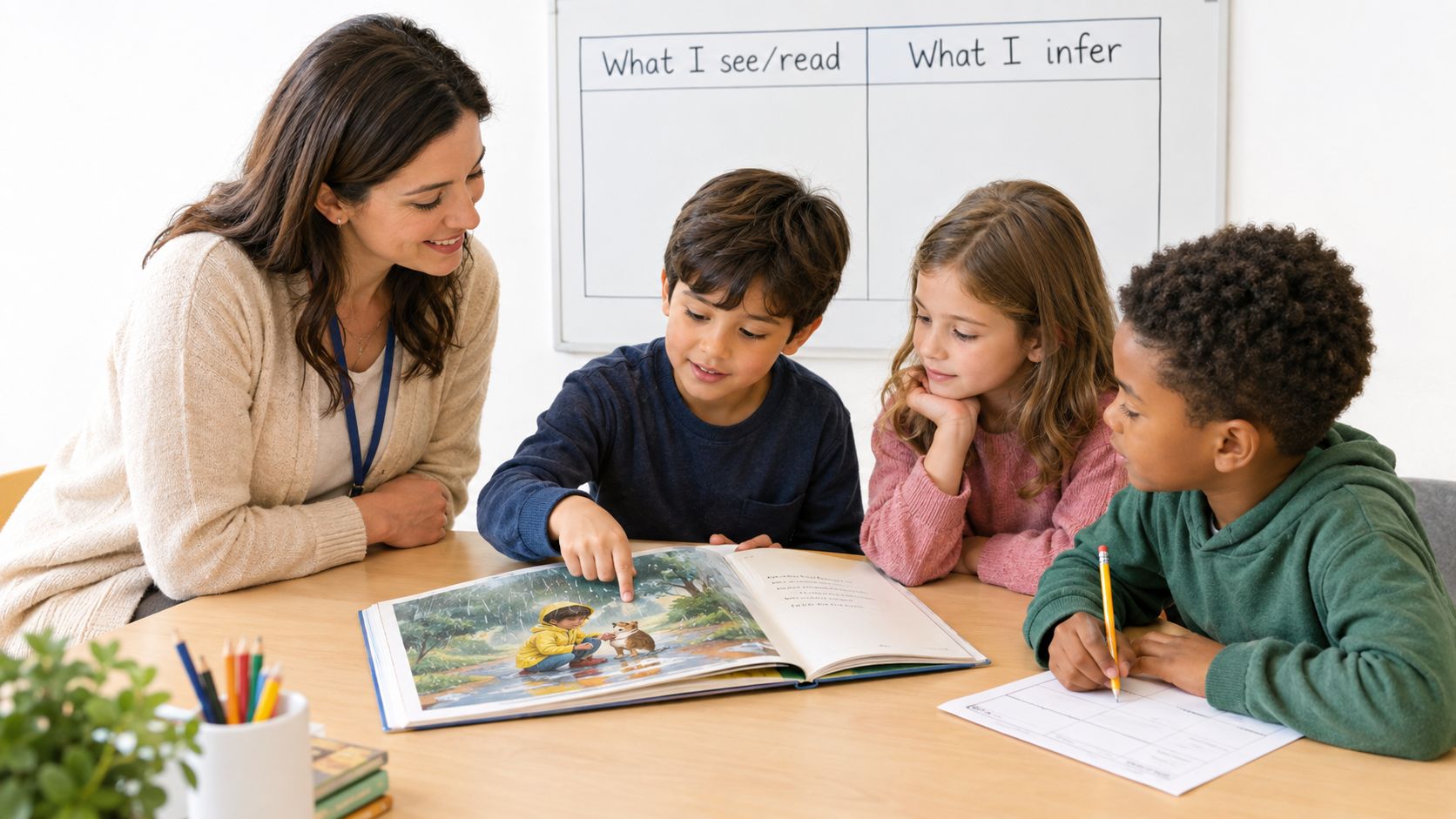
Inference becomes more manageable when students can point to both the clue and the idea they formed from it. A picture book is especially useful for third grade because illustrations provide an accessible entry point while the written text adds details about character emotions and motivations.
Objective and modeling
Use the objective: “I can make an inference about a character and support it with evidence from the picture or text.” Prepare a visual chart with three columns: What I notice, What I know, and My inference. Select a book with clear emotional cues and a relatable conflict.
In a 45-minute lesson, begin by displaying an illustration without revealing the next page. Model the process: “I notice the character is standing apart, and the character's shoulders are lowered. I know people sometimes stand apart when they feel uncomfortable. I infer that the character may feel left out.” Then connect the inference to a specific word, action, or illustration detail.
Students work through a second illustration with a partner, recording one observation and one inference. During guided reading, stop at planned points and ask students to revise an inference when the text provides new information. Independent students complete an evidence chart for a later page and write a sentence explaining the character's likely feeling or motivation.
Assessment and differentiation
Collect the chart as the student product. A strong response includes an interpretation and a relevant clue, not just a feeling word. If a student names an emotion without evidence, prompt with, “What did the character say, do, or look like that makes you think that?”
Use sentence frames such as “I infer ___ because ___” for developing readers. Offer a bank of emotion words, while asking advanced readers to compare two possible interpretations and explain which one the text supports more strongly.
The National Reading Panel review found that comprehension improves when teachers explicitly model and guide multiple strategies, including monitoring, questioning, summarizing, and activating prior knowledge. This lesson follows that gradual movement from teacher thinking to supported practice to independent evidence use.
4. Grade 4 Vocabulary in Context Lesson
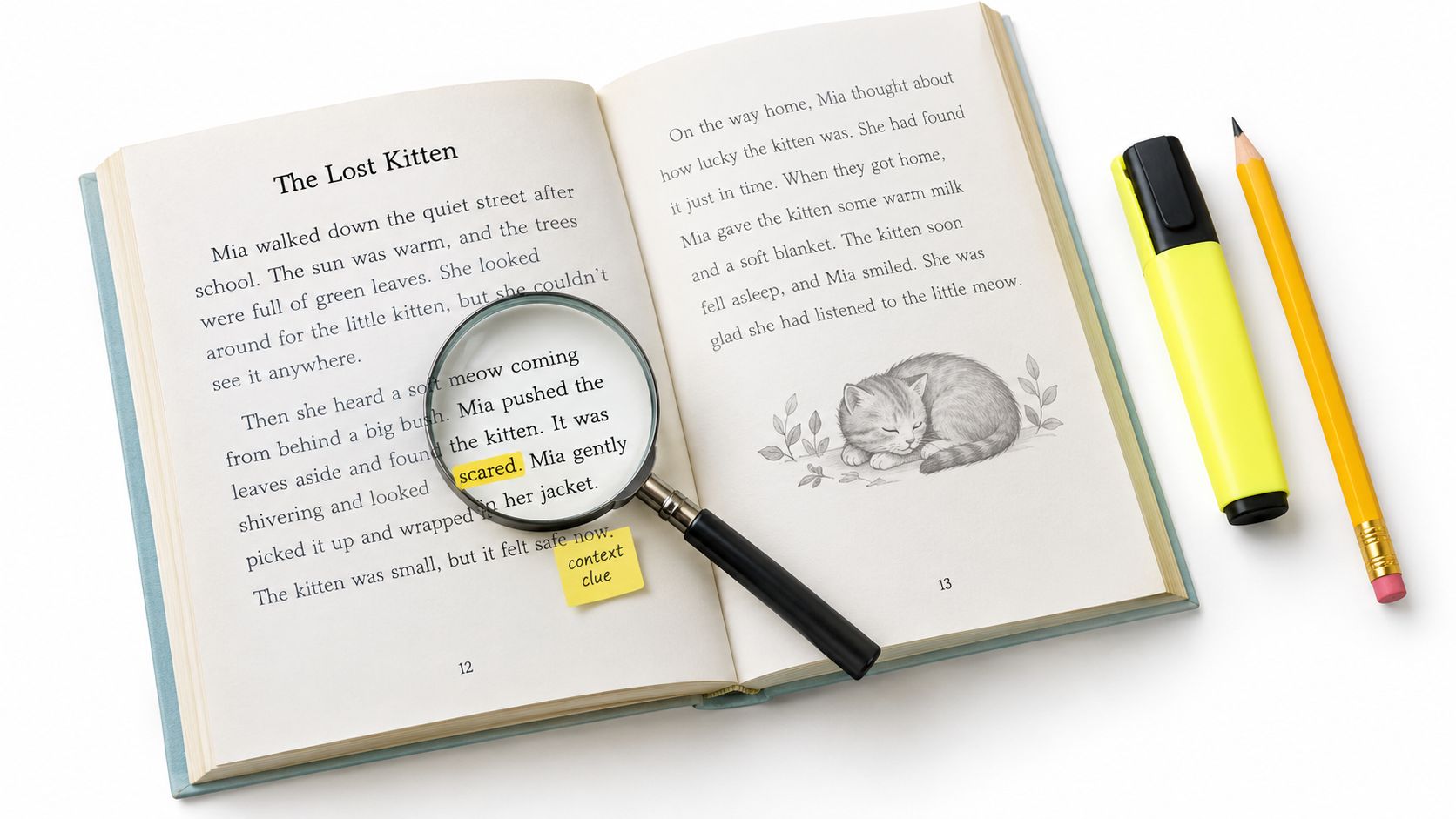
Students become more independent readers when they can approach an unfamiliar word without immediately waiting for a definition. This week-long sequence teaches fourth graders to use context clues, including definitions, synonyms, contrasts, and examples, then confirm whether the inferred meaning fits the passage.
A repeatable classroom routine
Choose several meaningful words from grade-level passages or students' independent reading. Avoid presenting vocabulary as a disconnected list. First, read the sentence and surrounding sentences together. Model noticing the clue: “The passage says the path was narrow, or not wide. The phrase not wide gives me a definition clue.”
Post an anchor chart with the four clue types. Across the week, use a consistent routine:
- Read around the word: Students examine the sentence and nearby information.
- Name the clue: They identify whether the passage gives a definition, synonym, contrast, or example.
- Propose a meaning: Students write a likely definition in their own words.
- Check the fit: They replace the word with their definition and decide whether the sentence still makes sense.
- Apply the word: Students use it in a new sentence or create a short context-clue passage for a classmate.
The student product is a completed clue analysis plus a sentence that demonstrates meaning. An oral guessing game can provide a quick warm-up before students work with print.
Adaptation and evidence
For multilingual learners and students with language gaps, preteach only words that are essential to understanding the passage, use a picture or gesture, and return to the word in context. For students who need more challenge, include figurative or academic language and ask them to explain why one clue is stronger than another.
Record whether students can identify the clue, infer a plausible meaning, and use the word accurately. If they identify the clue but produce an incorrect meaning, revisit sentence meaning and background knowledge. A randomized classroom trial involving 938 primary-grade students in 160 U.S. classrooms found that language-focused instruction improved vocabulary and comprehension monitoring, with vocabulary serving as the significant mediator of later comprehension gains; the reported effect sizes ranged from 0.55 to 1.98 for targeted language skills (study details from the Journal of Speech, Language, and Hearing Research). That supports making vocabulary an integrated part of comprehension planning, not an isolated pre-reading exercise.
5. Grade 5 Main Idea and Supporting Details Lesson
Fifth graders need to distinguish the topic from what the author is saying about that topic. A strong lesson also makes students prove that their main idea accounts for the supporting details instead of selecting a sentence because it sounds important.
Two-day sequence
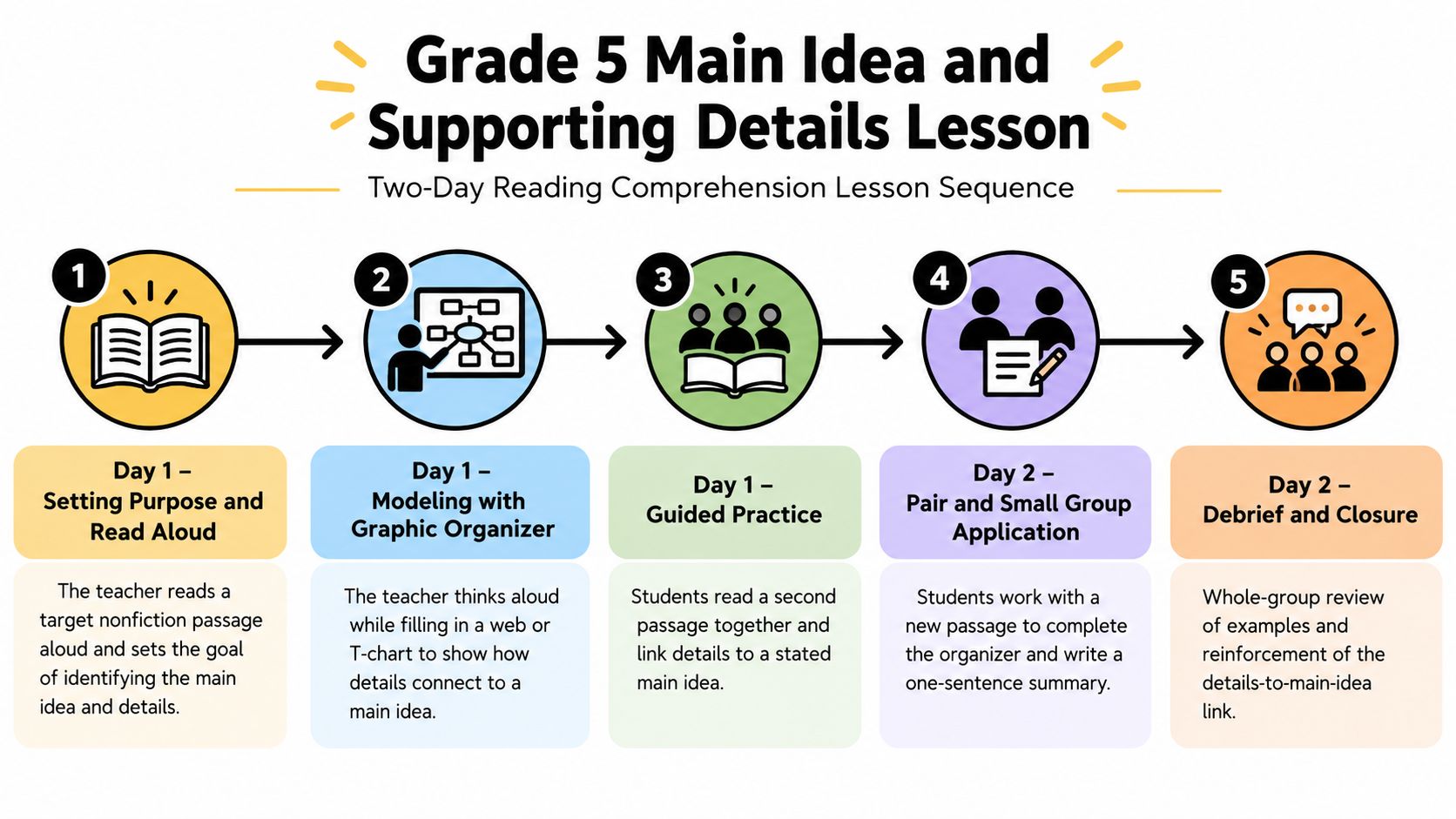
Choose a short nonfiction passage with a clear central idea for the first attempt. On day one, read the passage aloud once for general meaning. Then model a think-aloud by sorting details into “supports the message” and “interesting but not central.” Write a possible main idea, and show how each selected detail connects to it.
Students annotate a second passage, underline details, and write a tentative main idea in the margin. Partners compare their choices and return to the text when they disagree. On day two, introduce a passage in which the main idea is implied rather than stated. Students identify repeated ideas, combine related details, and write a one-sentence summary that includes the topic and the author's main point.
Use a three-part exit check:
- Evidence: Students cite or paraphrase two supporting details.
- Synthesis: Students state the main idea in their own words.
- Transfer: Students explain how the main idea would change if one key detail were removed.
This sequence fits well with reusable lesson planning templates, especially when you want to save the same modeling and assessment structure for later informational texts.
Adaptation and assessment
If students choose a minor detail, provide a paragraph with color-coded sentences and ask which idea connects the most information. If students can identify an explicit main idea but struggle with an implied one, keep the text short and use a shared evidence sort before asking for independent synthesis. Students who are ready can compare two passages and explain how each author develops a related idea.
Recent observational research across 24 elementary schools and 111 classrooms found that 64% of comprehension lessons had objectives focused on surface-level understanding rather than deeper comprehension (SRI learning brief). A written evidence task helps reveal whether students are integrating ideas, rather than merely completing low-level questions.
6. Grade 6 Character Development Across Chapters
Character analysis requires more than collecting isolated traits. Sixth graders need to track what changes, what causes the change, and what remains consistent across a sequence of chapters. A change-over-time chart gives them a durable record for discussion and later writing.
Build the chart as the novel unfolds
Create a large chart with columns for chapter or event, character action, motivation, evidence, and what has changed. At the start of the week, model one entry from an early chapter. Don't label the character as “brave” or “selfish” without evidence. Instead, write the action, quote or paraphrase the relevant passage, and explain what the action suggests.
Students add entries after each reading segment. At the end of each session, partners answer one question: “What does this event show that we didn't know before?” On the final day, students use the completed chart to write a short claim about the character's development, supported by evidence from more than one chapter.
A useful student product might begin: “At first, the character ___, but after ___, the character ___ because ___.” More advanced students can explain whether the change is internal, caused by another character, or revealed through a repeated pattern.
Adaptation and assessment
Pair visual learners with verbal debriefers, and keep the chart visible throughout the week. Students who need support can choose from a bank of motivations or use sentence frames. Students ready for deeper analysis can track a contradiction, compare the character's stated beliefs with actions, or explain why a change is gradual rather than sudden.
Photograph the completed chart for absent students and use it as a study guide before an essay or quiz. For targeted intervention, shorten the reading segment and complete the first row together before students add a second row independently. A meta-analysis of 112 primary-grade intervention effects found a mean effect of g = 0.37, with a 95% confidence interval of 0.27–0.47; the average intervention dosage was 57.19 instructional hours, and follow-up effects were approximately 0.16 smaller than immediate posttest effects (meta-analysis of reading-comprehension interventions). The planning implication is practical: revisit the chart after the unit instead of treating the first successful response as lasting mastery.
Use a lesson plan outline example to keep chapter objectives, evidence collection, and writing preparation in one ordered sequence.
7. Grade 7 Author's Purpose and Tone Analysis
By seventh grade, students move from naming whether a text informs or persuades to explaining how an author's choices shape meaning. A speech and an article on the same topic make that shift visible. Students can compare purpose, tone, language, structure, and rhetorical devices, then show their reasoning in a written product.
Three-day comparative reading
Choose a speech with a clear emotional or urgent tone and an article that presents the topic more measuredly. On day one, introduce persuade, inform, and entertain. Read or play the speech aloud while students mark repeated words, direct appeals, strong verbs, and changes in emotional intensity. Their annotations provide an early check of whether they can identify craft choices before naming their effects.
On day two, students read the article and annotate its claims, evidence, headings, and tone. Build a class word bank with terms such as urgent, skeptical, hopeful, neutral, and critical. Students then complete a comparison organizer with three columns: text feature, evidence, and effect on the reader. The completed organizer is the formative evidence. Look for a quoted or paraphrased detail linked to a specific effect, rather than a tone label without support.
On day three, students write a comparative paragraph. Require the product to identify each author's purpose, name a tone for each text, and cite language that supports the analysis. Students should reference a word, phrase, structural choice, or rhetorical device instead of writing only that “the speech is passionate.” A student who can name a feature but cannot explain its effect needs another modeled example before drafting.
Differentiation and responsible support
Provide an audio version, chunked passages, and a tone word bank for students who need access. For proficient readers, remove some labels and ask them to defend one tone word against a plausible alternative. Students can rewrite a paragraph in a different tone and explain which language changes produced the new effect. For related practice, figurative language activities for middle school can extend analysis of how comparisons and imagery influence tone.
Questioning should help students monitor understanding rather than function only as a teacher quiz. Have students write a prediction question before reading, an uncertainty question during reading, and an evidence question afterward. They answer the final question with a cited passage, following question-generation guidance for reading instruction.
Choose texts with care. Text-complexity guidance considers measurable features such as word frequency, sentence length, and cohesion alongside qualitative factors including structure, language clarity, levels of meaning, and knowledge demands (Common Core text-complexity materials). Delay AI scaffolds until students form an initial interpretation. A randomized crossover study of 195 college-aged participants found GPT-based supports helped lower-performing readers but significantly worsened comprehension for higher-performing readers (study of GPT-based reading supports). Have students explain their interpretation independently after any scaffold.
K–7 Reading Comprehension Lesson Comparison
| Lesson | Grade Level | Implementation Complexity | Resource Requirements | Expected Outcomes | Key Advantages |
|---|---|---|---|---|---|
| Phonemic Awareness & Rhyming: Sound Play and Rhyme Recognition | K–1 | Low, 15-minute daily routine, predictable steps | Minimal, rhyming picture cards, chart, optional instrument, familiar song | Recognize/produce rhymes; improved phonemic awareness and oral attempts | Quick, multisensory, high engagement; builds early automaticity |
| Retelling & Sequencing: Story Structure Cards | Grade 2 | Low–Medium, two scaffolded sessions | Moderate, emergent text, large sequence cards, index cards, sentence frames | Retell in correct sequence using sequencing language; prepare for writing | Strong visual scaffold; supports oral-to-written transfer; reusable |
| Guided Reading: Making Inferences from Picture Books | Grade 3 | Medium, 45-min lesson with modeling to independence | Moderate, picture book, inference chart, recording sheets, anchor chart | Make and justify inferences with textual/visual evidence | Emphasizes evidence-based thinking; scaffolds reasoning |
| Vocabulary in Context: Using Text Clues | Grade 4 | Medium, week-long unit with gradual release | Higher, multiple passages, anchor chart, graphic organizers, worksheets | Identify clue types and infer word meanings across texts | Teaches transferable strategies; covers multiple clue types |
| Main Idea & Supporting Details: Informational Text Analysis | Grade 5 | Medium, two-day sequence with modeling and application | Moderate, nonfiction passages, graphic organizers, summary templates | Identify explicit/implicit main ideas and summarize in one sentence | Clear modeling-to-summary progression; focuses on distinguishing details |
| Character Development: Change-Over-Time Chart | Grade 6 | Medium–High, week-long tracking and synthesis | Higher, novel/chapter book, change chart, sticky notes, vocab list | Track character change across chapters and explain causes with evidence | Deep longitudinal analysis; prepares for analytical writing |
| Author's Purpose & Tone Analysis: Comparing Texts | Grade 7 | Medium, three-day comparative lesson | Moderate, paired texts, anchor chart, comparison organizer, worksheets | Identify author's purpose and tone; explain word choice and rhetorical effects | Comparative focus sharpens critical reading and rhetorical awareness |
Turn One Lesson Into a Reusable Sequence
The seven plans share a planning logic that works across grade bands. Begin with oral sound awareness before asking young learners to complete print-heavy tasks. As students mature, model the comprehension process directly, whether they're sequencing events, inferring a character's feeling, determining a word's meaning, or analyzing an author's tone. Then make the thinking visible with a chart, card sort, annotation, or comparison organizer.
Every lesson should produce evidence that matches the objective. A rhyme response shows sound awareness. A sequence shows story structure. An evidence chart shows inference. A context-clue explanation shows whether a student understands both the word and the sentence. A one-sentence summary, change-over-time chart, or comparative paragraph reveals more than a string of correct answers because each product makes the student's reasoning inspectable.
The Education Endowment Foundation's 2025 reading-comprehension review synthesized 141 studies and estimated an average impact equivalent to six additional months of progress over one school year. The reported average was approximately six months for primary pupils and seven months for secondary students, with a high evidence rating and very high impact for very low cost. These are aggregate academic-year findings, not a promise that one lesson will produce that amount of growth. They support a more modest planning conclusion: revisit prediction, questioning, clarification, summarization, monitoring, and text-structure work across texts and subjects.
Use this adaptation workflow when converting one of the examples for a new class:
- Choose the skill: State exactly what students should understand or do.
- Select the text: Match complexity to the objective, background knowledge, language demands, and reading readiness.
- Define the product: Decide what students must say, write, arrange, annotate, or compare to demonstrate learning.
- Set the scaffold: Plan the model, sentence frame, chart, vocabulary support, grouping, or audio access students may need.
- Plan the exit check: Use one short task that reveals the next instructional decision.
Teacher Planner's day, week, month, unit timeline, and outline views can help organize these connected lessons. Its Lesson Plan Generator and other AI tools can produce editable drafts, worksheets, quizzes, adapted texts, or writing feedback, while resource-saving, copy, download, and print options support preparation. Review every draft for factual accuracy, accessibility, text fit, and alignment before using it. The browser-based planbook is designed for planning and material preparation, not as an LMS, gradebook, student assessment-delivery system, or school-wide curriculum-management suite.
When a disruption moves the sequence, Bump Forward can shift lessons while keeping later plans in order. A timetable photo or PDF can also reduce retyping for a fixed weekly grid or list, with teacher review before saving. Organize the objective, student product, and next step together so the lesson remains useful after the worksheet is finished.
Teacher Planner combines a browser-based planbook with editable AI drafting tools for lesson plans, worksheets, quizzes, text rewriting, and writing feedback. Use it to organize reading-comprehension sequences across day, week, or unit views, then review each draft before classroom use. Visit Teacher Planner to explore lesson organization and material-preparation support.